


Do you feel a story stirring within you, only to be met by the intimidating silence of a blank page? We often think of writing as an art form reserved for novelists, but its most profound power is personal. It's a key to mindfulness, a path to healing, and a direct line to your deepest self. This isn't just a creative hobby; it's a wellness practice backed by science.
Studies published in respected journals like the Journal of the American Medical Association confirm that expressive writing can improve mood, lower stress, and even boost immune function. This is your invitation to explore your inner landscape with curiosity and kindness.
These creative writing prompts for adults are more than just idea starters; they are practical tools for unlocking greater self-awareness and emotional clarity. Each one is an actionable step toward turning a simple pen and paper into your most powerful instrument for personal growth. Ready to explore even further? These more self-discovery journal prompts can beautifully complement the journey you're about to begin.
Let's transform the simple act of writing into a revolutionary practice of self-care.
1. Letters to Your Future Self
Imagine a conversation across time with the person you are becoming. This powerful prompt invites you to write letters to yourself at future milestones—one, five, or ten years from now. It’s a way to create a time capsule of your current hopes, fears, and dreams, bridging the gap between who you are now and who you aspire to be.

This practice of blending self-reflection with intention is a powerful way to solidify your goals and create a tangible record of your evolution. The act of writing makes your vision concrete, turning abstract hopes into a clear roadmap for your future.
Practical Action Points
- Create a Ritual: Find a quiet space. Light a candle or play soft music to signal that this is a special, reflective time.
- Choose Your Timelines: Select meaningful future dates—1, 5, and 10 years are classic choices.
- Write with Honesty: Pour your current reality onto the page. What are your hopes, fears, and daily joys? Don't hold back; authenticity is the magic ingredient.
- Seal and Store: Place your letters in marked envelopes and store them in a safe place. Set a calendar reminder to open them on the chosen dates.
Pro-Tip: Focus on your values and feelings. Ask your future self: "Are we living with kindness? Have we found joy in simple moments?" This elevates the exercise from goal-tracking to a check-in with your soul.
2. Gratitude Narrative: Three Good Things
Rewire your brain for happiness. The "Three Good Things" exercise is a cornerstone of positive psychology, proven to shift your focus from what's wrong to what's right. This prompt elevates it from a simple list to a storytelling practice. You don't just note three good things; you write the story behind them, deepening your appreciation and building a library of positive memories.
Dr. Martin Seligman's research shows this simple habit can significantly boost happiness and reduce depressive symptoms. By narrating the good, you relive the positive emotions, amplifying their impact and training your mind to seek out the good in every day.
Practical Action Points
- Set a Consistent Time: Make this a daily or weekly ritual, perhaps before bed, to reflect on your day.
- Recall Three Good Things: Identify three moments that brought you joy, no matter how small—a stranger's smile, a delicious meal, a productive meeting.
- Write the Story: For each one, write a short narrative. Describe what happened, where you were, and who was with you. Use sensory details to bring the memory to life.
- Explore the "Why": Reflect on why this good thing occurred. Was it your effort? The kindness of another? This helps you recognize the sources of positivity in your life.
Pro-Tip: Connect the event to your emotions. How did it make you feel? Naming the feeling—"a sense of deep peace," "a spark of pure joy"—cements the experience in your mind and heart.
3. The Unsent Letter: Writing What You Cannot Say
Some words need to be written, not spoken. This creative writing prompt for adults gives you a safe space to express unresolved emotions toward anyone or anything—a person, a situation, or even a past version of yourself. It's a powerful tool for processing grief, anger, or love without the fear of consequence.

Used in therapeutic settings, this technique provides catharsis and clarity. It’s not about communicating with someone else; it’s about having an uncensored, private conversation with yourself. By giving a voice to hidden feelings, you can acknowledge them, understand them, and finally begin to let them go.
Practical Action Points
- Create a Safe Haven: Find a private, quiet time where you won't be interrupted.
- Identify Your Recipient: Address the letter to a specific person, a younger you, or even an abstract concept like "my fear."
- Write with Radical Honesty: Let it all out. Don't worry about grammar, politeness, or logic. This is your space to be messy and real.
- Perform a Closing Ritual: Once you're done, you can symbolically release the emotions. Safely burning the letter, tearing it up, or burying it can provide a powerful sense of closure.
Pro-Tip: Follow this intense emotional work with a grounding activity. Spend a few minutes meditating, take a walk in nature, or listen to calming music to soothe your nervous system and transition back to your day.
4. The Stoic Reflection: Dichotomy of Control
Find peace and power in any situation. Stoicism’s most practical tool, the Dichotomy of Control, is an incredible creative writing prompt for adults. This exercise asks you to take any challenge and separate what is within your control from what is not. It’s a mental reset that channels your energy away from worry and toward meaningful action.
This ancient wisdom, practiced by Roman emperor Marcus Aurelius, transforms anxiety into action. By writing through a problem with this lens, you stop spinning in frustration and start creating a clear, empowered narrative focused on your own agency and resilience.
Practical Action Points
- Identify a Stressor: Choose a current challenge that is causing you anxiety.
- Create Two Columns: In your journal, draw a line down the center of the page. Label one side "Within My Control" and the other "Outside My Control."
- Sort Your Thoughts: List every aspect of the situation in the correct column. Another person's reaction is outside your control; your response is within it.
- Write Your Action Plan: Focus entirely on the "Within My Control" column. Write a short plan detailing the specific, concrete steps you will take.
Pro-Tip: After creating your action plan, write a short reflection on releasing the items in the "Outside My Control" column. Describe the freedom that comes from accepting what you cannot change. For a deeper dive, explore these foundational books on Stoicism.
5. A Day in the Life (Reframed Perspective)
See the familiar in a completely new light. This creative writing prompt for adults challenges you to describe an ordinary day from multiple perspectives—your partner, your child, a stranger on the street, or even your dog. This practice is a powerful workout for your empathy muscles and sharpens your eye for detail.
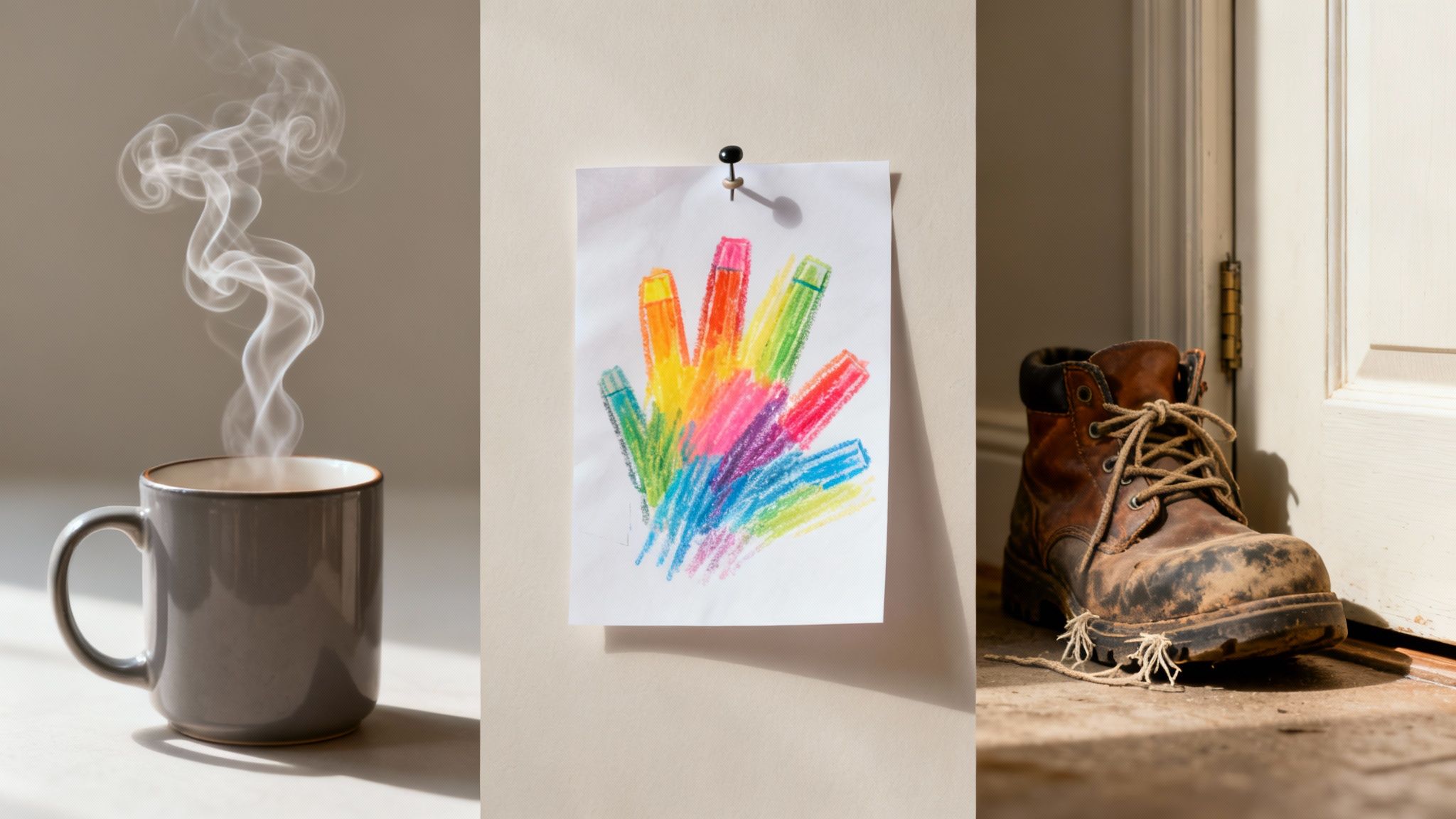
By stepping into another's shoes, you uncover the hidden emotional truths of everyday life. The goal is to feel what they might feel, realizing how radically perspective shapes reality. Your mundane routine becomes a rich tapestry of interconnected experiences, revealing the extraordinary in the ordinary.
Practical Action Points
- Map Your Day: Briefly outline the key events of a recent day from your own point of view.
- Choose Your Perspectives: Select 2-3 alternative viewpoints. Try someone close to you, then someone distant, like a barista.
- Embody Each Viewpoint: For each perspective, write a short scene from your day as they would have seen it. Write quickly and intuitively.
- Focus on Sensory Details: What does the world look, sound, and feel like from their position? How does their perception differ from yours?
Pro-Tip: Notice how priorities change with each perspective. Your stressful deadline means nothing to your cat, whose world revolves around sunbeams and naptime. This shift is the key to unlocking profound empathy.
6. The Values Clarification Essay
Discover your personal compass. Your core values provide direction for every decision you make, but first, you have to know what they are. This creative writing prompt for adults guides you to uncover what truly matters to you, explore where those values came from, and see how they show up in your life today.
This exercise, championed by researchers like Brené Brown, transforms abstract ideals into a concrete guide for intentional living. When you write about your values, you move beyond simply knowing them to understanding how to live by them, creating a life that feels authentic and aligned.
Practical Action Points
- Brainstorm Your Values: List 10-15 words that resonate with you, like integrity, connection, adventure, or security.
- Narrow to Your Core: Circle the 3-5 values that feel absolutely essential—the ones you would not compromise on.
- Write Value-Based Stories: For each core value, write about a time you truly lived by it. Then, write about a time it was challenged. This contrast reveals deep insights.
- Analyze and Align: Where is there a gap between your values and your actions? Identify one small step you can take this week to live in better alignment.
Pro-Tip: Revisit this essay once a year or during big life changes. Your values can evolve, and this practice ensures your internal compass stays true to who you are now.
7. Dialogue with Your Younger Self
Heal your past with present-day wisdom. This profound creative writing prompt for adults invites you to have a written conversation with yourself at a younger age. Offer the comfort, guidance, and compassion you needed back then, and in doing so, reframe your own story with kindness.
This technique mirrors therapeutic approaches that encourage dialogue with different parts of ourselves. By building a bridge between your past and present, you can integrate life lessons, heal old wounds, and honor the journey that brought you to where you are today.
Practical Action Points
- Choose an Age: Pick a specific age you want to connect with. Using an old photo can be a powerful anchor for this exercise.
- Select a Format: Will this be a letter, a script, or an interview? Choose whatever feels most natural to you.
- Initiate with Compassion: Begin by acknowledging what your younger self was experiencing. Offer validation and kindness before anything else.
- Listen to Your Younger Self: Make this a two-way conversation. Ask questions: What were their biggest dreams? What did they fear? What do they want you to remember now?
Pro-Tip: Remember that your younger self has wisdom for you, too. They hold the key to forgotten passions and authentic desires. Ask what they need you to know today.
8. Sensory Immersion: A Moment Fully Observed
Anchor yourself in the now. This creative writing prompt for adults is a mindfulness exercise that asks you to describe a single moment using all five senses. Transform an ordinary experience—like your first sip of coffee—into a rich, detailed narrative. This practice trains your attention and deepens your appreciation for the world around you.

By translating raw sensory data into vivid language, you build a stronger connection between your inner and outer worlds. This is the art of mindful observation, turning a simple moment into a masterpiece of detail and presence, making your writing more immersive and emotionally resonant.
Practical Action Points
- Choose Your Moment: Select a simple, immediate experience—peeling an orange, listening to a song, stepping outside into the rain.
- Engage Each Sense: Focus on one sense at a time. First, just look. Then, just listen. Move through all five, taking notes on everything you perceive.
- Use Concrete Language: Instead of "it smelled good," try "the scent of sharp citrus and sweet zest filled the air." Specificity creates a powerful scene.
- Capture Nuance: Notice the subtle details—the cool weight of the mug in your hands, the low hum of the refrigerator, the texture of the paper.
Pro-Tip: Set a timer for 10 minutes and commit to describing only that one moment. This constraint forces you to dig deeper and discover the richness hidden in the present.
9. The Legacy Letter: What You Want To Be Remembered For
Define your life's purpose. A legacy letter is a profound creative writing prompt for adults that asks you to articulate the values, stories, and contributions you hope will outlive you. It is a conscious act of crafting the narrative of your life and clarifying what truly matters.
This practice moves beyond journaling into an act of intentional living. By reflecting on the impact you want to have, you gain clarity that can guide your actions today. It’s about ensuring that the way you live aligns with the legacy you want to leave behind.
Practical Action Points
- Reflect on Core Values: What principles guide your life? List the values—like compassion, creativity, or resilience—you want to be known for.
- Outline Key Life Domains: Consider your impact on your family, career, and community. What mark do you hope to leave in each area?
- Use Stories as Evidence: Don't just state your values; illustrate them with anecdotes. Stories make your legacy tangible and memorable.
- Compose Your Letter: Address it to your children, grandchildren, or even a future you. Share your life lessons, hopes, and the wisdom you wish to pass on.
Pro-Tip: Your legacy is an evolving story, not a final statement. Revisit this letter every few years to update it with your personal growth and new perspectives.
10. The Unspoken Story: What No One Knows About You
Honor your whole self. This prompt invites you to write about a story, secret, or experience you rarely, if ever, share. It is an exercise in radical honesty, creating a safe container to explore the private parts of your life, give voice to the unspoken, and build profound self-acceptance.
As vulnerability researcher Brené Brown teaches, owning our stories is the key to worthiness. Writing your unspoken story, even just for yourself, is a transformative act. It can release the power a secret holds over you, turning it from a source of shame into a testament of your strength and resilience.
Practical Action Points
- Choose Your Story Wisely: Start with something that feels manageable, not your deepest trauma. The goal is gentle exploration.
- Write for Yourself Only: Your audience is you. This removes all pressure and allows for complete, unfiltered honesty. Sharing is always optional.
- Notice the Release: As you write, pay attention to the emotional and physical sensations in your body. Putting words to the experience is a powerful form of release.
- Consider a Witness: If it feels safe and right, you might share your story with a trusted friend or therapist. Being seen can be a profound step toward healing.
Pro-Tip: Treat your story with care. Use a special journal for this exercise to reinforce the idea that your experiences are worthy of respect and attention. If you're new to journaling, get started with these foundational tips on how to start journaling.
Comparison of 10 Adult Creative Writing Prompts
| Method | Complexity 🔄 | Resources ⚡ | Expected Outcomes ⭐📊 | Ideal Use Cases 💡 | Key Advantages ⭐ |
|---|---|---|---|---|---|
| Letters to Your Future Self | Low–Moderate 🔄: planned milestones | Low ⚡: journal, reminders | ⭐📊: long-term growth tracking, increased motivation | 💡: goal-setting, annual reflection, life transitions | ⭐: tangible record of change; builds accountability |
| Gratitude Narrative: Three Good Things | Low 🔄: simple daily practice | Very low ⚡: minutes, notebook | ⭐📊: improved mood, resilience, positive bias | 💡: daily mood boost, stress management, quick routine | ⭐: evidence-based; time-efficient impact |
| The Unsent Letter: Writing What You Cannot Say | Moderate–High 🔄: emotionally intense | Moderate ⚡: private space, time; possible support | ⭐📊: emotional release, clarity, reduced rumination | 💡: processing grief, unresolved relationships | ⭐: cathartic expression; clarifies feelings |
| The Stoic Reflection: Dichotomy of Control | Moderate 🔄: conceptual framing | Low ⚡: prompts, reading (Stoic texts) | ⭐📊: reduced anxiety, clearer action plans | 💡: decision-making, crisis reframing, anxiety work | ⭐: actionable framework; resilience-building |
| A Day in the Life (Reframed Perspective) | Moderate–High 🔄: multiple voices | Moderate ⚡: time, observational practice | ⭐📊: improved empathy, richer narratives | 💡: creative exercises, teaching perspective-taking | ⭐: develops empathy and descriptive skill |
| The Values Clarification Essay | Moderate 🔄: systematic reflection | Moderate ⚡: time, prompts, possibly coach | ⭐📊: clarity on priorities; better decisions | 💡: life transitions, career choices, prioritization | ⭐: aligns actions with core values; reduces paralysis |
| Dialogue with Your Younger Self | Low–Moderate 🔄: guided conversation | Low ⚡: photos optional, quiet time | ⭐📊: increased self-compassion, perspective | 💡: healing past wounds, cultivating self-kindness | ⭐: fosters forgiveness and recovered wisdom |
| Sensory Immersion: A Moment Fully Observed | Low 🔄: micro-writing, focused practice | Very low ⚡: 10–15 minutes, attention | ⭐📊: heightened presence, vivid prose | 💡: mindfulness practice, creative warm-up | ⭐: trains attention; produces evocative detail |
| The Legacy Letter: What You Want To Be Remembered For | Moderate–High 🔄: sustained reflection | Moderate ⚡: time, broad life review | ⭐📊: clarified purpose, long-term motivation | 💡: midlife reflection, legacy planning, family records | ⭐: guides meaningful choices; motivates action |
| The Unspoken Story: What No One Knows About You | High 🔄: deep emotional work | High ⚡: safe setting, time, possible therapy | ⭐📊: integration, reduced shame, authentic voice | 💡: deep healing, identity work (with support) | ⭐: profound authenticity; healing potential |
Your Story is Waiting: Putting Pen to Paper
You now hold a collection of keys, each designed to unlock a different room within your inner world. These creative writing prompts for adults are more than simple exercises; they are invitations to connect with yourself on a deeper level. From the science-backed power of a gratitude narrative to the ancient wisdom of a Stoic reflection, you have the tools to explore, heal, and grow.
We've covered prompts for cultivating joy, like the 'Three Good Things' practice, which psychologists like Martin Seligman have shown can measurably increase happiness. We've explored pathways to closure, such as 'The Unsent Letter,' a potent tool for processing complex emotions. This journey is about using words not just for art, but for life.
From Prompt to Practice: Building a Sustainable Habit
The true magic happens with consistency. The biggest hurdle is often the blank page itself. The key is to transform writing from a chore into a cherished ritual.
Here are your action steps to build a lasting habit:
- Schedule It: Block out 15-20 minutes in your calendar. Treat this appointment with yourself as sacred. Consistency is more important than duration.
- Create Your Space: Designate a cozy corner for your writing. An inviting space signals to your brain that it’s time to reflect.
- Start Small & Be Kind: You don't have to tackle the deepest prompt first. Choose the one that sparks your curiosity today. Some days call for a light 'Sensory Immersion,' others for the depth of a 'Legacy Letter.'
The Lasting Impact of Your Written Words
Engaging with these creative writing prompts for adults is an act of profound self-care. You are declaring that your inner world matters. This practice shifts you from a passive observer of your life to the active author of your story. By clarifying your values, conversing with your past, and reframing your present, you are architecting a more mindful, intentional, and resilient self.
The insights you gain can become the foundation for a much larger narrative. As you find your voice, you might feel ready to weave these reflections into a cohesive story. This comprehensive guide to telling your story can help you take that next step. Every word you write is a step toward clarity. Your story is not just waiting to be told; it is waiting to be understood by its most important audience: you.
Ready to begin your journey of self-discovery? Elevate your writing ritual with a beautifully crafted journal and pen from Mesmos. Our tools are designed to inspire you every time you pick them up, turning the simple act of writing into a luxurious and meaningful experience. Find the perfect companion for your creative practice at Mesmos.


