


Imagine unlocking a calmer, clearer, and more intentional version of yourself. This isn't a far-off dream—it's the power you can access with a health wellness journal. Think of it as your personal sanctuary, a quiet space to untangle your thoughts, track what truly matters, and celebrate every step of your journey. It’s more than just writing; it's a profound act of self-care.
How a Wellness Journal Can Reshape Your Life
Journaling is a beautifully simple tool to help you step back from the daily chaos and build a more intentional, peaceful life. By dedicating just a few minutes each day, you create a sustainable habit that feels like a gift to yourself—a moment to connect with your inner world and cultivate genuine well-being.
This practice isn’t about just recording what happened; it’s about processing it. The act of writing down your thoughts and feelings can lower blood pressure and ease stress. It allows you to see the patterns in your behaviors and emotions, giving you the clarity needed for real, meaningful growth.
The Science Behind Self-Reflection
The connection between writing and well-being is powerful and scientifically supported. Expressive writing, as noted by researchers, helps you manage emotions and can reduce symptoms of anxiety simply by helping you organize your thoughts. It’s a proven method for working through challenges and fostering a more positive mindset, as the simple act of putting pen to paper can slow down a racing mind.
This isn’t just a niche practice. The global wellness economy has surged into a $6.8 trillion industry, with mental wellness growing at an impressive 12.4% annually. This trend shows a collective shift towards authentic tools for mental health. You can explore more on this at the Global Wellness Institute website.
Key Benefits for Your Journey
When you embrace a health and wellness journal, you'll notice tangible benefits that ripple through every part of your life. It becomes a private, judgment-free space for radical honesty with yourself.
- Enhanced Self-Awareness: Uncover your triggers, motivations, and emotional patterns with profound clarity.
- Improved Emotional Regulation: By naming your feelings on paper, you gain control over your reactions to life’s stressors. We explore this more in our guide on the benefits of journaling for mental health.
- Goal Achievement: A journal is the perfect place to track progress, celebrate small wins, and stay inspired on your path to achieving your personal and health goals.
Finding the Right Journaling Companion
The best health and wellness journal—the one you'll actually stick with—is the one you genuinely love to use. Think of it less as another task and more as a trusted friend. The first step in building a practice that feels good is finding the perfect fit for your personality and lifestyle.
The big decision often boils down to structure versus freedom. A structured journal comes with pre-designed layouts and prompts, guiding you through daily gratitude, goals, and moods. It's perfect if you're starting out or appreciate having a clear path to follow.
On the other hand, a blank notebook offers a canvas for complete creative liberty. It’s your space for mind-mapping, sketching, or letting thoughts flow in long-form writing without constraints.
This simple flowchart shows just how powerful starting this practice can be, leading you from that first entry to a place of clarity and confidence.
As you can see, the simple act of putting pen to paper (or fingers to keyboard!) is a direct path toward feeling more centered and self-assured.
Physical vs. Digital Journaling
Your next choice is between the classic feel of pen on paper and the convenience of a digital app. There’s something special about a physical journal. It offers a mindful, screen-free ritual, and the act of writing itself can help slow your thoughts and process emotions on a deeper level. Plus, you’re left with a tangible record of your journey.
Digital apps, of course, bring their own magic with portability, search functions, and helpful reminders—a huge plus for a busy lifestyle.
The key is to pick the format that slips most easily into your daily life. A busy professional might love a pocket-sized notebook for jotting down reflections between meetings, while a student might prefer a digital app that syncs between their phone and laptop.
So, how do you decide? This table breaks down the core differences to help you find your match.
Choosing Between a Digital and Physical Journal
This comparison helps you decide between a traditional paper journal and a digital app based on your lifestyle, goals, and personal preferences.
| Feature | Physical Journal | Digital Journal App |
|---|---|---|
| Experience | Tactile, mindful, and screen-free. The physical act of writing can be therapeutic. | Convenient, portable, and accessible across multiple devices. |
| Customization | Offers total creative freedom with doodles, stickers, and mixed media. | Limited to the app's features, but often includes fonts, themes, and templates. |
| Portability | Depends on size, but can be carried anywhere. No battery required. | Highly portable on your phone or tablet. Accessible anywhere with your device. |
| Privacy | As private as the place you store it. | Often password-protected and encrypted for enhanced security. |
| Organization | Can be organized with tabs and bookmarks. Searching requires manual flipping. | Easily searchable with tags and keywords. Entries are automatically dated and sorted. |
| Cost | One-time purchase of a notebook and pen. | Can be free, a one-time purchase, or a recurring subscription fee. |
Ultimately, there’s no right or wrong answer—only what feels right for you.
A Modern Approach to Wellness
Journaling isn't just a quiet hobby; it’s part of a major shift toward intentional self-care, especially among younger generations. It's telling that Gen Z and millennials, who make up 36% of the US adult population, are driving over 41% of the nation's $500 billion+ in annual wellness spending.
This trend, explored in more detail in this report on wellness trends and their impact, shows a deep desire for real tools that support mental and emotional health.
To find your perfect journaling companion, ask yourself these questions:
- Your Lifestyle: Are you always on the move, or do you have a quiet corner at home for reflection?
- Your Personality: Do you crave structure and prompts, or does a blank slate excite you?
- Your Goals: Are you looking to track specific habits, process big emotions, or just explore your creativity?
In the end, the right health and wellness journal is one that feels personal and inspiring. It should be a tool that doesn’t just hold your thoughts but actively invites you to explore them, empowering you on your path to well-being.
Your Essential Journaling Toolkit
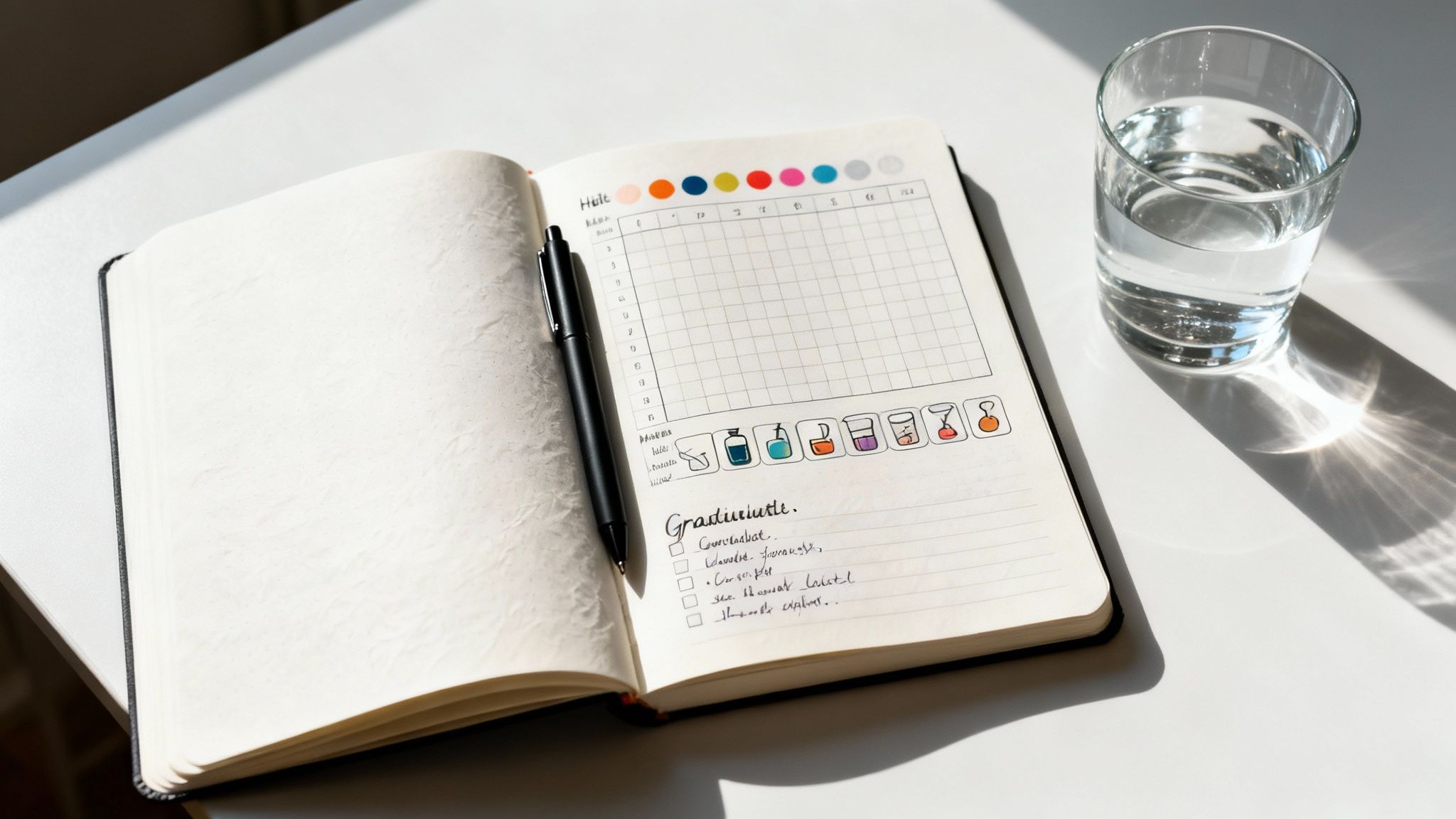
A blank page holds infinite promise, but let’s be honest—it can also feel intimidating. The secret to unlocking its power is filling your health wellness journal with simple, effective tools that invite reflection instead of pressure. Think of these as your building blocks for self-discovery, designed to help you tune into your body and mind with intention.
You don’t need a complex, color-coded system to start. The most powerful journaling practices are often the most straightforward. The goal is to create a resource that gives you clear, honest feedback on your life.
Start with Simple Trackers
Tracking isn't about judgment; it’s about awareness. When you see your habits laid out visually, patterns emerge that you’d otherwise miss. This data helps you connect the dots between what you do and how you feel.
ACTION POINT: Start with just one of these key areas to build momentum.
- Sleep Log: Note your bedtime, wake-up time, and sleep quality (1-5). This reveals how sleep impacts your energy and mood.
- Hydration Tracker: Did you drink enough water? A simple tracker with eight glasses to color in provides a quick visual cue and reminds you how hydration affects everything from mental clarity to energy.
- Movement Log: Jot down any physical activity—a walk, a gym session, a quick stretch. It all counts. This isn't about hitting targets; it's about celebrating every choice to move your body.
These trackers turn abstract goals like "get more sleep" into concrete actions, giving you a factual snapshot of your habits and empowering you to make gentle, positive adjustments.
Capture Your Inner World
Beyond the physical, your journal is the perfect place to explore your emotional landscape. This is where the real magic happens. A mood log is an excellent starting point.
ACTION POINT: Create a simple color key for your moods (e.g., yellow for happy, blue for sad). At the end of each day, color in a square representing your dominant mood. Over time, you’ll see a vibrant mosaic of your emotional life.
Your journal is your private space to untangle thoughts and gain perspective. Reviewing your entries allows you to identify patterns, process emotions, and track your personal growth with clarity.
This simple practice of naming your feelings has been shown to reduce stress. It’s a foundational tool for building emotional resilience and a more balanced inner life.
Powerful Prompts to Guide You
Some days, you just need a nudge to get the words flowing. Prompts are your best friend when you feel stuck or uninspired. They cut through the mental clutter and direct your focus toward meaningful reflection.
ACTION POINT: Pick one prompt that resonates with you and spend five minutes writing freely.
Daily Reflection Prompts:
- What one thing drained my energy today, and what one thing refueled it?
- Where did I feel most present and engaged today?
- What small moment brought me unexpected joy?
Weekly Review Prompts:
- What was my biggest challenge this week, and how did I handle it?
- Where did I show resilience or strength?
- What is one thing I want to carry into next week?
These aren't just questions; they are invitations to connect with yourself on a deeper level. By incorporating these tools, your health wellness journal becomes more than a notebook—it becomes an essential companion on your journey.
Building a Journaling Habit That Actually Lasts
Real transformation is built through the quiet power of consistency. Weaving your health wellness journal into your life shouldn’t feel like a chore. The goal is to create a sustainable practice that feels natural, forgiving, and genuinely supportive.
The secret isn’t finding more time; it’s linking your new journaling habit to an existing one. This powerful technique, known as habit stacking, anchors journaling to a solid part of your routine. Do you already have a morning coffee ritual? Perfect. That’s your cue.
ACTION POINT: Place your journal next to your coffee maker or on your nightstand. Let its presence be a gentle, automatic nudge, not a decision you have to force.
Start Small to Overcome Inertia
The pressure to write something profound can be paralyzing. Let’s release that idea right now. In the beginning, your only goal is to show up.
Commit to just five minutes a day. That's it. Setting the bar incredibly low makes it almost impossible to say no. You can find more tips for making this practice work for you in our complete guide on how to journal effectively.
Even on your most chaotic days, you can find five minutes. This small, consistent action builds momentum. Some days, five minutes might stretch into twenty, but that initial, tiny commitment is all that truly matters.
Navigating Common Roadblocks
It’s normal to hit a wall. When you feel uninspired or too busy, remember that flexibility is your greatest friend. Your health and wellness journal should serve you, not the other way around.
ACTION POINT: If you feel stuck, try one of these strategies.
- Try a Brain Dump: Set a timer for two minutes and write whatever comes to mind without stopping. The goal is to clear out the mental clutter.
- Use Bullet Points: Short on time? Jot down a few bullet points about your day, your mood, or one thing you're grateful for.
- Switch Up Your Focus: If you've been tracking habits, write about a memory instead. To build a lasting habit around mindful eating, for example, you can explore some practical advice on maintaining a food journal for deeper self-awareness.
The most important rule of journaling is that there are no rules. This practice is for you and you alone. Be kind to yourself, and if you miss a day, just pick it up the next without judgment.
Ultimately, building a lasting habit is about creating a routine that is both compassionate and adaptable. By starting small and having a plan for off-days, you can create a practice that will truly last a lifetime.
Personalizing Your Journal for a Deeper Connection
Your journal is so much more than a notebook; it’s a living document of your unique journey. While trackers and prompts are great, the real magic happens when you pour your personality onto the pages. This transforms your health wellness journal from a simple tool into a cherished space that truly feels like you.

Think of it as a personal scrapbook for your well-being. Adding tangible pieces of your life—a ticket stub from a concert, a pressed flower from a mindful walk, a photo from a joyful afternoon—makes those memories feel so much more real. Taping these mementos in instantly reconnects you to those positive emotions.
Infuse Creativity into Your Pages
You don't have to be an artist to make your journal visually inspiring! A splash of color can make the process more fun and engaging, encouraging you to return day after day.
ACTION POINT: Try one of these simple ideas to add personality to your pages.
- Use washi tape and stickers: Decorate borders or highlight important entries.
- Create a vision board: Dedicate a few pages to a collage of images and quotes that represent your biggest dreams.
- Incorporate color-coding: Assign different colored pens to different moods or themes (e.g., green for gratitude, blue for challenges).
When your journal becomes a creative outlet, it transforms into a keepsake you’ll cherish. It becomes a tangible record of your growth, your joys, and your resilience—a story told in your unique style.
Dedicate Sections to Your Passions
Your wellness journey includes all the things that bring you joy. Tailoring your journal with dedicated sections for your hobbies makes it a more holistic reflection of who you are.
Consider creating special areas for things like:
- New Recipes: Jot down healthy meals you've tried and loved.
- Workout Routines: Track your fitness progress and new exercises that made you feel strong.
- Inspiring Books: Keep a running list of quotes and key takeaways that moved you.
This simple practice turns your journal into a dynamic resource for every part of your life. To truly unlock its power, you might also try weaving in evidence-based ways to practice self-compassion throughout your entries. By making your journal your own, you create an empowering space that not only tracks your progress but actively celebrates the person you are becoming.
Got Questions? We’ve Got Answers.
Starting something new always brings up questions. It’s that mix of excitement and "am I doing this right?" that pops up on any new path. Let’s clear up the most common thoughts so you can dive into your journaling journey with total confidence.
Think of this as a friendly chat to iron out any last-minute hesitations.
How Much Time Do I Really Need to Spend Journaling?
The best journaling practice is the one you’ll actually do. Consistency is far more important than duration. You don’t need to find a spare hour to feel the benefits.
Start small. Aim for just 5-10 minutes. That's it. Some days, you might fill pages with thoughts. Other days, a quick gratitude list is all you’ve got—and that’s perfect. The goal is to create a small pocket of time for intentional reflection, not to add another stressful task to your list.
What If I’m Not a Good Writer?
This is one of the biggest myths holding people back! Your journal is a 100% judgment-free zone. It’s for your eyes only. Grammar, spelling, and perfect sentences could not matter less.
This is your space to express yourself in whatever way feels authentic.
- Jot down thoughts in bullet points.
- Write down single words that capture how you’re feeling.
- Doodle or sketch out your day.
- Use simple trackers to log your habits.
The whole point is to connect with your own thoughts honestly. Authenticity is the only rule.
Your journal is a private space for processing, not performing. The value comes from the honesty of your reflection, not the elegance of your prose.
I’ve Tried Journaling Before and It Didn't Stick. How Is This Time Different?
So many of us have started a journal only to let it gather dust—you are definitely not alone. The secret to making it stick is to approach it with more intention and a lot more self-compassion.
First, get clear on your "why." What do you hope to gain? More peace? Better sleep? A clearer head? Connecting journaling to a purpose that truly matters to you will fuel your motivation.
Next, make it ridiculously easy. Keep your journal and a pen you love somewhere you can't miss it—like your nightstand or right next to the coffee machine.
And most importantly, be kind to yourself. If you miss a day, or even a week, just pick it back up without guilt. This is a practice, not a performance. Every day is a new chance to show up for yourself.
Ready to start a journey toward a more mindful, intentional life? At Mesmos, we create beautiful, inspiring journals and wellness tools designed to be your trusted companions. Find the perfect journal to begin your practice and unlock a little more inner peace.


