


Learning how to ask for help is a profound act of self-respect. It's about seeing vulnerability not as a weakness, but as the superpower it truly is. This journey begins with a courageous shift in your mindset, getting crystal clear on what you need, and then reaching out with intention.
When you break it down, a challenge that feels monumental becomes a simple, empowering step toward your own well-being. Let's unlock this strength together.
The True Strength in Asking for Help
Let's be honest—asking for help can feel incredibly difficult. For many of us, it triggers a cascade of fears. Will they think I'm weak? Incompetent? A burden?
Imagine a dedicated parent running on empty, juggling work, home, and their own sanity, yet hesitating to ask their partner for just one hour of quiet time. Or the brilliant employee, swamped with deadlines, who stays late every night rather than asking a colleague for a fresh perspective on a project.
These scenarios are universal. We've been conditioned to believe that complete self-sufficiency is the ultimate goal and that needing others is a sign of failure. But what if that entire narrative is wrong?
Vulnerability isn't a weakness; it's our most accurate measure of courage. It's the willingness to show up and be seen when we have no control over the outcome. — Dr. Brené Brown
Reclaiming Your Power Through Support
The truth is, asking for help isn’t surrender—it’s a strategic and powerful act rooted in self-awareness. It's about honoring your limits and prioritizing your well-being. Research consistently shows that social support is a critical pillar of our mental and emotional health. As psychologist Dr. Susan Pinker highlights, direct, person-to-person contact is a key predictor of longevity and happiness. When we reach out, we build vital connections, reduce stress, and discover solutions we could never find alone.
Think of this guide as your personal roadmap, filled with both inspiration and practical action. It's here to help you move beyond stigma and find the courage to seek support.
You’ll discover how to:
- Action Point: Shift your mindset from seeing help as a weakness to viewing it as a powerful tool for growth and connection.
- Action Point: Pinpoint what you truly need and learn to ask for it with clarity and confidence.
- Action Point: Deepen your relationships by creating space for others to show up for you.
Mastering this skill is essential for building your inner fortitude. In fact, learning how to build emotional resilience is directly linked to our ability to lean on others. Asking for help is one of the kindest and most transformative things you can do for yourself, turning moments of struggle into opportunities for connection and growth.
Why Asking for Help Feels So Difficult
Before we dive into how to ask for help, let's honor why it can feel like one of the hardest things in the world. If you hesitate, you are not alone. Many of us carry deep-rooted psychological barriers that stop us in our tracks.
From a young age, we're often taught that independence is the ultimate sign of strength. This "myth of self-reliance," combined with today’s immense pressure to project an image of effortless success, creates a perfect storm of anxiety around reaching out.
These feelings are incredibly common, but they come at a high cost, especially in our careers. The World Health Organization reports that 12 billion working days are lost globally each year to depression and anxiety. Yet, a recent survey found only 13% of employees feel truly comfortable discussing their mental health at work. The fear of judgment can keep people from the very support that would help them thrive.
Unpacking the Common Fears
When you dig to the core, the reluctance to ask for help often stems from a few key fears. Simply naming them is the first step toward disarming them.
- Fear of Being Seen as Incompetent: This is a powerful fear, especially at work. We worry that asking for help will make others doubt our abilities.
- Fear of Being a Burden: We convince ourselves that our problems will inconvenience others. This is common in personal relationships, where we avoid "adding to their plate."
- Fear of Losing Control: Asking for help means surrendering a bit of control. For those of us who value independence, this can feel deeply unsettling.
A significant piece of this puzzle is often our own self-perception. A powerful step in shifting this is to learn how to build self-confidence and fully embrace your inherent worth.
This infographic brilliantly reframes the entire approach.
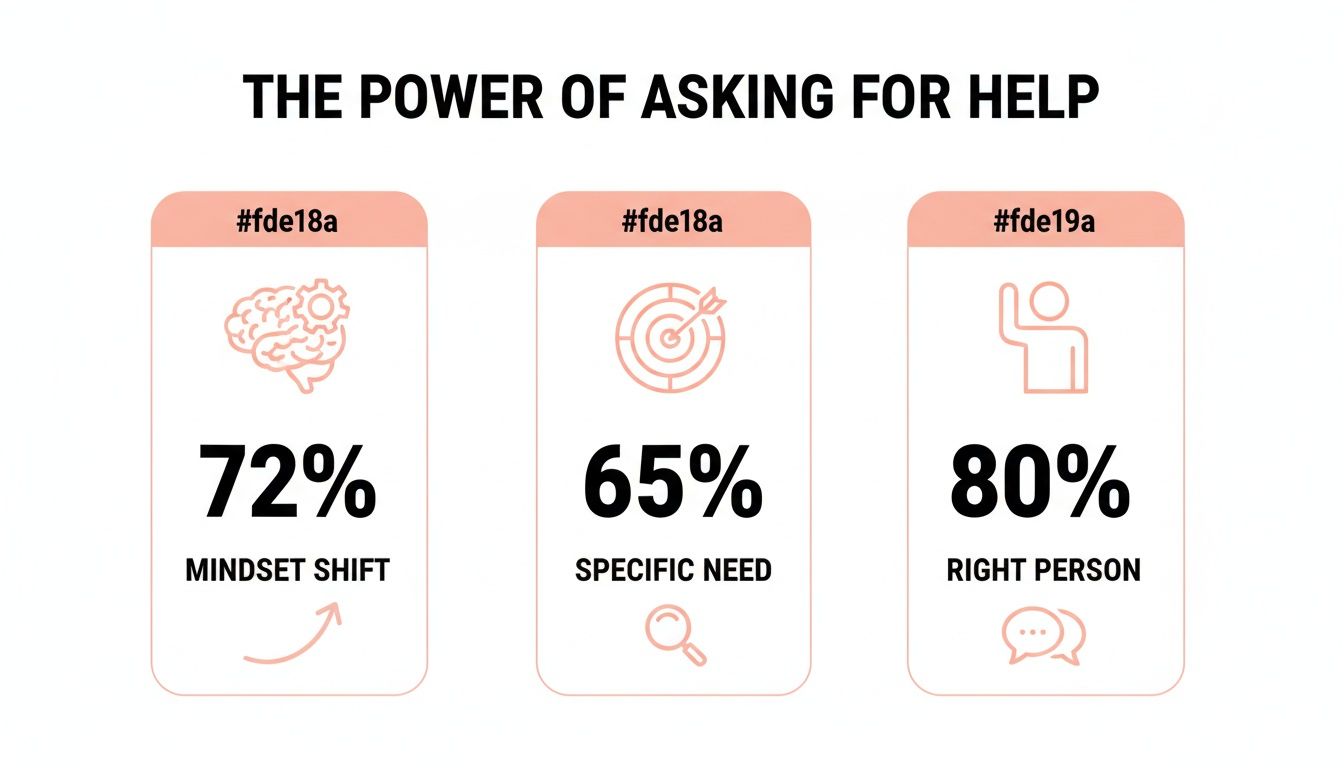
It all begins with an internal mindset shift, moves to gaining crystal clarity on your need, and culminates in connecting with the right person.
Normalizing the Hesitation
Understanding these anxieties are shared helps dissolve the stigma. Your hesitation is not a personal failing—it's a profoundly human experience. We all carry invisible pressures and societal expectations that make vulnerability feel risky.
By validating these feelings, you can start to see asking for help not as a moment of defeat, but as a courageous act of self-care. It's a sign that you value your well-being enough to seek the connection and support you deserve. This small shift in perspective transforms a moment of struggle into an opportunity for growth and deeper relationships.
A Practical Guide to Making Your Request

Now that we’ve shifted our mindset, let’s get practical. Knowing you should ask for help is one thing; knowing how to do it with confidence is a game-changer.
Think of it as a simple, repeatable skill you can build. This straightforward framework takes the anxiety out of the equation: Prepare, Practice, and Present. This formula transforms a vague feeling of overwhelm into a clear, actionable request, setting both you and the person you're asking up for success.
Let's walk through it.
Prepare By Pinpointing Your Exact Need
Before you speak to anyone, get crystal clear with yourself. Broad statements like, "I'm so stressed!" or "I need help with this project," are difficult for others to act on. They may want to help, but they don't know where to begin.
Action Point: Take five minutes to pinpoint your need. Ask yourself:
- What is the one thing causing the most pressure right now? Is it a looming report, a household chore, or the weight of a tough decision?
- What would a successful outcome look like? What would tangibly be different?
- Most importantly, what is one specific action someone could take to help you get there? This is the key. You're looking for a manageable task.
Getting specific isn’t just for their benefit; it’s for yours. When you can name the problem, you immediately take back a piece of your power. You start to see how a single, small act of support could make a genuine difference.
It’s often in this stage we realize we don't have one huge, insurmountable problem. We have a few smaller, manageable ones that have piled up.
This table shows how to translate overwhelming feelings into small, clear asks.
From Vague Feelings to Clear Requests
| Vague Feeling | Clear and Actionable Ask |
|---|---|
| "I'm drowning in work." | "Could you take a look at this one slide in my presentation? I'm stuck on the wording." |
| "I'm so overwhelmed at home." | "Would you be able to pick up the kids from practice on Tuesday so I can have an hour to myself?" |
| "I feel so lonely and isolated." | "I've been having a tough week. Would you be free for a 20-minute coffee catch-up on Friday?" |
| "This project is impossible." | "I'm not sure how to approach the data analysis part. Do you have 30 minutes to brainstorm with me?" |
See the difference? Clarity makes it easy for someone to say "yes."
Practice Scripting Your Request
Once you know what you need, it's time to find your words. This isn’t about memorizing a speech—it’s about having a few talking points ready so you can feel more confident and communicate clearly and kindly.
Action Point: Use this simple structure to frame your request:
- Open with the situation. (e.g., "I'm working on the Q3 report and feeling a bit behind.")
- Make your specific, actionable ask. (e.g., "Would you have 30 minutes to help me brainstorm the intro section?")
- Give them an easy out. (e.g., "No worries at all if you're swamped, but I thought I'd ask. Let me know if another time works better.")
When asking for help at work, using powerful check-in meeting questions can also be a great way to open the door for support in a more structured setting.
Present Your Request Thoughtfully
The final piece is the delivery. It’s all about choosing the right person, time, and method. A little thoughtfulness here can dramatically increase your chances of getting the help you need.
Action Point: Before you ask, consider the logistics:
- The Right Person: Who has the skills, knowledge, or capacity to help? Think about who has offered support in the past or has the right expertise.
- The Right Time: Avoid catching someone when they’re rushing or distracted. Find a calm moment where you can have their undivided attention.
- The Right Medium: A simple question is great for a message. But for a more sensitive request, a face-to-face conversation or quick call is almost always better, allowing for genuine connection and preventing misinterpretation.
By following this approach—Prepare, Practice, and Present—you can turn the daunting idea of asking for help into a manageable and empowering process.
How to Ask for Help at Work and Home
The art of asking for help is not one-size-fits-all. What works with your best friend probably won’t fly with your manager. Navigating these different conversations with finesse is key.
Whether you’re at your desk or your kitchen table, the core principles are the same: clarity and vulnerability are your greatest assets.
In the professional world, the conversation around mental health and workload is finally opening up. The key is to frame your request in a way that is professional, solution-oriented, and focused on shared goals.
At home, the challenge is often more emotional. The goal is to create a safe space for open communication where everyone’s needs can be shared without blame.
Crafting Your Request in a Professional Setting
Asking for help at work is essential for avoiding burnout and doing your best work. Many of us hold back, worried we'll appear incompetent.
The data tells a different story. Research from Oxford University's Saïd Business School found that happy, supported employees are 13% more productive. Your well-being is a direct benefit to the company. While 75% of employees believe it's appropriate to discuss mental health at work, fear of judgment remains a powerful silencer. For more on this, explore these workplace mental health statistics.
Action Points for Asking Your Manager:
- Be Proactive. Try to have this conversation before you hit a crisis. Frame it as a strategic check-in, not a desperate plea.
- Focus on the Work. Connect your need for help directly to business outcomes. Instead of, "I'm overwhelmed," try, "To ensure I meet the deadline for Project X with the highest quality, I could use support with..."
- Bring a Solution. Don't just present a problem. Suggest a possible solution, like delegating a task, adjusting a deadline, or getting access to a tool.
Example Script for a Manager:
"Hi [Manager's Name], do you have 15 minutes to chat this week? I'm mapping out my priorities for the month and wanted to align on the best way to tackle the upcoming launch. I've identified a couple of areas where some extra support could help us hit our targets more effectively."
This approach transforms a personal struggle into a collaborative, professional dialogue.
Asking for Support from Friends and Family
In our personal lives, the emotional stakes can feel even higher. The most effective way to ask for help from loved ones is to be direct, specific, and loving.
Clear communication is everything. Using "I" statements makes a huge difference, as it centers the conversation on your feelings instead of placing blame. For example, "I'm feeling really exhausted" lands much softer than "You never help around the house."
"When we ask for help, we are not admitting defeat. We are inviting others into our lives and giving them the beautiful opportunity to show up for us."
Building this kind of open communication is foundational to strong relationships. A huge part of this is learning how to set healthy boundaries, which ensures that everyone's needs are respected.
Example Script for a Partner or Friend:
"Hey, I've been feeling pretty depleted lately with everything going on. Would you be willing to handle dinner on Tuesday and Thursday this week? Having those two evenings to just recharge would make a huge difference for me."
This request is specific, time-bound, and explains the positive impact. It’s an invitation, not a demand, and it strengthens your connection through mutual support.
What to Do When Someone Says No
Let’s face the moment we all dread. You’ve summoned your courage, made a clear request, and the answer is… no. It can feel like a gut-punch. But a "no" is not a dead end.
In fact, it's a powerful opportunity to prove to yourself that your worth is never tied to someone else’s availability.
The key is not to take it personally. A "no" is almost never about you. It's usually about the other person’s limitations—their schedule, their energy, or their own emotional capacity at that moment.
The fear of hearing "no" is a primary reason people avoid asking for support. The stakes feel high; the 2025 global mental health at work report reveals that 68% of millennials and 81% of Gen Zs have left jobs for mental health reasons, underscoring the urgent need for supportive environments.
Gracefully Moving Forward
How you respond in that moment can preserve your relationship and your own peace of mind. The goal is to close the loop with grace.
Action Point: Keep your response simple and genuine:
- "Thanks so much for considering it. I really appreciate your honesty."
- "No problem at all, I completely understand. Thanks for letting me know."
- "I appreciate you hearing me out. I'll figure out another plan."
These phrases acknowledge their position and release any tension, allowing you both to move on.
A 'no' is not a rejection of you; it's a redirection for your request. It's a signpost pointing you toward a different path, another person, or a new resource.
Create Your Support Map
This is where you get strategic. A "no" is an invitation to build your support map—a diverse web of people and resources you can turn to.
Action Point: Who’s next on your list?
- Could a different colleague offer a new perspective?
- Could a family member just listen, even if they can’t offer a practical solution?
- Is it time to look into a professional service, like therapy or coaching?
This isn’t about scrambling after one "no." It's about recognizing that help comes in many forms and from many places. By diversifying your resources, you empower yourself to keep moving forward until you find exactly what you need.
Answering Those Lingering Doubts
Even when you know asking for help is the right move, it’s normal for a little voice of doubt to appear. Let’s tackle those last-minute anxieties head-on so you can move forward with confidence.
What if I’m Too Anxious to Even Start the Conversation?
First, take a breath. Anxiety means this is important to you—it's not a stop sign. The trick is to build up to it with small, manageable actions.
Action Point: Start by writing it down. Scribble what you want to say in a journal. Seeing the words on paper often makes them feel less intimidating. Then, try a low-pressure text to open the door, like: “Hey, do you have a few minutes to chat this week? There’s something I’d love to get your thoughts on.”
How Can I Ask Without Feeling Like a Burden?
This is the #1 fear, tied to the belief that our needs are an inconvenience. It’s time to flip that script. You are not handing someone a burden; you are offering them an opportunity to connect and show they care.
Action Point: Be specific. A vague statement like, "I'm so overwhelmed," can feel heavy. Instead, a clear, concrete request like, “Could you help me by making dinner on Tuesday night?” shows respect for their time and makes it easy for them to say "yes" and feel good about helping.
Is There a “Wrong” Way to Ask for Help?
While there’s no single “right” way, some approaches are less effective. The most common missteps are being vague, making demands, or catching someone at a terrible time. A good request is always clear, respectful, and mindful of the other person.
Action Point: Choose your moment. Asking for a big favor over text in the middle of a chaotic workday is unlikely to succeed. Instead, find a calmer time to connect thoughtfully. This small consideration shows you value them and their time, and it makes all the difference.
At Mesmos, we believe in the power of connection and self-care. Our thoughtfully designed products are here to inspire moments of peace and mindfulness on your journey. Discover meaningful gifts that support your well-being.


