

Ready to build a life that feels less draining and more energizing? A self-care routine is your personal blueprint for doing just that. It's not about adding more to your overflowing to-do list; it's about making a compassionate commitment to your own well-being through small, sustainable actions. This is your guide to weaving moments of genuine restoration into the fabric of your daily life, creating a foundation of strength and joy.
It all starts with getting honest about what you truly need and then scheduling those moments with the same importance as any other appointment on your calendar. Let's begin this transformative journey together.
Why Self-Care Is More Than Just a Buzzword
Let's be real—the term "self-care" often conjures up images of pricey spa days or picture-perfect bubble baths. While those things are lovely, they only scratch the surface of this powerful practice.
At its core, creating a self-care routine is a vital strategy for navigating the beautiful chaos of modern life. This is your official permission slip to reframe self-care from an occasional indulgence into a non-negotiable necessity for a thriving life.

From Luxury to Foundational Practice
So many of us are running on fumes, treating rest as a reward we must earn only after pushing ourselves to the absolute brink. That cycle isn't just unsustainable; it's a recipe for burnout. True self-care is the antidote—it's the preventative maintenance that keeps your mind and body resilient.
This isn't just a fleeting trend; it’s a global movement toward prioritizing well-being. According to the Global Wellness Institute, the wellness economy is a multi-trillion dollar market, highlighting a collective shift in human priorities. The science backs this up: research from the Journal of Psychosomatic Research shows that engaging in leisure activities, a core part of self-care, is linked to lower blood pressure, reduced stress, and better overall physical function.
Self-care is your anchor in a chaotic world. It allows you to shift from reacting to everything life throws at you to acting with intention. It’s about proactively filling your own cup so you never have to pour from an empty one.
This proactive approach builds resilience, sharpens your focus, and quiets the constant background noise of stress. These intentional moments give your nervous system a much-needed chance to downshift from "fight or flight" mode into a state of "rest and digest." This is where real restoration happens, setting the foundation for a life that feels more grounded, centered, and full of possibility.
Discovering What Truly Recharges You
An effective self-care routine isn't one-size-fits-all; it has to be deeply, wonderfully you. This is where we get real about what you actually need to feel whole again.
Forget what you think self-care is supposed to look like. Let's begin with a moment of gentle, honest self-assessment. This is about learning to listen to your own energy—understanding the difference between an activity that genuinely restores you versus one that just distracts you for a bit.
Moving From Drained to Restored
The first step is to become an observer of your own life. Pay attention to the small shifts in your mood and energy throughout the day. A fantastic way to start is by asking yourself a few simple questions before you go to sleep.
Action Point:
Tonight, before bed, take just two minutes to reflect on these questions:
- What parts of my day consistently left me feeling drained or just plain blah?
- What tiny moments, no matter how small, brought me a little flicker of peace or joy?
- When did I feel most like myself today?
- Which activities made me feel rested afterward, and which ones were just a temporary escape?
Jotting down the answers helps you pinpoint your unique stress triggers and, more importantly, uncovers what replenishes your reserves. If you'd like a little more structure, our guide on how to start journaling has easy tips to get your thoughts flowing.
This quiet self-reflection is the foundation for everything. It’s not about adding more to your to-do list; it’s about making intentional choices that honor how you feel.
Identifying Your Unique Needs
Once you start this practice, you'll begin to notice patterns. Maybe you realize that a lack of quiet time is making you irritable, or that sitting at a desk all day is zapping your physical energy. Perhaps you discover that a quick walk outside does more for your mood than an hour of scrolling ever could.
This isn’t about judging yourself; it's about gathering data. For some, peace comes from a simple ritual, like brewing a calming tea that relaxes body and mind. Once you understand what drains you and what recharges you, you can finally start designing a self-care routine that’s built just for you.
Building Your Personal Self Care Menu
Here comes the fun part—choosing the activities that will actually fill your cup. Think of it like creating a personalized menu of self-care options, where each choice gives you exactly what you need, whether that's mental clarity, a physical reset, or a moment of pure joy.
This isn't about adding chores. It's about hand-picking a few simple practices that you'll genuinely look forward to.

Curating Your Go-To Activities
A well-rounded routine nurtures your whole self. The goal is to have a toolkit of choices ready, so you can grab whatever feels right without overthinking it.
Action Point:
Brainstorm one or two simple ideas for each category below. Don't censor yourself—just write down what sounds appealing.
- Mental Self-Care: Activities that quiet the noise. Think a 5-minute guided meditation, solving a puzzle, or reading a book.
- Physical Self-Care: Ways to honor your body. This could be a 30-minute walk, a gentle stretching session, or simple self-massage techniques.
- Emotional Self-Care: Actions that help you process feelings. Try journaling, calling a supportive friend, or simply allowing yourself to sit with your emotions without judgment.
- Creative & Social Self-Care: Practices for connection and self-expression. Schedule a coffee date, spend an hour on a hobby, or just sit in a park and people-watch.
Your Self Care Activity Menu
Feeling stuck? Use this table as a thought-starter. Mix and match ideas based on your needs and how much time you have.
| Focus Area | 5-10 Minute Idea | 15-30 Minute Idea | 60+ Minute Idea |
|---|---|---|---|
| Mental | Do a brain dump in a journal | Listen to an inspiring podcast episode | Take an online class on a topic you love |
| Physical | Stretch at your desk | Go for a brisk walk outside | Go for a hike or take a yoga class |
| Emotional | Listen to a favorite feel-good song | Call a friend or family member to chat | Watch a movie that makes you laugh or cry |
| Social | Send a thoughtful text to a friend | Have a coffee date (virtual or in-person) | Plan a weekend brunch with loved ones |
| Creative | Doodle or sketch with no goal in mind | Spend time on a hobby (knitting, painting) | Visit a museum or art gallery |
| Restorative | Practice deep breathing exercises | Take a relaxing bath or shower | Take a guilt-free nap |
Remember, this is just a starting point. The real magic happens when you customize this list to fit your life and your preferences.
Making It Your Own
The beauty of a self-care routine is that it’s completely, 100% yours. Your menu should feel like a reflection of your personality and your real-life needs.
Don't choose activities based on what you think you should be doing. Select practices that feel like a gift to yourself—activities you genuinely look forward to.
Maybe your idea of restoration is digging in the garden, while for someone else, it’s listening to a true-crime podcast. The only thing that matters is that it recharges you. Your menu is a living thing; it will grow and change as you do. Start with one or two small things that feel both easy and delightful. That’s how you begin.
Weaving Self-Care Into Your Busy Schedule
A beautiful self-care plan is wonderful, but it only works if you actually do it. The magic happens when you start weaving those intentions into the fabric of your real, messy, beautiful life. This is where we shift from planning to practice.
The secret isn’t finding more hours in the day—it’s using the moments you already have with more intention. A few dedicated minutes of care each day will always be more powerful than a grand, one-off gesture once a month. Consistency is everything.
The Power of Habit Stacking
One of the easiest ways to make a new habit stick is through a brilliant technique called habit stacking. Popularized by James Clear in his book Atomic Habits, the idea is simple: you link a new self-care habit to an existing one you already do on autopilot. This connection acts as a mental trigger, helping the new practice become second nature.
Action Point:
Choose one self-care activity and "stack" it onto an existing habit using this formula: "After/Before [Current Habit], I will [New Habit]."
- After I pour my morning coffee, I will write down three things I’m grateful for.
- While my kids have 20 minutes of screen time, I will do five minutes of stretching.
- After I brush my teeth at night, I will do a one-minute breathing exercise.
This technique works because it leverages existing neural pathways, making it much easier to welcome a new behavior into your life.
You don't need to reinvent your schedule. Your existing routines are the foundation. By stacking self-care on top of them, you’re just enhancing the life you already live.
Protect Your Time with Intention
Another game-changing strategy is time blocking. This is exactly what it sounds like: scheduling self-care in your calendar just like a work meeting. When you give these moments a designated home in your day, you subconsciously give them more value.
This could be a 15-minute block for a “Mindful Walk” during lunch or a 30-minute slot in the evening for reading. When you put it on the calendar, you’re sending a powerful message to yourself: my well-being is a priority. It stops being an afterthought and becomes a protected part of your commitment to yourself. And that’s a crucial step in learning how to create a self care routine that truly lasts.
Real-Life Examples of Self Care Routines
So, we've talked about the what and the why. But sometimes, the best inspiration comes from seeing what a self-care routine looks like in the real world.
Think of these as flexible blueprints, not strict rules. Your own routine will be a perfect reflection of your unique life. The goal is to see how small, consistent actions build a powerful foundation for well-being, no matter what your schedule throws at you.
This simple framework is a great way to visualize how to make it all happen.
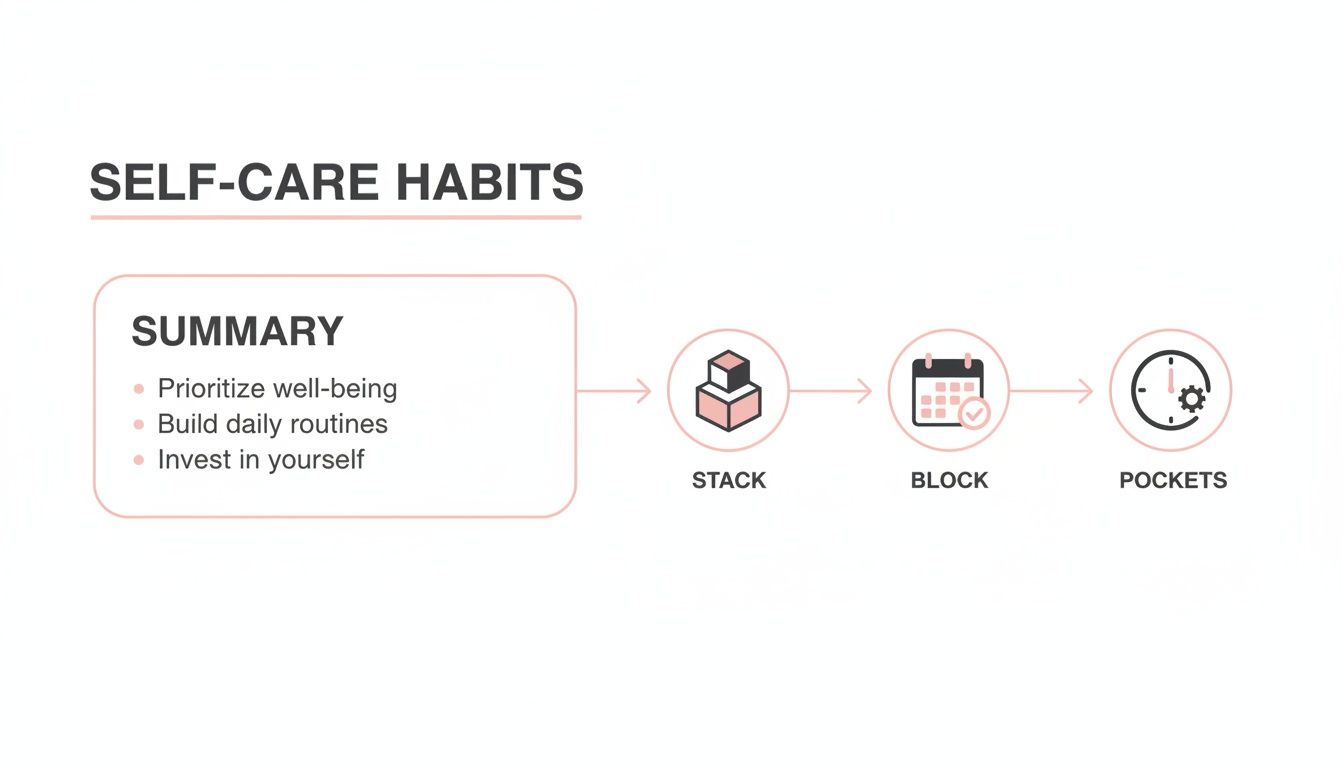
It’s all about using clever strategies—stacking habits, blocking out time, and finding tiny pockets—to make self-care feel like a natural part of your day.
The Busy Professional
For someone juggling back-to-back meetings, self-care is about creating intentional pauses to sidestep burnout. The focus is on efficiency and mental clarity.
- Morning (7:00 AM): Before opening a single email, take five minutes with a coffee and a journal. A quick "brain dump" clears mental clutter for a focused day.
- Afternoon (1:00 PM): Use the first 10 minutes of lunch for a screen-free walk. Research shows that even brief exposure to nature can lower cortisol (the stress hormone) and improve concentration.
- Evening (8:00 PM): Set a hard stop for work. Spend 20 minutes on something unrelated to your job—listening to a podcast, reading a novel—to help your brain shift gears and power down.
The Overwhelmed Parent
When you’re constantly tending to others, self-care means fiercely protecting tiny pockets of time for yourself. This routine is built around those quiet moments before the house wakes up and after it settles down.
- Morning (5:30 AM): Wake up just 15 minutes before the kids. Use that precious silence for gentle stretching or to simply enjoy a hot cup of coffee without interruption.
- Afternoon (Naptime/Quiet Time): Before diving into chores, take the first 10 minutes for yourself. Pop in your headphones and listen to a favorite playlist or a short guided meditation. The laundry can wait.
- Evening (9:00 PM): Once the kids are asleep, take a warm shower or bath. A study in Sleep Medicine Reviews found that a warm bath 1-2 hours before bed can significantly improve sleep quality by helping regulate body temperature.
Remember, these are just ideas. The most effective self-care plan is the one that recharges you—the one you can joyfully and consistently return to, day after day.
The Wellness Beginner
Just starting out? Keep it simple, doable, and genuinely rewarding. Forget a total life overhaul. Instead, focus on one or two small habits that feel good and are easy to stick with.
- Morning: Before anything else, drink a full glass of water. This small win sets a positive, healthy tone for the day.
- Afternoon: Pick one small action. A five-minute walk around the block, tidying one corner of your desk, or taking three deep, mindful breaths when you feel stressed.
- Evening: A half-hour before you plan to sleep, put your phone away. This simple boundary between your busy day and a restful night is a game-changer for sleep quality.
Making Your Self-Care Routine Stick
You’ve done the beautiful, reflective work of designing a routine that honors your needs. This is a huge win. But the real magic isn’t just in the planning; it’s in the practice—day in and day out.
This final piece is about making your self-care a lasting, evolving relationship with yourself. Sustaining this new rhythm is a journey of compassion, not criticism.
Navigating Obstacles with Grace
Life is messy. You’ll get busy, feel drained, or simply forget. When you miss a day—and you will—the most important thing is to avoid the guilt spiral.
Beating yourself up for being human only piles on more stress, the very thing we’re trying to soothe. Instead, meet these moments with gentle curiosity. Ask yourself, "What got in the way today?" Maybe your plan was too ambitious, or an unexpected event threw you off. This isn't failure; it's feedback.
Think of your self-care practice not as a rigid set of rules, but as an evolving conversation with yourself. The goal is progress, not perfection.
This mindset shift transforms your routine from a source of pressure into a source of support. If you need a gentle nudge, a simple tool like this daily self-care checklist can be a wonderful visual reminder of your commitment.
Evolving Your Routine for Long-Term Success
The person you are today isn't the same person you'll be in six months. Your needs, energy, and life circumstances are always changing, so your self-care routine must be flexible enough to change with you.
What works during a calm season might not be what you need during a period of high stress. This is why checking in with yourself is so crucial.
Action Point:
Set aside a few minutes each month to review your practices. Ask yourself:
- Is this still serving me? Does this activity still feel restorative?
- What needs to change? Are there new stressors that require a different kind of support?
- What am I craving more of? Maybe it’s more connection, more quiet time, or more creativity.
By staying curious and flexible, you build a supportive, kind, and deeply personal practice that truly lasts a lifetime—empowering you to not just survive, but to thrive.
At Mesmos, we believe in the power of small, intentional acts to create a life filled with meaning and joy. Our thoughtfully designed products are here to support you on your journey to inner peace. Discover our collection of wellness tools and gifts at https://mesmos.co.


