

If you’re feeling utterly drained, disconnected from your work, and haunted by the thought that nothing you do matters—you are not alone. That feeling isn't a personal failure. It’s a powerful signal called burnout.
Burnout is a human response to a work culture that often demands more than we can sustainably give. It’s a sign that the systems around us need to change, not that we are broken. You have the power to rise from this.

The scale of this issue is immense. Research reveals that an astounding 82% of employees are at risk of burnout. The ripple effect costs businesses an estimated $322 billion annually in lost productivity. It's impacting our youngest professionals profoundly, with many Gen Z and millennials reporting burnout by age 25. You can explore the widespread impact of burnout in the workplace to understand its scope.
But this is more than just data; it's about your life and your energy. The path forward is a journey of three powerful steps: Recognize the signs, Reverse the damage with immediate, intentional action, and Rebuild your resilience for a vibrant future. This is your roadmap to reclaiming your spark.
The Telltale Signs of Burnout
So, what is this state of chronic stress that's affecting so many? It’s far more than just feeling tired. The World Health Organization defines burnout through three core dimensions you might recognize in your own life:
- Chronic Exhaustion: This is a profound, soul-deep fatigue that sleep can't seem to touch. It’s the feeling of having nothing left in your emotional or physical reserves.
- Growing Cynicism: You may feel increasingly detached, cynical, or negative about your job. It's a slow erosion of the passion and purpose that once drove you.
- A Feeling of Ineffectiveness: This is the creeping doubt that you’re not making a difference, which chips away at your confidence and sense of accomplishment.
Your Recovery Framework: The Three R's
Learning how to deal with burnout can feel overwhelming, but we can simplify it. This guide is built around a clear, empowering framework to guide your journey: The Three R's of Recovery.
This framework breaks your path into manageable, inspiring phases. It shifts your focus from feeling overwhelmed to taking purposeful steps toward healing and renewed strength.
Here’s a glimpse of the journey ahead.
Your Three R Framework for Burnout Recovery
| Phase | Core Focus | Key Action |
|---|---|---|
| Recognize | Acknowledge the signs of burnout and their impact. | Identify specific stressors and symptoms without judgment. |
| Reverse | Stop the downward spiral and create immediate relief. | Set non-negotiable boundaries and implement quick-win self-care tactics. |
| Rebuild | Develop sustainable habits for long-term well-being. | Redefine your relationship with work and create a resilient lifestyle. |
Think of this as your personal blueprint for reclaiming your life. Each section will guide you with practical advice and actionable steps, supported by tools from Mesmos to champion you along the way.
Let’s begin the journey back to your most vibrant self.
Identifying the True Signs of Burnout
Burnout is a quiet storm. It gathers slowly, clouding your days until you can barely remember what sunshine feels like. Simply acknowledging its presence is the first, most courageous step toward reclaiming your energy. This isn’t about admitting defeat—it’s about giving yourself the grace to see what’s really happening.

Often mistaken for stress, burnout is a deeper, more persistent state of depletion. The key difference? Stress is characterized by over-engagement—a feeling of frantic urgency. Burnout is defined by disengagement. It leaves you feeling empty, detached, and utterly exhausted.
To truly understand it, let’s explore its three core pillars.
Pillar One: Emotional Exhaustion
This is the heavy blanket you can’t seem to shake off. It’s a profound fatigue that no amount of sleep can fix. Emotional exhaustion is waking up already dreading the day, with no energy for the things you once loved. Your emotional well has run dry.
- Practical Action: For the next three days, rate your energy level from 1 to 10 when you wake up and when you go to bed. This simple act of tracking helps you objectively see the depth of your exhaustion.
Pillar Two: Cynicism and Detachment
This pillar is a protective—but ultimately damaging—emotional shield. Also known as depersonalization, it’s when you feel distant and negative about your work and colleagues. It’s a defense mechanism to cope with overwhelming demands.
This can manifest as:
-
Irritability: Snapping at others over minor issues.
-
Pessimism: Assuming the worst about new projects or your own efforts.
-
Emotional Numbness: Feeling like you’re on autopilot, disconnected from your own life.
-
Practical Action: Identify one small, positive interaction you can have at work tomorrow—like genuinely complimenting a colleague or thanking someone for their help. This micro-action can begin to counteract the pull of cynicism.
Burnout strips away our sense of agency and can lead to a state of helplessness. Recognizing these early warning signs is the crucial first step to taking back control before it consumes you.
Pillar Three: Reduced Personal Accomplishment
This final pillar strikes at your professional identity. It’s the nagging feeling that you're no longer effective. Despite working hard, you feel you're not making a meaningful impact, which erodes your confidence. This creates a vicious cycle: feeling ineffective reduces motivation, which further fuels the sense of failure.
- Practical Action: At the end of today, write down just one thing you accomplished—no matter how small. It could be answering a difficult email or simply making it through the day. Acknowledge your effort.
By seeing which of these pillars resonate most with you, you transform your experience from a personal failing into a clear signal for change. That recognition is where your power truly begins.
Finding Immediate Relief From Exhaustion
When you’re completely depleted, the thought of a massive recovery plan can feel exhausting. The good news? You don’t have to fix everything at once. Your mission right now is to create just enough space to breathe.

This phase is about immediate relief. These small, low-effort actions are your emergency kit for breaking the stress cycle, even for just a few moments. These micro-breaks can reset your nervous system and give you the strength for the next step. Every time you take one, you're sending a powerful message to your mind and body: my well-being matters.
The Power of the 5-Minute Reset
One of the most effective tools is the intentional disconnect. You don’t need an hour of yoga; you just need five minutes to calm the storm.
Here’s your action plan:
- Set a 5-minute timer. This creates a protected space just for you.
- Close your eyes. Instantly reduce overwhelming sensory input.
- Focus on your breath. Try "box breathing": Inhale for a count of four, hold for four, exhale for four, and hold for four. This simple rhythm, used by Navy SEALs, is incredibly effective at calming the nervous system.
- Just be. Your only job for these five minutes is to breathe.
This isn’t about emptying your mind; it’s about giving it a single, calming focus. It’s a powerful way to step off the hamster wheel of anxious thoughts.
Reclaim Your Commute and Your Evenings
Is your workday bleeding into your personal time? Creating a clear separation is crucial for recovery.
Here’s your action plan:
- If you commute: Use that time to transition consciously. Listen to an uplifting podcast, an audiobook, or music that fills you with joy. No work emails or replaying stressful meetings.
- If you work from home: Create a "shutdown ritual." Close your laptop, tidy your desk, and take a quick walk around the block. This symbolic act tells your brain the workday is officially over.
Burnout thrives when the lines between work and life blur into nonexistence. By creating clear end-of-day rituals, you are actively defending your personal time and giving yourself permission to truly rest and recharge.
The cost of not doing this is staggering. Employees experiencing burnout are 63% more likely to take sick leave. On a global scale, this adds up to a productivity loss of roughly $1 trillion annually. These numbers really drive home how urgent it is for us to build better well-being habits. You can discover more insights about the global impact of workplace stress from TherapyRoute.
Breathing Techniques for Instant Calm
When stress spikes, your body’s "fight or flight" response takes over. Your breath is your remote control to switch it off and activate your calming "rest and digest" system.
Try the scientifically-backed Physiological Sigh. Andrew Huberman, a neuroscientist at Stanford, champions this as the fastest way to reduce stress in real-time.
- Take two sharp inhales through your nose (the first one deep, the second a shorter top-up).
- Then, exhale slowly and fully through your mouth.
Repeat this just one to three times. You can do it anywhere—before a big meeting, during a stressful call, or anytime you feel that wave of overwhelm rising. These techniques are your first, crucial steps toward taking back control and finding the breathing room you so desperately need.
Reclaiming Your Time and Setting Boundaries
Sustainable recovery isn’t just about managing stress—it's about changing the conditions that caused it. This means moving from a reactive state to proactively taking command of your work life. It all starts with setting firm, healthy boundaries to protect your most precious resources: your time and your energy.
This can feel daunting in a culture that glorifies being “always on.” But a boundary is a powerful act of self-respect. It’s a clear signal to yourself and others that your well-being is non-negotiable.
The Art of the Professional No
Learning to say "no" is one of the most liberating skills you can develop. It’s not about rejection; it’s about creating the space to excel at what truly matters. The key is to be clear, confident, and release the guilt.
Here’s your action plan:
Instead of a blunt refusal, frame your "no" around your current priorities. This shifts the conversation from rejection to responsible workload management.
- When asked to take on a new project: "Thank you for this opportunity. My focus is currently dedicated to [Project X] to ensure it succeeds. I could give this the attention it deserves after [Date]."
- For a request outside your role: "That's an important task. My expertise is in [your area], so I’m not the best person for this. I suggest connecting with [Relevant Person/Team], who is excellent at this."
- When you simply lack capacity: "I appreciate you thinking of me, but I don’t have the bandwidth to do this justice right now."
Learning to set boundaries is a practice. Each time you do, you build the muscle of self-advocacy.
Redesigning Your Workday for Sustainability
Burnout thrives when the lines between "on" and "off" disappear. It's no wonder that a staggering 63% of people experiencing burnout also report feeling less productive. The solution is to become the architect of your workday.
You cannot wait for someone else to give you permission to rest. Building a burnout-proof career means you must intentionally design your schedule to include periods of both focused work and genuine disconnection.
Here’s your action plan:
- Schedule Your Breaks: Block 15-minute breaks in your calendar and treat them like meetings you can't miss. Step completely away from your screen.
- Establish a Hard Stop Time: Decide on a firm time to end your workday and stick to it. Create your "shutdown ritual" to signal to your brain that it's time to switch off.
- Protect Your Lunch Hour: Step away from your desk. Eating while answering emails is not a break.
Having the Workload Conversation With Your Manager
If your workload is truly unsustainable, a direct, professional conversation with your manager is essential. Learning how to achieve work-life balance without burning out is about strategic partnership, not just personal struggle.
The goal isn't to complain; it's to collaborate on a solution.
Here's your action plan:
- Gather Data: Track your tasks for a week to show where your time is going. This turns "I feel overwhelmed" into "Here’s a breakdown of my 45-hour work week."
- Identify Priorities: Align your key tasks with company goals. What delivers the most value?
- Propose Solutions: Come prepared. "To focus on [High-Priority Project], could we de-prioritize [Lower-Priority Task] until next quarter? Or could [Colleague] assist with it?"
This proactive approach demonstrates your commitment while making it clear that the current pace is unsustainable. You are taking back control and building a career that supports your life, not consumes it.
Building Your Long-Term Resilience Plan
Moving beyond quick fixes is where true, lasting change happens. Now it's time to build a life so full and resilient that burnout struggles to find a foothold. This is about mindfully choosing habits that energize you and reconnect you with who you are beyond your job title.
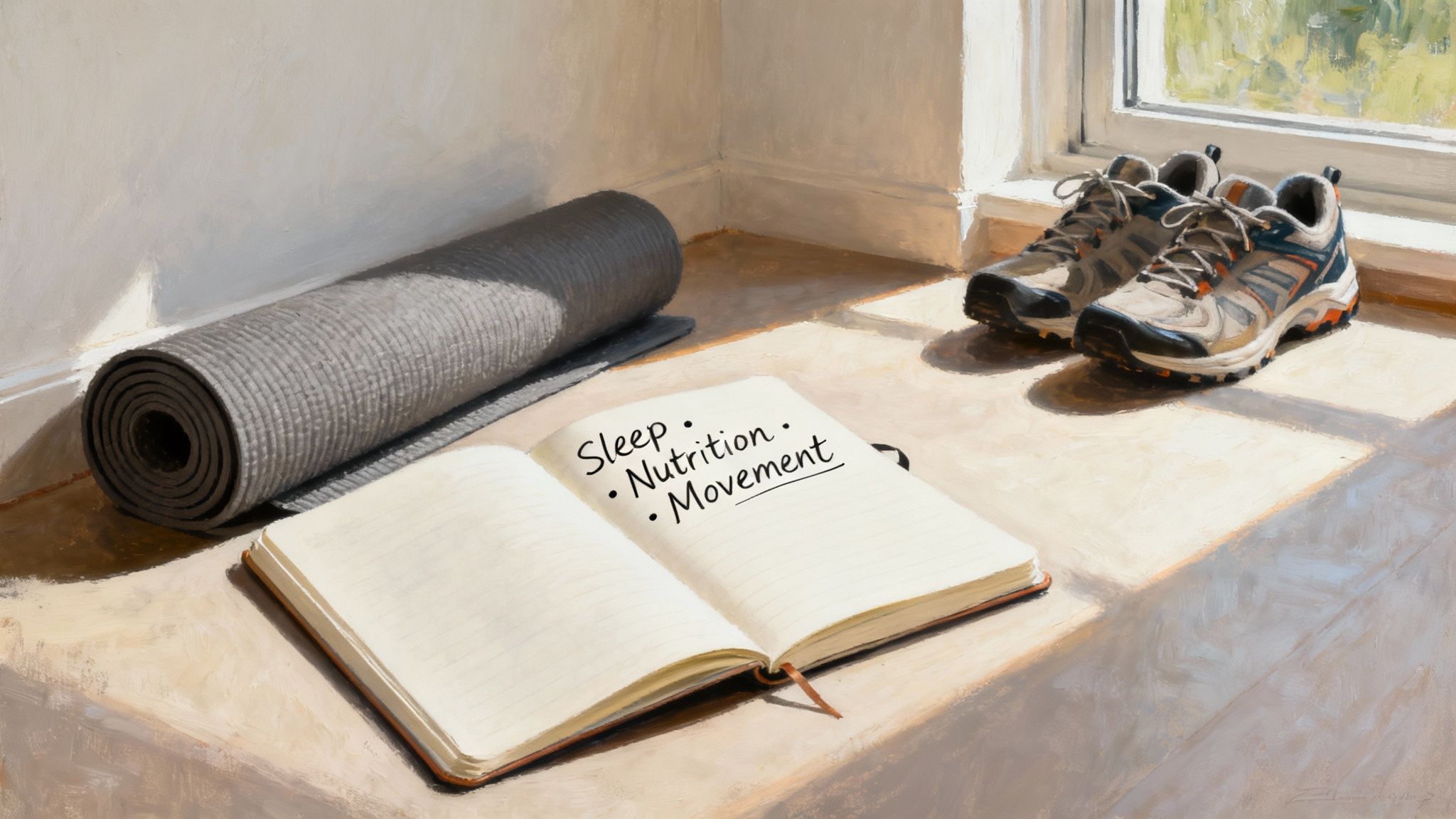
Resilience is built on a foundation of non-negotiable self-care. Focus on the three pillars that give your body and mind the fuel they need to thrive: sleep, nutrition, and movement.
Prioritize Restorative Sleep
Sleep is your ultimate recovery tool. Quality rest calms your nervous system and repairs the damage from chronic stress. Yet, it’s often the first thing we sacrifice.
Here’s your action plan:
Aim for 7-9 hours of consistent sleep. Consistency is key. Going to bed and waking up around the same time daily regulates your body's internal clock, dramatically improving your rest. A study in the journal Sleep found that consistent sleep schedules are linked to better health and performance.
It’s a common myth that you can just "catch up" on sleep over the weekend. While a little extra rest helps, it’s the consistent, nightly sleep that truly repairs the damage from daily stress and builds your resilience back up.
Fuel Your Body to Fight Fatigue
When you’re exhausted, it’s tempting to reach for sugar or caffeine for a quick spike. But this leads to a crash that leaves you feeling worse. Your food directly impacts your mood and energy.
Here’s your action plan:
Build your next meal around foods that provide sustained energy:
- Complex Carbohydrates: Oats, brown rice, sweet potatoes.
- Lean Proteins: Chicken, fish, beans, lentils.
- Healthy Fats: Avocados, nuts, olive oil.
You don't need a perfect diet. Start with one small, intentional choice. For more simple ideas, our daily self-care checklist offers practical, easy-to-follow suggestions.
Move Your Body in a Way You Enjoy
Exercise is a powerful stress-reducer, but a grueling workout can feel impossible when you're drained. The secret is to find movement you genuinely enjoy.
Here’s your action plan:
Ask yourself: what sounds even a little bit appealing right now?
- A 20-minute walk outside listening to music.
- A 10-minute stretch on your living room floor.
- Dancing in your kitchen to a favorite song.
The goal isn't to burn calories; it's to burn off stress hormones like cortisol and release mood-boosting endorphins. Research shows even short bursts of activity can significantly improve mental well-being.
Reconnect with Your Passions
Burnout shrinks your world until your job feels like your entire identity. Reclaiming your hobbies is a powerful act of defiance. It reminds you that your worth is not tied to your productivity.
Here's your action plan:
What did you love to do before life got so busy? Schedule time for it in your calendar. This isn't a luxury—it’s essential. When you lose yourself in an activity you love (a "flow state"), you are deeply restoring your mind and soul. It rebuilds your sense of self and proves a joyful, vibrant life is waiting for you beyond the stress.
Knowing When to Seek Professional Support
While self-guided strategies are powerful, sometimes you need a professional in your corner. Let’s be clear: asking for help is not a sign of weakness. It is a courageous act of self-advocacy and a profound sign of strength. It is you, declaring you are worthy of dedicated support.
You don't have to wait until you hit rock bottom. If your efforts aren't moving the needle, or if feelings of hopelessness have become your new normal, it might be time to reach out.
Key Signs You Need More Support
Burnout can sometimes overlap with or lead to more serious conditions like depression and anxiety. It's time to seek support if you notice a persistent low mood, a loss of interest in everything you once enjoyed, or significant changes in your sleep or appetite.
Chronic stress can also manifest physically. Persistent headaches, digestive issues, or other unexplained pains are clear signals from your body that it needs more help.
Reaching out for professional help is an investment in your long-term well-being. A therapist or coach provides a safe, confidential space to unpack the root causes of your burnout and co-create a personalized recovery plan that actually works for you.
Finding the Right Professional
Finding the right person is key. Do you need a therapist to work through underlying emotional patterns, or a coach to help you strategize career changes?
Here’s your action plan:
- Check with your employer: Many companies offer an Employee Assistance Program (EAP) with free, confidential counseling sessions. It's an excellent place to start.
- Ask your doctor: Your primary care physician can provide trusted referrals to mental health professionals.
- Use online directories: Websites like Psychology Today allow you to filter therapists by specialty, insurance, and location, simplifying your search.
Taking this step can feel daunting, but it’s one of the most empowering things you can do on your path back to feeling like yourself again.
Burning Questions About Burnout
When you’re in the thick of it, questions come up. Getting clear answers can be a huge relief, helping you make sense of what you're feeling and figure out what to do next. Let's dig into a few of the most common ones.
What Is the Difference Between Stress and Burnout?
It’s easy to mix these two up, but they’re fundamentally different.
Think of stress as a state of over-engagement. You're running on adrenaline, feeling frantic, and drowning in pressure. Everything feels urgent, and you're just trying to keep your head above water. It's a feeling of too much.
Burnout, on the other hand, is about disengagement. Instead of feeling frantic, you feel empty. You're emotionally drained, motivation is nowhere to be found, and a sense of helplessness has taken over. It’s a feeling of not enough.
How Long Does Burnout Recovery Take?
I wish there was a magic number, but the truth is, recovery is deeply personal. The timeline really depends on how severe your burnout is and what changes you're able to make in your life.
For some, a few weeks of dedicated rest and firm boundary-setting can bring significant relief. For others who are deeper in, it might take several months—or even a year—to truly feel like themselves again.
The key is to let go of the idea of an overnight fix. Focus on small, consistent steps forward and celebrate every bit of progress you make along the way.
Can I Recover From Burnout Without Quitting My Job?
Yes, absolutely. For many people, leaving a job isn’t an option or even the right solution. Often, the real work is in fundamentally changing your relationship with your job.
The strategies we've talked about—like setting non-negotiable boundaries, redesigning how you approach your workday, and making space for joy outside of your career—are all about empowering you to take back control right where you are.
If your job is the primary source of your burnout, you might find some targeted advice in a guide on how to overcome burnout at work and reclaim your energy. The goal is to build a work life that actually supports you, and that’s often more achievable than you think.
Your journey back to yourself is a beautiful act of self-love. To help you along the way, Mesmos creates thoughtfully designed mindfulness tools and printables that make it easier to build routines that protect your peace. Explore our collections and find the perfect companion for your recovery at https://mesmos.co.


