

Are you ready to create some much-needed breathing room in your mind? To truly declutter your thoughts, you need a simple yet powerful strategy to get all those swirling worries out of your head and onto paper. This is your journey to mental clarity, and it starts with small, inspiring actions like a 'brain dump' to offload stress, tidying your physical and digital worlds to quiet the external noise, and embracing mindfulness to calm the internal chaos. Let's begin.
Why Your Mind Feels So Cluttered

Does your mind ever feel like a browser with far too many tabs open? You're not alone. This mental overload is a modern reality, fueled by a relentless flood of information, endless decisions, and a long list of worries. It's not just exhausting—it’s a fast track to stress and burnout.
Let's reframe the idea of how to declutter your mind. See it not as another chore, but as an empowering act of self-care. It’s about consciously carving out space for peace, focus, and joy in a world that’s constantly demanding your attention. You have the power to create a calmer inner world.
Your Path to Mental Calm
That feeling of overwhelm is deeply connected to our well-being. Globally, anxiety and depression, conditions that thrive on mental clutter, affect over one billion people. Shockingly, mental health often receives a mere 2% of total health budgets—a statistic from the World Health Organization that highlights why developing our own wellness strategies is so vital.
A huge part of this is learning how to calm anxiety before bed, as nighttime is often when our minds feel the most restless.
"Focus is nothing more than mental declutter. When you clear the noise, you create a direct line to what truly matters."
Throughout this guide, we'll explore practical strategies that offer both immediate relief and lasting change. From quick resets to transformative habits, you’ll discover simple, effective methods to regain control and find the stillness you deserve.
Your Quick Guide to a Clearer Mind
Before we dive deep, here’s an overview of the key techniques we’ll explore. Think of this as your cheat sheet for a calmer mind—a go-to reference when you need the right tool for the moment.
| Technique | Primary Goal | Best For |
|---|---|---|
| The Brain Dump | Offload mental clutter | When you feel overwhelmed with to-dos and worries. |
| Digital Declutter | Reduce online distractions | Quieting the noise from notifications and social media. |
| Environmental Reset | Create a calming physical space | Finding focus and peace in your home or office. |
| Cognitive Reframing | Shift negative thought patterns | Challenging worry and anxiety to build resilience. |
These methods are designed to be simple, actionable, and easy to fit into your busy life. Let’s get started on clearing the noise and making space for what truly matters.
Mastering the Brain Dump for an Instant Mental Reset

If you're searching for immediate relief from that spinning, overloaded feeling, the brain dump is one of the most powerful tools in your arsenal. This isn't just another to-do list; it’s a profound act of releasing every thought, worry, idea, and task from your head onto paper.
Think of it as a deep clean for your mind. The simple act of externalizing thoughts creates an instant feeling of lightness and control. It’s your first, most essential step to declutter your mind and find your focus again.
The Simple Process of a Brain Dump
Getting started is refreshingly easy. All you need is a pen, paper, and the courage to let your thoughts flow freely.
Your Action Plan:
- Choose Your Tool: A beautiful notebook like our "I Am a Limited Edition” Leather Lined Journal, a simple pad, or a digital app. The medium matters less than the action.
- Set a Timer: Start with just 10-15 minutes. A timer creates a focused, low-pressure space for the exercise.
- Write Without a Filter: This is crucial. Let go of perfection. Don't worry about spelling, grammar, or whether a thought is "important." Just write.
Your brain dump is meant to be messy—that’s how you know it's working! This isn't a performance; it’s a release. For inspiration on putting pen to paper, explore how to journal effectively.
What to Write When You Feel Stuck
Sometimes, the hardest part is just starting. If you’re staring at a blank page, use these prompts to get the ball rolling.
A brain dump is like giving your mind permission to exhale. You’re not solving everything at once; you’re simply setting down the weight you've been carrying.
Actionable Prompts to Get You Started:
- What tasks have I been putting off?
- What's draining my energy right now?
- What am I worried about for the upcoming week?
- What are all the small, nagging to-dos floating around in my head?
- What creative ideas have I been too busy to explore?
These questions unlock different corners of your mind, letting everything spill onto the page. You’ll be amazed by what emerges when you give yourself space to listen.
Turning Chaos into a Clear Plan
Once your timer goes off, you'll have a raw, unfiltered look at everything on your mind. Now, it's time to turn that jumble of stress into a clear, manageable plan.
Your Action Plan for Organizing Your Thoughts:
Take a deep breath and review your list. Use highlighters or different colored pens to sort your thoughts into these four simple categories:
- Act Now: Urgent tasks for today or tomorrow.
- Schedule Later: Important things that can wait. Assign them a specific time in your calendar.
- Delegate or Delete: Can you ask for help? Or, even better, can you let this worry go completely?
- Incubate: Great ideas that need more time. Move them to a separate "ideas" list.
By sorting your thoughts, you shift from feeling overwhelmed to feeling empowered with a clear path forward. You’ve just taken a vital step to declutter your mind and create actionable peace.
How Your Physical Space Shapes Your Mental State

Have you ever walked into a messy room and felt an instant wave of stress? That frantic search for your keys is more than a minor annoyance; it’s a small dose of the chronic stress that physical clutter creates in our lives.
The link between a disorganized environment and a scattered mind is real. Our brains constantly process our surroundings. When our space is cluttered, it sends a continuous stream of stimuli, forcing our minds to work overtime. A Princeton University study found that physical clutter competes for your attention, resulting in decreased performance and increased stress. This cognitive load makes it nearly impossible to truly declutter your mind.
The journey to a calmer mind can start with small, intentional actions that create a more serene physical environment.
The Science of a Tidy Space
The link between our environment and our mental state is profound. Research published in the Personality and Social Psychology Bulletin found that women who described their homes as "cluttered" or full of "unfinished projects" had higher levels of the stress hormone cortisol.
Conversely, a tidy space signals to your brain that it's okay to relax. By taking control of our surroundings, we actively reduce that mental burden. You can dive deeper into the connection between tidiness and mental health in our detailed article.
Your outer world is a reflection of your inner world. When you clear your physical space, you create a direct pathway to clearing your mental space.
It’s no wonder people are recognizing that a decluttered home is a powerful tool for a decluttered mind. You can start making small changes today that bring big mental rewards.
Small Actions for Big Mental Shifts
Instead of a monumental project, think of decluttering as a series of small, sustainable habits. These simple practices can be woven into your daily life, creating a ripple effect of calm.
Your Action Plan for a Tidy Space:
- The '15-Minute Tidy' Habit: Set a timer for 15 minutes each evening and tackle one small area—your kitchen counter, your desk, or the entryway table. Progress, not perfection, is the goal.
- The 'One-In, One-Out' Rule: For every new item you bring home, let go of one similar item. This stops clutter before it starts.
- The 'Touch It Once' Principle: When you bring in the mail, sort it immediately. When you take off your coat, hang it up. Dealing with items on the spot prevents piles from forming.
These micro-habits are the building blocks of an organized space, which supports a consistently calm mind.
Create Your Own Sanctuary
One of the most impactful ways to use your physical space to declutter your mind is to create a dedicated 'calm corner.' This doesn’t need to be a whole room. It can be a comfortable chair by a window, a corner with a cozy cushion, or your bedside table cleared of everything but a lamp and a journal. This space becomes your physical anchor for peace.
Your Action Plan:
Designate a spot in your home for quiet activities like reading or meditating. By consistently using this spot for relaxation, you train your brain to associate it with peace. When you feel overwhelmed, retreating to your calm corner can trigger an immediate sense of stillness.
Taming Your Digital World for a Quieter Mind
While a tidy room calms your senses, the biggest source of modern mental clutter is often digital: the endless notifications, the overflowing inbox, and the scattered desktop files. Each ping fragments our attention, slowly draining our mental batteries until we feel exhausted.
This digital noise is a direct line to cognitive overload. Taking back control of your digital world is one of the most critical steps to declutter your mind. With a few intentional habits, you can transform your digital environment from a source of stress into a space of focus and tranquility.
The Unseen Weight of Digital Clutter
That feeling of dread when you open your email? It's a recognized source of mental strain. Digital clutter disrupts our focus and spikes our stress levels. A 2022 survey found that 46% of office workers report feeling "overwhelmed" by the sheer volume of digital communications. Today, decluttering is about curating our digital lives to support our well-being.
"Your digital world should serve you, not the other way around. Every notification you silence is a moment of focus you reclaim."
Taking control of your digital life is a powerful act of self-care. It’s about creating systems and boundaries that protect your most valuable asset: your attention.
Your Inbox Is Not a To-Do List
For many, the email inbox has become a chaotic, default task manager, creating constant low-grade anxiety. It’s time to reclaim your inbox with a few game-changing habits.
Your Action Plan for Email Calm:
- Schedule Your Check-Ins: Instead of reacting to every email, set specific times to check your inbox—perhaps once in the morning and once in the afternoon. This shifts you from a reactive to a proactive mindset.
- The Unsubscribe Challenge: Make it a daily habit to unsubscribe from five promotional newsletters you never open. This small action has a huge cumulative effect.
- Embrace a Simple Folder System: Start with three folders: "Action" (requires a response), "Waiting" (awaiting a reply), and "Archive" (everything else). This clears your immediate view and brings you closer to "Inbox Zero."
These small adjustments dramatically lower email stress, freeing up valuable brainpower.
Create a Digital Sunset
Just as our bodies need rest, our minds need a real break from the constant stimulation of screens. A "digital sunset" is a powerful boundary where you intentionally disconnect from all screens at least an hour before bed. This simple practice has a profound impact on your ability to declutter your mind and improve sleep quality.
Your Action Plan:
The blue light from phones interferes with melatonin, your body's natural sleep signal. Tonight, put your devices away an hour before bed. Give your mind a chance to wind down and prepare for restorative rest. For more great strategies, check out these 10 Actionable Ways to Reduce Screen Time.
By taming your digital world, you're building a fortress of focus and creating the mental space for creativity, peace, and deep thinking to flourish.
Rewiring Your Thoughts for Lasting Clarity
A tidy desk and an empty inbox feel great, but true calm can vanish the moment a stressful thought appears. Lasting mental clarity isn’t just about organizing what’s around you—it begins with the thoughts inside you.
Lasting peace comes from learning how to quiet the internal chaos: the worry loops, the self-doubt, and the negative stories we tell ourselves. You are the architect of your mindset. With powerful tools from Cognitive Behavioral Therapy (CBT), you can actively rewire the thought patterns that create mental clutter. These are practical skills you can use anywhere, anytime.
Catch, Challenge, and Change Your Thoughts
One of the most powerful things you can do is learn to intercept unhelpful thoughts before they spiral. This simple three-part method, a cornerstone of CBT, helps you create space between a thought and your reaction to it.
Your Action Plan:
- Catch the Thought: First, just notice. Become aware when a negative or anxious thought appears, like, "I'm going to fail this presentation." Acknowledge it without judgment.
- Challenge the Thought: Now, get curious. Is this thought 100% true? What’s the real evidence? Challenge it by reminding yourself, "I've prepared for this, and I’ve given good presentations before."
- Change the Thought: Finally, swap the original thought for one that’s more realistic and constructive. Instead of, "I'm going to fail," reframe it to, "I am prepared, I'll do my best, and I can handle whatever happens."
This isn't about forced positivity. It's about finding a balanced perspective that breaks the cycle of automatic negativity.
The Power of Scheduling Your Worries
This may sound strange, but one of the best ways to handle persistent anxiety is to give it an appointment. The "Worry Time" technique is a surprisingly effective way to contain anxious thoughts so they don’t take over your day.
Setting aside a specific time to worry is like telling your mind, "I hear you, and we will deal with this, but not right now." This simple boundary can reclaim hours of your day from the grip of anxiety.
Your Action Plan:
Pick a specific, limited window each day—say, 15 minutes in the afternoon—as your designated "Worry Time." When an anxious thought appears outside of that time, jot it down in a notebook and promise yourself you’ll address it during your scheduled slot. Often, by the time the appointment arrives, the worry has lost its intensity or you can address it more logically.
Uncovering Your Triggers with Journaling
To create long-term mental clarity, you have to get to the root of what’s causing the clutter. Journaling is an incredible tool for this self-discovery, helping you pinpoint the situations, thoughts, or even people that trigger overwhelm.
Grab a notebook and spend a few minutes with these prompts designed to help you dig deeper.
Actionable Journaling Prompts:
- When did I feel most mentally cluttered this week? What was happening at that moment?
- What specific thought or story do I keep replaying in my mind?
- Are there certain people or environments that consistently leave me feeling drained?
- What is the one "should" that is putting the most pressure on me right now? (e.g., "I should be more productive.")
When you regularly explore these questions, patterns emerge. This awareness is the first step toward building resilience. You learn not just how to clear your mind, but how to stop the clutter from building up in the first place.
Your 14-Day Action Plan for a Decluttered Mind
Knowing what to do is one thing; turning those ideas into habits is where the real transformation happens. This simple 14-day plan is designed to help you build momentum without feeling overwhelmed. Each day has a single, focused task that takes only about 15 minutes. The goal is progress, not perfection.
Catch, Challenge, and Change Your Thoughts
Before we dive into the day-by-day plan, let's touch on a powerful technique you'll use: the Catch, Challenge, and Change method. It's a simple, three-step cycle for interrupting those automatic negative thought patterns and building a more resilient mindset.
You start by catching the thought, then you challenge its validity, and finally, you change it into something more constructive.
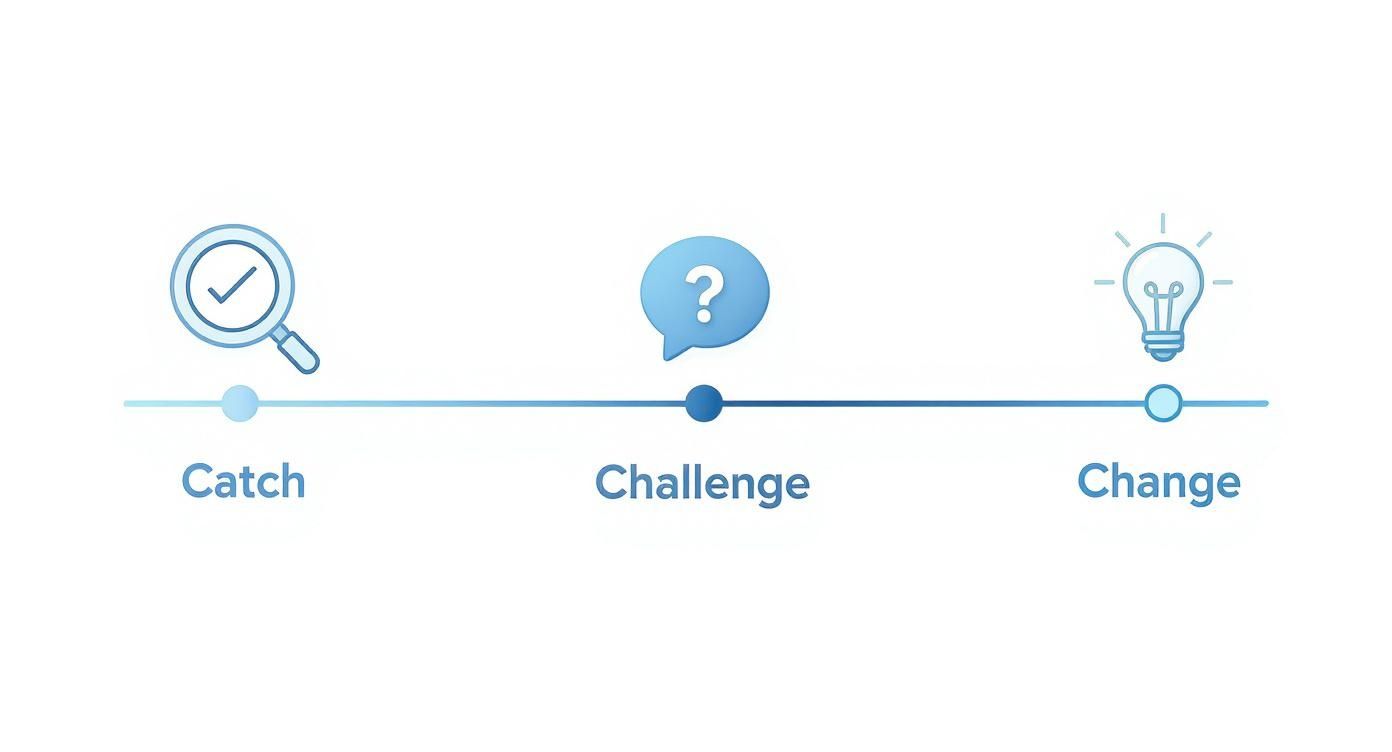
This process is a practice, not a one-time fix. Every time you do it, you're strengthening your ability to choose your response instead of being controlled by old habits.
Your 14-Day Mental Declutter Challenge
Ready to start? This day-by-day guide will help you build a foundation for lasting mental clarity. Each task is small enough to fit into a busy schedule but powerful enough to make a real difference.
| Day | Focus Area | Your 15-Minute Action |
|---|---|---|
| 1 | Release Mental Weight | Do a 10-minute unfiltered brain dump in your favorite notebook. Get it all out! |
| 2 | Digital Boundaries | Unsubscribe from 10 email newsletters you never open. |
| 3 | Ground Yourself | Practice a 5-minute focused breathing exercise. Just breathe. |
| 4 | Physical Space | Tidy one small surface—your desk, a counter, or your nightstand. |
| 5 | Reduce Distractions | Turn off all non-essential notifications on your phone. |
| 6 | Cultivate Positivity | Write down three things you’re grateful for and why. |
| 7 | Screen-Free Stillness | Spend 15 minutes in a quiet space with no screens. Let your mind wander. |
| 8 | Mindful Organization | Do another brain dump, but this time, organize it into categories. |
| 9 | App Clean-Up | Delete five old apps from your phone you haven't used in months. |
| 10 | Cognitive Reframe | Identify one negative thought loop and use the Catch, Challenge, Change method. |
| 11 | Digital Workspace | Clear your computer's desktop, dragging files into simple folders. |
| 12 | Restful Evening | Plan a "digital sunset"—no screens for one hour before bed. |
| 13 | Environmental Tidy | Go through one drawer and remove anything you haven't used in a year. |
| 14 | Reflect & Continue | Look back on the last two weeks. What worked? What will you keep doing? |
Remember to celebrate your progress! Every completed task is a victory for your inner peace. Your journey to a decluttered mind is a marathon, not a sprint, and these small steps build the foundation for lasting calm.
A Few Common Questions on Decluttering Your Mind
As you start this journey, it’s normal for questions to pop up. Think of this as a friendly chat to help you move forward with confidence.
How Quickly Will I Actually Feel a Difference?
You can feel relief almost immediately after a 10-minute brain dump. But lasting calm is like getting in shape—one workout feels great, but real change comes from consistency. Following a simple routine, like our 14-day challenge, is about building tiny habits that lead to sustainable peace. Remember, the goal is progress, not perfection.
What if I'm Too Overwhelmed to Even Start?
That feeling is the biggest sign you’re ready for a change. The secret is to start so small it feels almost silly. Forget organizing your entire life in one afternoon. Instead, pick one tiny, manageable task:
- Clear off only your computer's desktop icons.
- Spend just five minutes writing down whatever’s swirling in your head.
- Tidy one single drawer in your desk.
Small wins build the momentum you need to keep going without feeling like you’re climbing a mountain.
Can These Techniques Genuinely Help with Anxiety?
Absolutely. Many of these methods are grounded in mindfulness and cognitive-behavioral practices used to manage anxiety. When you get thoughts onto paper, organize your space, or reframe a negative thought, you’re actively lightening your cognitive load.
Decluttering helps shrink that overwhelming feeling of being out of control—a major anxiety trigger. It carves out the mental space you need to respond to anxious thoughts more calmly and intentionally, putting you back in charge.
Ready to turn these ideas into action? The beautifully designed stationery from Mesmos is the perfect partner for your brain dumps and journaling. Find journals and planners that inspire clarity and calm at mesmos.co.


