

What if you held the key to unlocking your own potential? Developing a growth mindset isn’t just a feel-good idea—it’s a powerful, transformative journey. It’s the conscious choice to see your abilities not as fixed traits, but as skills you can cultivate through dedication and effort.
Imagine embracing challenges with open arms, learning from criticism instead of fearing it, and finding strength in persistence when things get tough. This single, profound shift in belief can completely rewire your relationship with success and failure, turning every experience into a launchpad for growth.
Your Mindset Is Your Greatest Asset
Have you ever thought, "I'm just not good at this," and walked away? That's the voice of a fixed mindset. It’s a sneaky, limiting belief that tells us our talents and intelligence are static—things we’re simply born with. This common internal script can place a ceiling on our potential before we even begin.
This thinking fuels a fear of failure, causing us to shy away from the very challenges that hold the seeds of our greatest triumphs.
A growth mindset, however, operates on a liberating and scientifically-backed principle: your brain is built to grow. This isn't just wishful thinking; it's grounded in the science of neuroplasticity. Research shows our brains can forge new connections and pathways throughout our entire lives.
Every time you learn something new, wrestle with a complex problem, or take one small step outside your comfort zone, you are physically rewiring your brain for success.
This shift isn’t about becoming someone else. It's about unleashing the incredible potential already inside you. It’s the difference between saying, "I can't do it," and asking, "How can I do it?" That tiny change in language opens up a universe of possibilities.
Embracing the Journey of Improvement
Choosing a growth mindset is a powerful decision to view your life as a grand adventure in learning. It’s about internalizing the truth that effort—not just innate talent—is the true engine of achievement. When you genuinely believe you can grow, you naturally start investing in the actions that make it happen.
This journey is also deeply connected to your sense of purpose. When you’re clear on your core values and what drives you, cultivating a growth mindset feels more natural and meaningful. If you're seeking clarity on your "why," exploring how to find your life purpose can build a powerful foundation for this work.
To truly master this, digging into resources on the power of mental toughness can also offer profound insights for building a more resilient outlook.
A growth mindset means you see your self-improvement journey as an infinite staircase. The step you are on today is simply where you are today. You have the ability to take another step up any time you choose.
Ultimately, this mindset is your most valuable asset. It transforms how you approach everything—your career, your relationships, your personal goals—creating a more fulfilling and resilient life.
The Science Behind Your Mindset
It’s one thing to hear that a “growth mindset” is good for you, but it’s another to understand why it works. This isn't about feel-good affirmations; it's rooted in the incredible, proven ability of your brain to change and grow.
When you truly grasp the science, you start to see that building a growth mindset isn't wishful thinking. It's a real investment in yourself, backed by biology.
Your Brain Is Made to Change
The magic behind a growth mindset lies in a concept called neuroplasticity. Forget the old idea that your brain is fixed and unchangeable. Instead, think of it as a dynamic, living network that constantly rewires itself based on what you do and think.
Every time you learn something new, push through a difficult problem, or even just shift your perspective, you are physically creating and strengthening connections between your brain cells.
This means that your effort actually changes your brain's structure. The more you practice a skill or challenge yourself, the stronger those neural pathways become. It’s scientific proof that you aren't stuck with the abilities you have today—you are constantly building the person you will be tomorrow.
The image below shows this difference in a beautifully simple way, contrasting the open, evolving nature of a growth mindset with the closed-off beliefs of a fixed one.
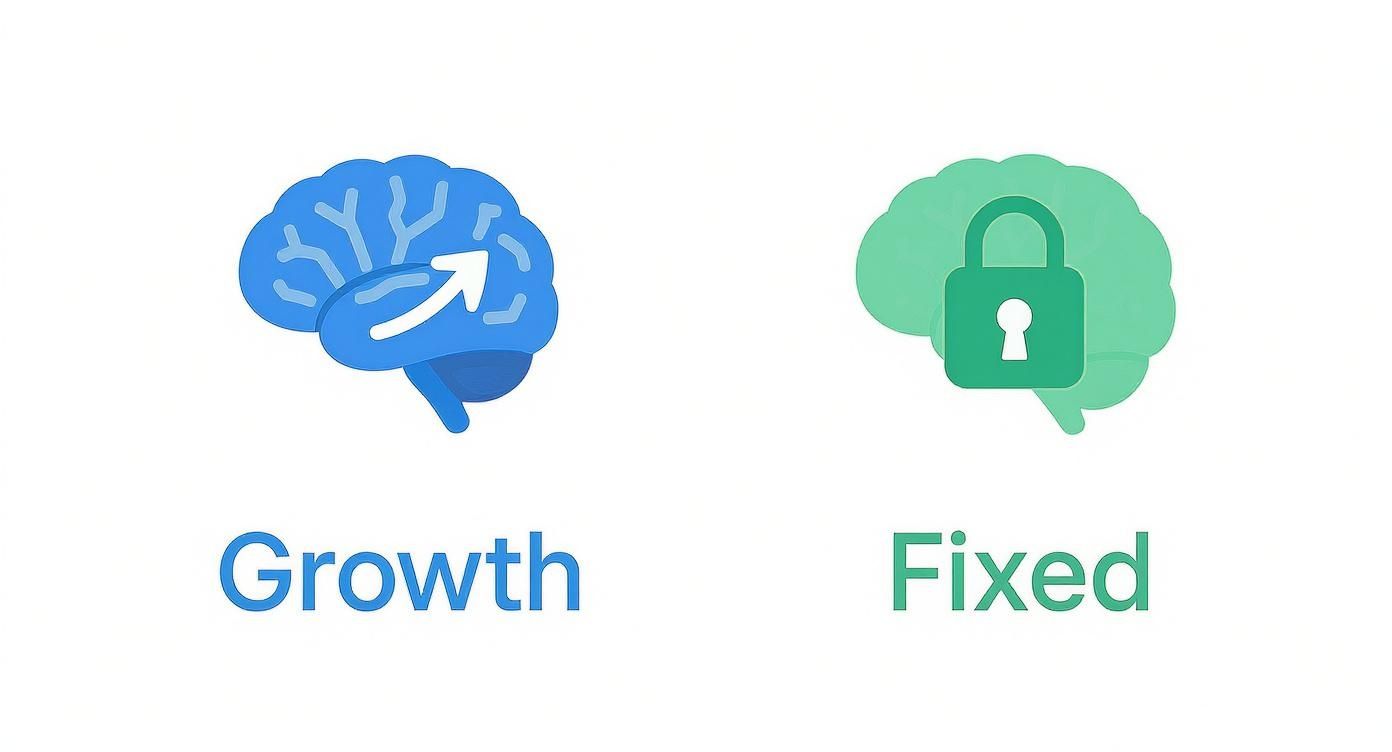
It’s a powerful visual reminder: a growth mindset opens you up to a love of learning and resilience, while a fixed mindset can keep you from ever starting.
To really see these two mindsets in action, it helps to put them side-by-side.
Fixed Mindset vs Growth Mindset: A Quick Comparison
Understanding the core differences in beliefs, actions, and outcomes between a fixed and a growth mindset.
| Characteristic | Fixed Mindset Belief | Growth Mindset Belief |
|---|---|---|
| Abilities & Intelligence | They are innate and unchangeable. You're either good at something or you're not. | They can be developed through dedication, effort, and learning. |
| Challenges | Avoid them to prevent failure and protect self-image. | Embrace them as opportunities to learn and grow. |
| Effort | It's a sign of weakness. If you were smart, you wouldn't need to try. | It's the path to mastery. Effort is what builds ability. |
| Feedback | Take it personally and get defensive. Criticism feels like an attack. | See it as a valuable source of information for improvement. |
| Setbacks & Failure | They define you. They're a sign you don't have what it takes. | They are lessons. They provide a chance to learn and try a new approach. |
| Success of Others | It feels threatening and inspires jealousy. | It's inspiring and provides lessons for your own success. |
This table shows just how deeply your mindset can influence everything from how you see your own potential to how you react to the world around you.
Real-World Proof: The Impact on Success
This isn't just a theory—it's been proven time and again in major studies. The link between a growth mindset and real-world achievement is clear, powerful, and honestly, pretty inspiring.
Take a landmark study by the OECD, which surveyed nearly 600,000 students across 78 countries. The results were staggering. Students with a growth mindset scored significantly higher than their peers with a fixed mindset.
Just how much higher?
- 31.5 points higher in reading
- 27 points higher in science
- 23 points higher in mathematics
In the United States, the gap was even wider, with growth-minded students showing an incredible 60-point advantage in reading. You can dive into the details in the full study on student well-being.
This research powerfully demonstrates that mindset is a critical predictor of academic success, often more so than socioeconomic background. It proves that believing in your capacity to grow directly translates to better outcomes.
These numbers are more than just data points; they represent thousands of students unlocking their potential. They show us that when people believe they can improve, they put in the work that creates real, measurable growth.
This scientific backing gives us the confidence to know that learning how to develop a growth mindset is one of the most impactful journeys we can take.
Practical Habits to Build Your Growth Mindset
Knowing the theory is a great start, but putting it into practice is where the real transformation begins. Developing a growth mindset isn't a one-time decision; it's built from the small, consistent actions you take every single day. This is your toolkit—a collection of simple, powerful habits designed to rewire your brain for resilience and growth.
Let's get practical. These daily exercises are the building blocks for creating lasting change, helping you construct a more expansive and optimistic perspective. Think of it as your personal training plan for your mind.

Embrace the Power of Yet
One of the simplest and most profound tools in your mindset toolkit is a tiny, three-letter word: yet. The next time you catch yourself thinking, "I can't do this," or "I'm not good at this," just tack "yet" onto the end.
This small shift reframes everything. "I can't do this" feels final and defeating. But "I can't do this yet" holds a promise of future potential. It turns what feels like a failure into a single point on your learning journey.
"The word 'yet' signals that you are on a learning journey. It acknowledges a current limitation without accepting it as a permanent state, creating space for growth and future success."
Imagine you’re learning a new language and feeling completely stuck on grammar rules. The fixed mindset says, "I'll never get this." The growth mindset, armed with "yet," gently corrects that to, "I haven't mastered this... yet." This subtle change keeps you in the game, motivated to find a solution instead of giving up.
Turn Your Inner Critic Into an Inner Coach
We all have that voice in our heads that chimes in when things go wrong. For most of us, it sounds like a harsh critic, quick to point out every flaw. A key habit for a growth mindset is to consciously transform that critic into a supportive inner coach.
Instead of beating yourself up over a mistake, try asking gentle, coaching questions:
- What's the lesson here for me?
- What could I do differently next time?
- What part of this actually went well, and what part needs a new approach?
This isn’t about ignoring your mistakes—it’s about mining them for wisdom. Your inner coach is curious, not judgmental. It focuses on the process and the path forward, which is essential for building the resilience to keep trying.
Actively Seek Out Challenges
Comfort zones feel nice and safe, but they are where our growth comes to a halt. To really cultivate a growth mindset, you have to get comfortable with being a beginner again. This doesn't mean taking huge, terrifying risks every day. It's about consistently choosing the path that stretches you, even just a little.
Here are a few small ways to step outside your comfort zone:
- At work: Offer to help with a project that involves a skill you want to develop.
- In your hobbies: Try a more complex recipe or a challenging workout you've been avoiding.
- Socially: Strike up a conversation with someone new at a gathering.
The goal is to normalize the feeling of being challenged. Every time you try something new, you reinforce the belief that your abilities can expand. You prove to yourself that you are capable of learning and adapting.
Start a Growth-Focused Journal
Writing down your journey is an incredibly powerful way to make your new mindset stick. A journal gives you a dedicated space to reflect, notice unhelpful thought patterns, and actually see your progress over time.
This isn't just about recording what happened; it's about processing your experiences through a growth-oriented lens. If you're new to this, our guide on how to start journaling offers simple, actionable steps to turn it into a rewarding habit.
Once you feel comfortable, you can use specific prompts to guide your reflections:
- Describe a challenge you faced today. How did you handle it? What did you learn, win or lose?
- What feedback did you receive recently? How can you put it to good use?
- When did you feel stretched or uncomfortable today? What did that feeling teach you?
This practice makes your mental shifts tangible. Looking back through your entries after a few weeks will be incredibly motivating—you'll have concrete proof of how much your perspective has evolved. For parents hoping to foster this outlook in their kids, this guide on how to build a growth mindset in children is an excellent resource.
Building these habits is a process. It takes time and conscious effort, but it all comes down to making small, deliberate choices every day. Be patient with yourself, celebrate the little wins, and remember that every step forward is progress on your journey.
Navigating Setbacks and Common Pitfalls
The path to a growth mindset is an incredibly rewarding one, but it’s rarely a straight line. Just like any journey worth taking, you can expect a few bumps and detours along the way.
You’ll have moments of self-doubt. You'll feel the sting of setbacks. You’ll definitely experience the discomfort that comes with stepping into the unknown. But this isn't a sign you’re failing—it's proof that you're stretching, learning, and growing.
Think of these challenges as the resistance that builds your mental muscle. The first real step is simply recognizing them for what they are: a normal and necessary part of the process. This section is here to help you stay resilient when the path gets a little steep.
Reframe Your Fear of Failure
One of the biggest hurdles for so many of us is the fear of failure. Our brains are hardwired to avoid pain, and messing up can feel like a direct hit to our self-worth. In a fixed mindset, failure feels like a final verdict on your abilities. But with a growth mindset, it’s just data.
When that familiar anxiety starts to creep in, try to reframe it. Instead of seeing it as a warning sign to stop, see it as a signal that you're about to learn something important. That feeling of unease is often just the sensation of your comfort zone expanding.
This isn’t just a feel-good trick; it has real psychological benefits. An OECD study across 74 nations found that students with fixed mindsets had a greater fear of failure, which is a known risk factor for poor mental health. By learning to see challenges differently, you’re not just improving your skills—you're building a stronger, more resilient foundation for your well-being. You can explore the full research on mindset and well-being to see just how deep the connection goes.
When you reframe failure, you take away its power. It’s no longer an indictment of your worth but simply a stepping stone on your path to mastery.
Troubleshoot Your Inner Critic
We all have that little voice that gets loudest right when we stumble. It’s the one that whispers, "I knew you couldn't do it," or "You're just not smart enough for this." The key isn’t to silence this voice completely but to change the conversation you’re having with it.
Here are a few practical ways to troubleshoot that negative self-talk:
- Give It a Name: It sounds silly, but personifying your inner critic helps. Naming it something like "Nervous Neville" or "Captain Catastrophe" creates a bit of distance and helps you see its commentary as separate from your true self.
- Ask for Evidence: When your critic insists you're a failure, gently challenge it. Ask, "Where's the proof? Is there a more balanced way to look at this situation?"
- Practice Self-Compassion: Treat yourself with the same kindness you would offer a friend who just made a mistake. It’s okay to acknowledge the disappointment without letting it define you.
What to Do When You Feel Stuck
It’s completely normal to hit a plateau or feel like you’re just not making progress. This is often where people get discouraged and slip back into old thinking patterns. But when you feel stuck, it’s a sign to get curious, not critical.
Here’s your action plan for breaking through a plateau:
- Analyze the Process: Instead of focusing on the outcome that disappointed you, break down your process. Which specific part of your strategy isn't working as well as it could?
- Seek Different Feedback: If your current approach isn’t getting you anywhere, you might need a fresh perspective. Ask a mentor, a colleague, or a trusted friend for their honest input.
- Learn from Others' Success: Find someone who has overcome a similar challenge. What can you learn from their journey, their methods, and their mindset?
- Take a Strategic Break: Sometimes, the best way forward is to step back for a moment. Give your brain time to rest and process. A walk, a good night's sleep, or even just switching to a different task can often lead to that "aha!" breakthrough.
Remember, every setback is just a setup for a comeback. These pitfalls aren't signs to quit; they are invitations to dig deeper, learn more, and strengthen your resolve. By embracing them, you’re not just learning how to develop a growth mindset—you’re truly living it.
How to Nurture a Growth Mindset in Others
Once you start seeing the world through a growth mindset lens, you can't help but want to share it. It's not just a personal tool—it’s a way of thinking that can uplift everyone around you.
Whether you're a parent, a team leader, a teacher, or a friend, you can become a catalyst for this positive shift. It’s not about giving lectures; it's about shaping conversations and creating an environment where learning is celebrated, effort is honored, and mistakes are seen as stepping stones. This is how your personal practice blossoms into a shared culture of resilience.

Praise the Process, Not Just the Person
One of the most impactful changes you can make is in how you give praise. It’s a small tweak with huge results. We often default to praising talent or intelligence—"You're so smart!" or "You're a natural!"
While the intention is good, this kind of feedback actually reinforces a fixed mindset. It suggests that success comes from a trait you either have or you don't. When a child praised for being "smart" eventually struggles, they might think, "Maybe I'm not so smart after all," and simply give up.
Instead, shift your praise to the process: the effort, the strategies, and the persistence. This is known as process praise.
Here’s how you can reframe common compliments:
- Instead of: "You're a math genius!"
- Try: "I was so impressed with how you stuck with that tricky math problem until you figured it out."
- Instead of: "Wow, you’re an amazing artist!"
- Try: "I love how you used those bright colors. Can you tell me what made you decide to draw it that way?"
This simple change sends a powerful message: what matters most is your effort and your willingness to learn. It celebrates the journey, which is the heart of a growth mindset.
Praising the process—the hard work, the strategies, the focus, the perseverance—is what creates resilient and confident learners. It tells people that their abilities are in their own hands.
Make it Safe to Fail
For a growth mindset to truly take root, people need to feel safe enough to fail. This is all about creating psychological safety—a shared belief that it’s okay to take risks, speak up, or admit you made a mistake without being punished or humiliated.
When people are afraid of failing, they play it safe. They avoid challenges and hide their errors, which are classic signs of a fixed mindset.
Here are a few ways to build psychological safety:
- Model Vulnerability: Be the first to admit when you don't know something. Saying, "I messed that up, but here's what I learned," gives everyone else permission to do the same.
- Frame Work as Learning: Position new projects as learning opportunities, not just performance tests. This shifts the focus from "getting it right" to "seeing what we can discover."
- Welcome All Questions: Create an atmosphere of genuine curiosity. When someone asks a question, thank them for it. Make it clear that questioning and exploring are valued.
This kind of environment doesn’t just foster a growth mindset; it can also be a powerful force for good. In fact, new research highlights how a growth mindset can help close educational gaps tied to socioeconomic status. An analysis covering 73 countries found that a growth mindset was linked to better academic performance across the board. The study suggests that supportive, growth-oriented environments can help lessen the effects of disadvantage. You can read the full research on growth mindset and educational equity to learn more.
Share Stories of Struggle and Growth
Finally, make it a point to normalize the messy reality of success. We're surrounded by highlight reels—the polished final products that make achievement look effortless.
Counter that narrative by sharing stories of struggle. Talk about the challenges you've personally faced, the mistakes you've made, and the persistence it took to move forward. Share stories of famous people who failed again and again before they succeeded.
This simple act of storytelling helps reframe failure for what it is: not a sign of weakness, but an essential part of any meaningful journey. When you show others that even the most successful people face setbacks, you give them a more realistic and empowering roadmap for themselves.
Your Questions About Growth Mindset, Answered
As you start this incredible journey of learning how to cultivate a growth mindset, it's totally normal for questions to pop up. Let’s be honest—this path is about rewiring beliefs we’ve held for years, which can feel a little tricky at times. Getting clear, straightforward answers is the best way to move forward with confidence.
Here, we’ll dive into some of the most common questions people ask. Think of this as your practical guide to navigating the nuances of this powerful perspective, ensuring you feel supported every step of the way.
How Long Does It Take to Develop a Growth Mindset?
This is one of the first questions on everyone's mind, and the truest answer is that it's an ongoing journey, not a destination with a finish line. You're building new neural pathways in your brain, and just like building muscle at the gym, progress is gradual but it all adds up.
You'll likely notice small but meaningful shifts in your thinking within just a few weeks. It might be catching yourself thinking, "I'm terrible at this," and consciously reframing it to, "I haven't mastered this yet." These little wins are the foundation of lasting change.
The goal isn't to achieve a perfect, unshakable growth mindset overnight. Instead, the aim is to continually embrace learning and challenge as a fundamental part of your life.
For these new thought patterns to become your automatic, go-to response, it can take several months or even longer. Consistency is far more important than intensity. A few minutes of mindful reflection each day will do more for you than a single, intense burst of effort once a month.
Can You Have a Mixed Mindset?
Absolutely. In fact, it's incredibly common to have a growth mindset in some areas of your life and a fixed mindset in others. This isn't a sign of failure; it’s just part of being human.
You might feel confident that you can learn new skills and climb the ladder at work, fully embodying a growth mindset in your career. But when it comes to, say, public speaking or painting, you might hear that fixed-mindset voice whisper, "I'm just not a creative person" or "I'm way too shy for that."
The first and most powerful step is to recognize these specific mindset triggers.
- Pay attention to situations where you feel defensive about feedback.
- Notice when you avoid a challenge you know would be good for you.
- Acknowledge when you feel the urge to give up easily after one setback.
These moments are your clues, pointing directly to the areas where a fixed mindset has taken hold. Once you identify them, you can apply the practical strategies from this guide—like using "yet" or reframing your inner dialogue—to those specific situations.
Is It Possible to Lose a Growth Mindset?
Yes, a growth mindset is a practice that requires care and attention. It's not a permanent state you achieve and then have forever. Life happens, and its pressures can sometimes cause us to slip back into old habits.
Stress, big setbacks, or even just getting thrown off your routine can trigger a return to fixed-mindset thinking. This is completely normal and expected. The most important thing is how you respond: with self-awareness and compassion, not judgment.
When you notice yourself slipping, take a moment to acknowledge it without beating yourself up. Gently guide your thoughts back to a growth perspective. You can do this by:
- Reminding yourself of past challenges you successfully overcame.
- Reaffirming your belief in your capacity to learn and adapt.
- Flipping through your journal to see just how far you've already come.
Consistent practice with tools like mindfulness and daily reflection helps strengthen your growth mindset, making it more resilient and your natural way of thinking over time.
At Mesmos, we believe in the power of small, daily practices to create a more beautiful and significant life. Our thoughtfully designed planners and journals are the perfect companions for your growth mindset journey, giving you a dedicated space to reflect, learn, and grow. Explore our collection at https://mesmos.co and find the perfect tool to support your transformation.


