

Learning how to journal for anxiety is your first step toward creating a safe, judgment-free space to untangle your thoughts. It’s a powerful, active way to slow down that racing mind and bring beautiful order to the chaos, simply by putting your feelings onto paper.
This simple act can help you gain clarity, challenge those negative thought loops, and reclaim your sense of control.
Your Path to a Calmer Mind Starts Here
Anxiety can feel like a relentless storm inside your head, a constant hum of worry that leaves you feeling utterly overwhelmed. If this sounds familiar, you are so far from alone.
Anxiety disorders are the most common mental health challenge in the world, affecting a staggering 301 million people as of 2019, according to the World Health Organization. These aren't just statistics; they represent a shared human experience.
But here is the empowering truth: you have a powerful anchor right inside you, and something as simple as a pen and paper can help you find it. Journaling is more than just writing things down; it’s the conscious act of moving that mental clutter outside of yourself, giving you the space you need to breathe, reflect, and heal. Think of it as your personal sanctuary, a place where you can meet your thoughts with curiosity instead of fear.

Why This Simple Practice Is a Game-Changer
When you write down your worries, you are transforming them from abstract, looping fears into concrete, manageable words on a page. This process forces your brain to slow down and organize thoughts that feel jumbled and chaotic. Instead of letting them spin, you’re actively engaging with what you’re feeling—and that’s the first step toward reclaiming your peace.
This practice isn't about finding the perfect words. It's about raw honesty and radical release.
Journaling provides a tangible space to confront your anxious thoughts without judgment. It transforms the overwhelming noise in your head into organized words you can see, process, and ultimately, reframe.
This simple shift from thinking to writing can dial down the intensity of your emotions and help you pinpoint the triggers behind your anxiety. You're not just venting; you're becoming an observer of your own mind. That's where your power lies.
Core Principles for Your Most Effective Practice
Let’s build a journaling practice that actually works for anxiety. Think of these less as strict rules and more as friendly guides to help you create a habit that feels supportive, inspiring, and truly yours.
Journaling is one of many incredible ways to manage stress and anxiety, offering a practical path to a calmer you.
Your Action Plan: The goal is to build a personal ritual you can count on. Use this table as your launchpad.
| Core Principles of Anxiety Journaling | | :--- | :--- | :--- | | Principle | Why It Works | How to Start Today | | Consistency Over Intensity | Building a regular habit creates a reliable outlet for stress before it builds up. | Commit to just 5 minutes a day. Pair it with a habit you already have, like your morning coffee. | | Honest Expression | Uncensored writing allows you to access and process your true feelings without the pressure of perfection. | Let go and write whatever comes to mind without editing. This is for your eyes only. | | Curiosity, Not Judgment | Approaching your thoughts with curiosity helps you understand their message instead of getting lost in self-criticism. | Ask gentle questions like, "What is this feeling trying to tell me?" instead of "Why do I feel this way?" | | Actionable Reflection | Rereading your entries helps you spot patterns and identify small, empowering steps to soothe your worries. | After writing, identify one small action you can take to feel 1% better right now. |
By keeping these ideas in mind, you can turn a blank page into one of your most powerful tools for finding peace.
The Science of Writing for a Quieter Mind
Have you ever scribbled down a frantic list of worries and felt an immediate wave of relief? That feeling isn't just your imagination—it's your brain responding to the powerful, science-backed act of putting thoughts on paper.
Journaling for anxiety isn't just a comforting ritual. It's a practice grounded in neuroscience that actually changes how your brain processes stress and emotion.
When you feel anxious, your amygdala, the brain's alarm system, is often in overdrive. This triggers the fight-or-flight response, making it hard to think clearly. But the simple act of writing engages a different, more logical part of your brain, and that's where the magic happens.

Engaging Your Brain’s CEO
Think of your prefrontal cortex as the calm, rational CEO of your brain. Located right behind your forehead, it's responsible for problem-solving, emotional regulation, and logical thinking.
When you journal, you activate this powerful part of your brain. By translating jumbled, emotional worries into structured language, you shift control away from the panicked amygdala and hand the reins back to your prefrontal cortex. This is why you feel a sense of clarity and control after just a few minutes of writing.
Your Action Plan: You're not just venting; you're actively helping your brain regulate itself.
By naming your feelings on paper—a practice known as "affect labeling"—you can actually reduce their intensity. Studies in neuroscience show that this simple act can calm the amygdala's response. It’s like turning down the volume on your brain's alarm system.
This process gives you the power to observe your thoughts from a distance instead of being trapped inside them. You can explore the many other benefits of journaling for mental health to see how this practice supports your overall well-being.
The Power of Expressive Writing
The practice of writing about your deepest thoughts and feelings is known as expressive writing. Pioneered by researcher James W. Pennebaker, it’s about confronting the emotions tied to stressful events without a filter.
The results are astounding. Research shows that consistent expressive writing can reduce intrusive thoughts, improve working memory, and even lead to fewer stress-related doctor visits. Your journal becomes a private lab where you can explore your anxieties and experiment with new perspectives.
The evidence is compelling. Studies consistently show that adults who journal for just 15-20 minutes a day can see a significant reduction in their anxiety levels. Expressive writing is so effective it has been adapted into clinical practices like Written Exposure Therapy to help individuals process trauma and PTSD.
This scientific backing confirms what so many have felt intuitively: your journal is an evidence-based tool for building resilience and cultivating a quieter mind.
Creating Your Personal Journaling Practice
Getting started is often the hardest part, but it doesn't have to be. The secret is to think of it less like a chore and more like a comforting ritual—a quiet moment that’s just for you. This is your roadmap to building a practice that feels supportive and sustainable.
The best part? There are no rules. A five-minute brain dump before bed or a thoughtful session with your morning coffee—the only goal is to create a habit that truly serves you.
Choosing Your Sacred Tools
This is the fun part—picking your tools! While any notebook and pen will do, choosing materials you genuinely love makes the experience feel more inviting and special.
What inspires you? Perhaps it's a smooth, gliding pen, or a beautifully designed notebook from a brand like Mesmos that makes you excited to open it each day. Your tools are the gateway to your practice, so pick things that make you feel calm and creative.
Your Action Plan: Here are a few ideas to get you started.
- The Classic Notebook: A simple lined or unlined notebook is a blank canvas, offering total freedom for your thoughts and doodles.
- Guided Journals: If a blank page feels intimidating, a guided journal with prompts can be the perfect entry point for themes like gratitude or anxiety relief.
- Digital Apps: For those who prefer to type, journaling apps offer convenience, privacy, and features like password protection and daily reminders.
Ultimately, the best tool is the one you’ll actually use. Experiment and see what feels most natural.
Finding Your Peaceful Space and Time
Your environment sets the tone. You don’t need a dedicated room—just a quiet corner where you feel safe and comfortable. This could be a cozy chair, your bedside table, or even your car on your lunch break.
Once you have your spot, think about when you can realistically carve out a few minutes. Remember, consistency is more important than duration. Starting with just five minutes a day is a powerful way to build momentum.
The most effective journaling practice is one that fits seamlessly into your existing routine. This is a concept known as 'habit stacking'—pairing a new habit with one you already do automatically.
Your Action Plan: Try journaling for five minutes right after pouring your morning coffee or just after brushing your teeth at night. This simple trick makes it a natural part of your day.
Exploring Different Journaling Methods
So, you have your tools and your time. Now what? There are tons of ways to journal for anxiety, and part of the fun is discovering which ones resonate with you.
There’s no right or wrong way to do it. For a closer look at different techniques, you might love our guide on how to journal effectively.
Your Action Plan: Try one of these popular methods today.
- Stream-of-Consciousness (The "Brain Dump"): Set a timer for 5-10 minutes and write nonstop. Don’t edit, don’t judge, just let whatever is in your head flow onto the page. This is incredible for clearing mental clutter.
- Structured Prompts: If you need more direction, prompts are a game-changer. These targeted questions guide your writing. Start with, "What is one thing I can control in this situation?" or "What would my wisest self tell me right now?"
- Gratitude Logging: Anxiety loves to focus on what might go wrong. A gratitude log trains your brain to notice what’s going right. At the end of the day, jot down three things you're grateful for. Research from positive psychology shows this simple practice can significantly boost your well-being.
Think of your journaling practice as a living thing. It will and should evolve as your needs change. Give yourself permission to experiment and find the methods that bring you the most peace.
Journaling Prompts That Calm Anxious Thoughts
Staring at a blank page when your mind is racing can feel overwhelming. But what if that page wasn't an obstacle, but a gentle guide?
The right prompt acts as a key, unlocking jumbled thoughts and giving you a clear, calming place to start. It's about using focused questions to turn chaotic anxiety into organized reflection.
Think of these prompts as your personal toolkit, designed to meet you exactly where you are.
Prompts to Untangle the Worry Knot
Anxiety often feels like a tangled knot of "what-ifs." These prompts help you gently pull on the threads, allowing you to examine your fears with curiosity rather than panic.
-
Prompt: If my anxiety had a shape and color, what would it look like? Describe it.
- How it helps: This creative exercise distances you from the feeling, letting you observe it as a separate entity instead of being consumed by it.
-
Prompt: What is the story my anxiety is telling me right now? Is this story 100% true?
- How it helps: This helps you challenge anxious thoughts—a core principle of Cognitive Behavioral Therapy (CBT). You question the narrative instead of accepting it as fact.
-
Prompt: Write a letter to your anxiety. What do you want to say to it?
- How it helps: Personifying your anxiety lets you express frustration, set boundaries, or even ask what it’s trying to protect you from.
Here's what that might look like: "My anxiety is telling me that if I mess up this presentation, my boss will think I'm incompetent. Is that 100% true? Probably not. I've given good presentations before. The story is a catastrophe, but the reality is likely much milder."
This simple shift moves you from a place of fear to a place of empowerment.
Before you decide on the perfect notebook, this decision tree can help you choose the best format for your personal journaling practice.
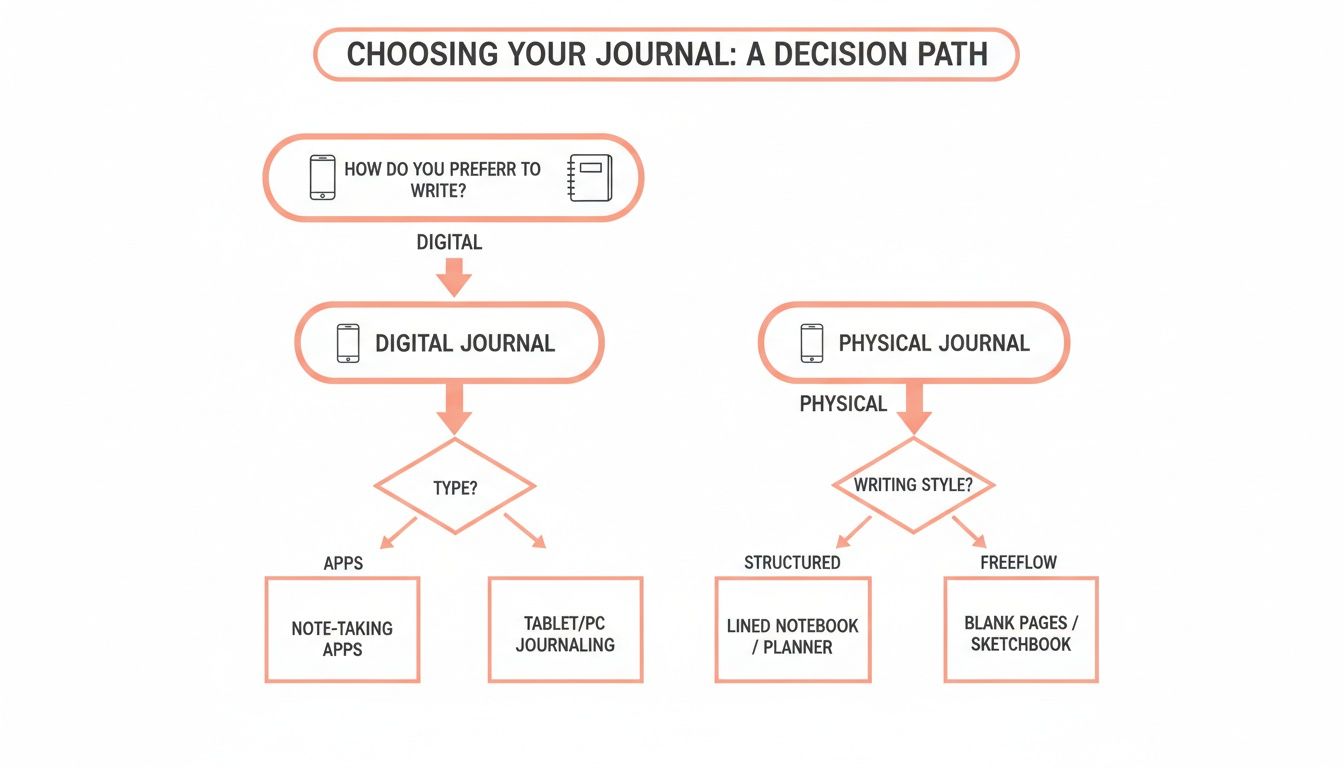
The key takeaway? The best tool is the one that fits seamlessly into your life.
Prompts to Cultivate Self-Compassion
Anxiety is often fueled by a harsh inner critic. Self-compassion is the perfect antidote. These prompts help you treat yourself with the same kindness you would offer a dear friend.
-
Prompt: What is one kind, gentle thing I can say to myself right now?
- How it helps: This simple question interrupts the cycle of negative self-talk and introduces a moment of genuine care.
-
Prompt: Think of a time you felt proud of how you handled a difficult situation. What strengths did you show?
- How it helps: It shifts your focus from perceived failures to proven resilience, reminding you of your own inner strength.
-
Prompt: If a friend came to you with this exact worry, what compassionate advice would you give them?
- How it helps: This is a powerful way to tap into your own wisdom. We are often kinder to others than ourselves, and this prompt helps bridge that gap.
Practicing self-compassion isn't about ignoring your flaws; it’s about acknowledging your humanity.
Prompts to Anchor in the Present and Future
Anxiety loves to pull you into past regrets or future fears. These prompts ground you in the present moment or guide you toward a more hopeful vision.
To help you find what works best for you, here’s a quick comparison of a few different journaling techniques.
Journaling Techniques for Anxiety Relief
This quick guide compares a few methods to help you find the best fit for your needs right now.
| Technique | Best For | How to Do It |
|---|---|---|
| Worry Exploration | Untangling specific fears and challenging negative thought patterns. | Use prompts to question the reality of your worries and explore where they come from. |
| Gratitude Logging | Shifting focus from anxiety and training your brain to notice the positive. | Each day, list 3-5 specific things you are grateful for, focusing on the feeling. |
| Future Self Journaling | Building hope and creating a positive vision to work toward. | Write from the perspective of your future self who has overcome the anxieties you're facing now. |
Choosing the right technique depends on what you need in the moment.
-
Prompt (Present Moment): Name five things you can see, four you can feel, three you can hear, two you can smell, and one you can taste.
- How it helps: This is the 5-4-3-2-1 grounding technique. It pulls your attention out of your racing mind and into your physical senses, immediately anchoring you in the present.
-
Prompt (Positive Future): Describe in vivid detail a future day where you feel calm and at peace. What are you doing? Who are you with? How does it feel in your body?
- How it helps: This visualization exercise creates a positive emotional blueprint that can counteract feelings of hopelessness.
These prompts are just a starting point. Feel free to adapt them and return to the ones that resonate most.
Overcoming Common Journaling Hurdles
Your journaling journey is deeply personal. And just like any meaningful path, it’s normal to hit a few roadblocks. Some days, the words will pour out. On others, you might feel stuck or shaken by what comes up.
This isn’t a sign that you’re doing it wrong; it’s a sign you’re doing the real work. These moments are opportunities to be kind to yourself and gently change your approach.
When the Blank Page Feels Intimidating
We’ve all been there. You open your journal, and your mind goes blank. This is writer’s block, and it can feel paralyzing. But here’s the secret: your journal has zero expectations. Its only job is to be there for you.
Your Action Plan: When words feel out of reach, get creative.
- Try Visual Journaling: You don't need to be an artist! Doodle, sketch, or use colors to represent your emotions. This can be a powerful way to process them without a single word.
- Use an Audio Diary: Grab your phone and hit record. Speaking your thoughts out loud can feel more natural and less filtered than writing.
- Start with a Single Word: Write down one word that captures how you feel. Then another. Let it become a simple, pressure-free game of word association.
The real goal is just to show up for yourself. The simple act of opening your journal is a win.
Navigating Difficult Emotions
Journaling can sometimes bring up intense feelings. This is a sign that it’s working—it’s helping you connect with emotions that need healing. That said, it’s important to have a plan so you don't feel overwhelmed.
Setting boundaries with your journaling practice is a powerful form of self-care.
Give yourself permission to pause. If an entry feels too intense, it’s okay to close the notebook. End your session by writing down one small, comforting thing you can do right now, like making a cup of tea or doing a quick stretch.
This simple act reminds your nervous system that you are safe and in control.
Deepening Your Practice Over Time
As you grow, your journaling practice will evolve. What starts as a space to release anxiety can become a tool for actively reframing your thoughts and celebrating how far you’ve come. This is where you shift from coping to thriving.
This journey is more important than ever. Globally, the number of women experiencing anxiety is rising, with a significant impact on well-being. You can discover more about these important mental health trends and their global impact00454-9/fulltext).
Your Action Plan: As you get more comfortable, try these techniques to take your practice to the next level.
- Challenge and Reframe: After writing down a worry, go back and gently challenge it. Write a more compassionate or realistic alternative.
- Celebrate Your Progress: Dedicate entries to acknowledging your wins, no matter how small. Note the moments you felt calm or handled a situation with courage.
- Future Self Journaling: Write a letter to yourself from your future self—the one who is calm and resilient. What wisdom would they offer you right now?
By embracing these hurdles with kindness, you ensure your journal becomes a lifelong companion—a testament to your resilience and a beacon guiding you toward inner peace.
A Few Common Questions About Journaling for Anxiety
Starting a powerful new practice like this naturally comes with questions. Think of this section as a friendly guide to help you feel confident and inspired as you get started.
How Quickly Will I See Results?
While some people feel immediate relief just from getting their thoughts out, the most profound benefits build over time. It’s less about a single magic moment and more about creating a steady, reliable habit.
Many people feel a real difference within a few weeks of consistent journaling, often by setting aside 15-20 minutes a few times a week. The real win is focusing on the process. Creating that consistent space for yourself is a deeply healing act.
What If Journaling Makes My Anxiety Worse at First?
This is surprisingly common, so please know it’s not a sign you’re doing anything wrong! When you first start digging into difficult feelings, it can feel like you’re stirring things up.
If this happens, be incredibly gentle with yourself.
It’s not uncommon to feel a temporary spike in anxiety when you first put difficult feelings on paper. This is often a sign you’re accessing emotions that need healing. The key is to move forward with compassion.
Your Action Plan: Try setting a timer for just five minutes. You could also shift to a gratitude prompt or end by writing down one small, calming action you can take right now. If the feeling persists, it might be helpful to chat with a mental health professional.
Is It Better to Handwrite or Type My Journal?
Honestly, the best answer is whichever one works for you.
Research does suggest that the physical act of handwriting can be more effective for processing emotions. The slower pace engages different parts of your brain and can lead to deeper reflection.
However, the best journaling method is always the one you'll stick with. If typing on your computer feels more natural, that is still an incredibly powerful practice. Don't let the idea of a "perfect" method get in the way of a good one.
Ready to find the perfect tools to inspire your journaling practice? Mesmos creates beautifully designed stationery and gifts that turn journaling from a task into a cherished ritual. Discover our collection and start your journey to a calmer mind today at https://mesmos.co.


