

Stress management for educators isn't just another wellness trend—it's your superpower. It's the essential skill that protects your passion, fuels your energy, and empowers you to be the incredible teacher your students deserve.
Mastering it means taking charge of your emotional and mental well-being, so you can build a career that’s not just sustainable, but deeply joyful.
Why Stress Management for Educators Is a Professional Skill

Teaching is a profession of the heart. It demands immense emotional investment, day in and day out. You’re not just delivering lessons; you’re inspiring young minds, navigating complex human dynamics, and adapting to constant change. This deep commitment is what makes the job so rewarding, but it's also what makes it uniquely draining.
Here’s a powerful mindset shift: stop seeing stress management as another item on your overflowing to-do list. Start seeing it as a core professional competency.
Think of it as classroom management for your own inner world—a vital skill to maintain focus, effectiveness, and calm. When you are centered and regulated, your ability to manage your classroom and connect with students skyrockets.
The True Cost of Chronic Stress
The ripple effects of unmanaged stress reach far beyond your own well-being. Chronic stress can erode your patience, cloud your judgment, and drain the creative energy you need to teach with passion. This directly impacts the learning environment you work so hard to create.
The numbers paint a stark picture. According to a 2022 Merrimack College survey, an overwhelming 90% of teachers reported feeling "fairly" or "very" stressed. What drives this? Workload, student behavior, and administrative pressures. The American Psychological Association notes that teacher stress levels are often on par with those of physicians, a field known for high-pressure environments.
This isn't just an individual problem; it's a systemic one with serious consequences, directly linked to teachers leaving the profession.
Taking Proactive Control
The incredible news is that you have the power to change this narrative. Proactively managing your stress isn't a sign of weakness—it's a declaration of strength and a commitment to your longevity in this vital profession. It’s about building a toolkit of practices that help you navigate daily challenges with more grace and resilience.
"Sometimes the most important thing in a whole day is the rest we take between two deep breaths."
This journey is about more than just surviving—it's about thriving. By prioritizing your well-being, you protect your passion for teaching and ensure you can keep making a positive impact for years to come. Understanding how to prevent teacher burnout is the first powerful step toward creating a career that is not only successful but also deeply fulfilling.
Quick Calming Techniques for a Hectic School Day

The bell screams, the hallway explodes, and you have ninety seconds before the next wave of students arrives. In these moments, stress is a tidal wave threatening to pull you under.
You don’t need an hour of yoga. You need powerful, fast-acting tools that work right now, in the slivers of time you get between classes. These micro-practices are your lifeline.
Master Your Breath with Box Breathing
When you feel your pulse quicken and your thoughts race, your breath is your most powerful anchor. This isn't just a cliché; controlled breathing is scientifically proven to activate your parasympathetic nervous system—your body's "rest and digest" mode—countering the "fight or flight" rush.
Action Point: Try Box Breathing
Used by Navy SEALs and surgeons to stay sharp under pressure, this technique is perfect for the moments before a tough conference or after a classroom disruption.
- Inhale slowly through your nose for a count of four.
- Hold your breath for a count of four.
- Exhale slowly through your mouth for a count of four.
- Hold your breath again for another count of four.
Repeat this cycle 3 to 5 times. The predictable rhythm gives your racing mind a single point of focus, slowing your heart rate and bringing you back into control. No one even has to know you’re doing it.
Ground Yourself with the 5-4-3-2-1 Technique
Sometimes stress is a tornado of thoughts, pulling you in a million directions. When you feel overwhelmed, a grounding exercise can pull you right back to the present moment.
Action Point: Use the 5-4-3-2-1 Method
This technique uses your senses to interrupt the cycle of anxious thoughts and root you in the here and now.
Take a slow, deep breath and silently identify:
5 things you can see (your favorite pen, a poster on the wall, the light from the window).
4 things you can feel (the cool surface of your desk, the fabric of your sleeve, your feet on the floor).
3 things you can hear (the hum of the projector, a distant laugh, the ticking of the clock).
2 things you can smell (the scent of old books, your coffee).
1 thing you can taste (a sip of water, the hint of mint from your tea).
This simple practice forces your brain to shift from abstract worries to concrete, immediate sensations. It’s an incredibly effective way to halt a spiral of "what-ifs" and regain your footing in under a minute. For more inspiration, explore these mindfulness activities for teachers.
Your 5-Minute Stress Reset Toolkit
Think of these techniques as your personal emergency kit for staying centered. The key is to practice them when you're calm, so they become second nature when you really need them.
| Technique | Time Needed | Best For | Simple Steps |
|---|---|---|---|
| Box Breathing | 1-2 minutes | Calming a racing heart and anxious thoughts. | Inhale (4), Hold (4), Exhale (4), Hold (4). Repeat. |
| 5-4-3-2-1 Grounding | 2-3 minutes | Regaining focus when your mind is scattered or overwhelmed. | Name 5 things you see, 4 you feel, 3 you hear, 2 you smell, 1 you taste. |
| Mindful Minute | 60 seconds | A quick reset between classes to clear your mind. | Close your eyes and focus solely on the sensation of your breath. |
| Progressive Muscle Relaxation | 3-5 minutes | Releasing physical tension in the body, like tight shoulders. | Tense a muscle group (e.g., fists) for 5 seconds, then release completely. |
Making these quick techniques a part of your day is a powerful act of self-preservation, equipping you with the resilience you need to navigate the beautiful chaos of teaching.
Building Resilience with Daily and Weekly Routines

While in-the-moment techniques are your first line of defense, lasting resilience is a proactive game. It’s about creating small, consistent habits that become your shield, so daily pressures feel less like a tsunami and more like a gentle tide.
This isn’t about cramming more into your packed schedule. It's about weaving powerful, restorative moments into the fabric of your day.
Crafting Your Daily Resilience Rituals
The way you start and end your day can absolutely make or break your ability to handle stress. These brief rituals anchor you in calm, creating a buffer against the chaos of school life.
Action Point: The 5-Minute Morning Win
Before your feet hit the floor, dedicate five minutes to a simple practice. Try focusing on your breath, listening to a short guided meditation on an app like Calm, or just sitting in silence with a cup of tea. This tiny act centers you before the day’s demands rush in.
Action Point: Set a Single Daily Intention
As you’re getting ready, ask yourself, "What's the one feeling I want to bring to my classroom today?" It could be patience, connection, or focus. Write that word on a sticky note and place it on your laptop as a powerful reminder.
Your evening routine is just as crucial. A "digital sunset" is a game-changer.
Decide on a time—say, 8:00 PM—when all work-related devices and notifications get turned off for the night. This non-negotiable boundary is key to preventing the chronic stress that comes from feeling like you're always "on."
Designing Your Weekly Work-Life Systems
Zoom out and look at your week from a bird's-eye view. This is how you stop the dreaded "Sunday Scaries" and prevent work from constantly creeping into your personal time. It’s about working smarter.
The key is to shift from being reactive to being proactive. By batching similar tasks, you conserve precious mental energy and become far more efficient.
Action Point: Try Protected Time Blocking
This system creates non-negotiable blocks for specific tasks, giving you control over your week.
| Day/Time Block | Task Focus | Why It Works |
|---|---|---|
| Monday (3:30-4:30 PM) | Weekly Planning: | Lays out a clear roadmap, cutting down on decision fatigue. |
| Tues/Thurs (Prep Period) | Grading Block: | Stops papers from spilling into your evenings and weekends. |
| Wednesday (After School) | Lesson Planning for Next Week: | Puts you ahead of the curve, freeing up brain space for the weekend. |
| Friday (Last 30 Min) | Desk Reset & To-Do List: | Clears your physical and mental workspace for a fresh start. |
Remember, these routines are about consistency, not perfection. Start small. Pick one new habit—like a five-minute morning meditation—and watch how it creates a powerful ripple effect, building the resilience you need to thrive.
How to Set Boundaries and Systemize Your Workload
One of the heaviest weights educators carry is the feeling that the work is infinite. The lesson plans, the grading, the parent emails—it’s a current that can easily pull you under. This is where stress management shifts from just thinking differently to doing differently.
Let’s be honest: a never-ending workload is a primary driver of burnout. Statistics show that 44% of K–12 teachers often or always feel burnt out. It's a crisis driven by overwhelming workloads and a lack of support. To dive deeper into the data, you can discover more insights about teacher burnout statistics on devlinpeck.com.
So, how do we push back? It starts with drawing clear lines and creating smarter systems.
Mastering the Art of the Gracious "No"
Setting boundaries isn't about being difficult; it's about being sustainable. It's a declaration that to give your best to students, you must protect your own resources. The trick is to be clear, kind, and firm.
Action Point: Practice These Scripts
- When asked to join another committee: "Thank you for thinking of me! My current commitments mean I couldn’t give it the attention it deserves. I'll be cheering you all on!"
- For a parent requesting a non-urgent meeting: "I’m looking forward to connecting. My dedicated conference times are [Days/Times]. Please let me know which slot works best for you."
- For a colleague asking you to take on their work: "I'd normally love to help, but I'm at full capacity meeting my own deadlines. I hope you can find someone else."
Establishing these lines is a cornerstone of a manageable career. For more ideas, check out these practical tips for boundaries and work-life harmony.
Taming Your Workload with Smart Systems
Systems turn chaos into order. Instead of constantly reacting, you can create predictable workflows that save incredible mental energy. The secret? Task batching.
Action Point: Create Your Own Workload System
- Email Power Hour: Pick two times a day (e.g., 8:00 AM and 3:30 PM) to manage emails. Outside those windows, keep your inbox closed. This stops constant interruptions.
- Grading Sprints: Schedule two 90-minute "grading sprints" each week. Put on music, silence your phone, and focus solely on giving great feedback.
- Planning Zone: Block off a few hours on Friday afternoon to plan the core of next week’s lessons. This one action can nearly eliminate the "Sunday Scaries."
Your Weekly Reset for a Calmer Mind
A simple weekly planning session is one of the most powerful tools in your toolkit.
Action Point: The Friday Reset
Before you head home on Friday, take 20 minutes to:
- Brain Dump: Write down every to-do swirling in your head.
- Identify Your "Big 3": What are the three most important things to accomplish next week?
- Map It Out: Schedule your "Big 3" and task blocks into your calendar.
- Schedule Replenishment: Just as importantly, schedule something restorative for yourself—a walk, coffee with a friend, or an hour with a book.
This simple ritual transforms an overwhelming mountain of tasks into a clear, manageable path, letting you walk into Monday feeling prepared, not panicked.
Finding Strength in Peer and School Support Systems
You carry an incredible amount on your shoulders, but you were never meant to carry it alone. The culture of hyper-independence in education can trick you into believing that asking for help is a sign of weakness.
The truth? Leaning on your community is one of the most powerful ways to manage stress. This is about intentionally building systems of support that lift everyone up.
From Venting to Validating Peer Networks
Your colleagues are your greatest resource. They are the only ones who truly get the unique blend of pressures and joys you face. The game-changer is transforming those relationships from casual complaint sessions into constructive support networks.
Action Point: Build a Buddy System
Find one or two colleagues you trust and make a pact to be each other’s sounding board. When one of you is struggling, the other's job is to listen, validate, and then gently nudge the conversation toward action.
Instead of just spiraling on, "I'm so buried in grading," your support buddy might say, "I hear you; that's exhausting. What if we block out our prep period on Thursday to grade together? We can keep each other on track."
Shifting from shared frustration to shared strategy is everything. It turns a moment of stress into a chance to connect and solve a problem, building resilience for both of you.
Advocating for Yourself and Your School
Systemic stress needs systemic solutions. This means learning to advocate for your needs on a school-wide level—not as a complaint, but as a professional recommendation to improve the entire school environment.
Approaching leadership with solutions, not just problems, is far more effective. Frame your ideas around the benefits for student learning and teacher retention.
Action Point: Propose a Solution-Oriented Idea
- "Protected Planning" Time: Suggest a school-wide policy for one meeting-free afternoon a month so teachers can actually plan and grade.
- Peer Mentorship Program: Propose a formal program pairing seasoned teachers with newer educators.
- Wellness Workshops: Ask for professional development days that focus on practical, actionable wellness strategies.
How to Communicate Your Needs Professionally
Advocacy can feel intimidating, but it’s incredibly empowering.
Action Point: Frame the Conversation Collaboratively
- Start with a Shared Goal: "I wanted to talk about ideas for supporting teacher well-being, because I know we all want the most positive learning environment for our students."
- Present the Observation: "I've noticed many of us are struggling to keep up with grading after hours, which I worry could lead to burnout."
- Offer a Concrete Solution: "What if we piloted a 'Grading Buddies' system during a staff meeting to make the process more efficient and collaborative?"
When you take these steps, you become an active architect of a healthier, more supportive school culture. You remind everyone that your well-being isn't a luxury—it's the foundation of great teaching.
Your Action Plan for Lasting Change
Knowing what to do is one thing. Doing it is where the magic happens. This is your roadmap to move from just understanding stress management to living it, one small, intentional step at a time. This is about progress, not perfection.
Your 30-Day Momentum Builder
Let’s break this down into a simple, actionable 30-day plan. Each week has a single focus, letting you master one new habit before adding another.
- Week 1 Focus: Master One Calming Technique. Pick one method, like Box Breathing, and practice it twice a day—even when you aren't stressed. Think of it as building muscle memory.
- Week 2 Focus: Implement a 5-Minute Morning Routine. Add just five minutes of intentional calm before the day’s chaos. Sip your coffee in silence or write down a single intention for your day.
- Week 3 Focus: Set One Meaningful Boundary. Pinpoint one area where your energy is drained. This week, your challenge is to set and hold just one boundary, like enforcing a "no work email after 7 PM" rule.
- Week 4 Focus: Schedule One Hour of Restoration. Look at your calendar now and block out one hour that is purely for you. Protect this time fiercely; it's the fuel that gets you through the week.
The Power of A Supportive Ecosystem
Sustainable change rarely happens in a vacuum. The systems around us matter just as much as our individual efforts.
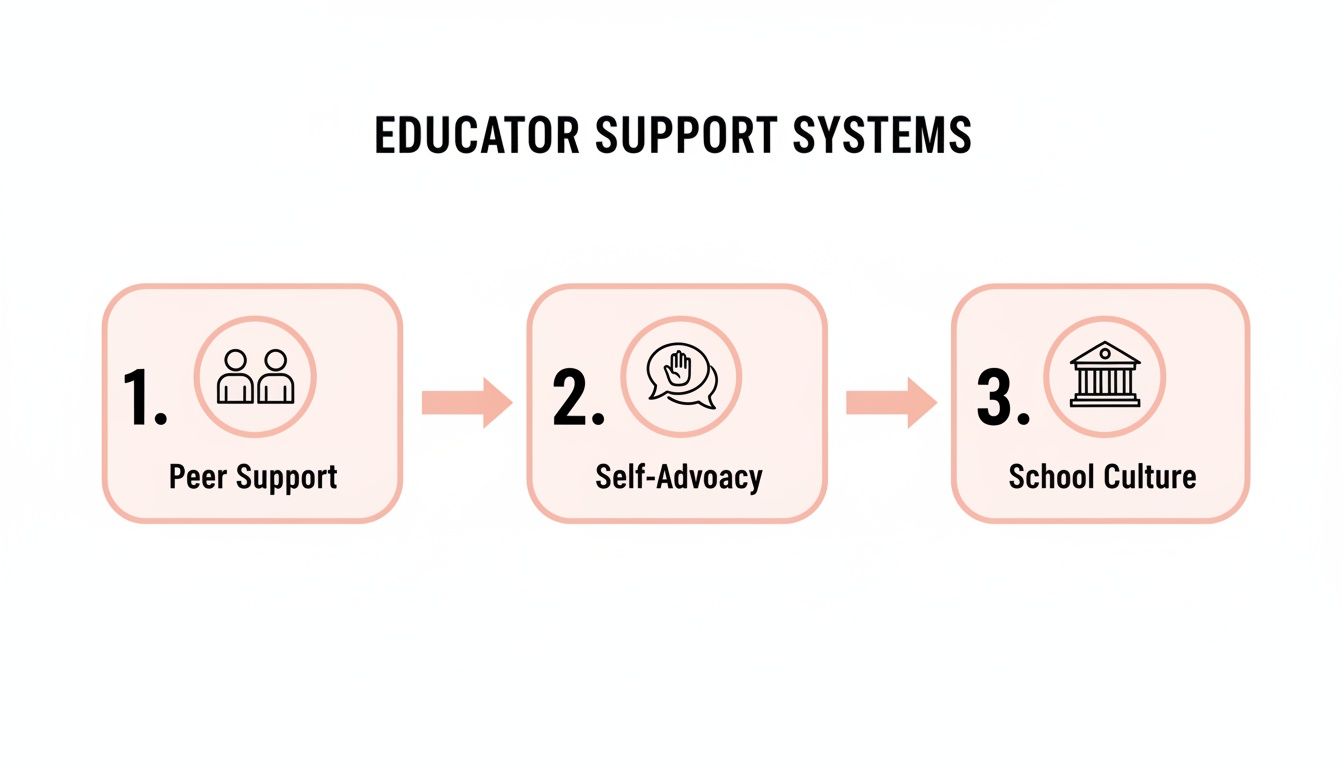
Our own resilience is amplified when we lean on our peers, strengthened when we advocate for ourselves, and sustained by a positive school culture. It all works together.
Making It Stick For The Long Term
True stress management isn’t a destination; it's a practice. It’s a continuous cycle of tuning in, adjusting, and giving yourself grace. Some weeks will be a struggle. That's normal. The key is to just keep coming back to your core practices.
Small, consistent actions, compounded over time, lead to profound results. You are building a more resilient, balanced, and sustainable career with every deep breath you take and every boundary you set.
For extra support, explore a practical, modern guide on how to manage stress.
You have the strategies and a clear plan. Your journey toward a more balanced and joyful teaching career doesn't start "someday"—it starts now, with the very next choice you make. You have the power, you have the tools, and you absolutely deserve the peace that comes from putting your own well-being first.
At Mesmos, we believe in the power of mindfulness to transform daily life. Explore our collection of thoughtfully designed stationery and gifts to support your journey toward inner peace and well-being. Visit us at Mesmos.co to find your inspiration.


