


Anxiety can feel like an relentless storm, clouding your thoughts and stealing your peace. But what if you held the power to find the eye of that storm—not by fighting the winds, but by anchoring yourself firmly in the calm center? This is the transformative power of mindfulness. It isn't about eliminating stress; it's about courageously changing your relationship with it.
This guide is your roadmap to that inner calm. We'll explore 10 powerful, science-backed mindfulness exercises for anxiety, each designed to ground you in the present and gently dissolve the grip of worry. You won't find generic advice here—only specific, actionable techniques with step-by-step instructions you can use immediately, whether you have 30 seconds or 30 minutes.
From the sensory-based 5-4-3-2-1 method that can halt a rising panic to the deep tranquility of a Body Scan Meditation, you are about to build a versatile toolkit for emotional resilience. Think of each exercise as a way to rewire your brain for long-term peace. This is your journey to transforming your inner world, one conscious breath at a time. Let's begin.
1. Body Scan Meditation
The Body Scan Meditation is a foundational practice that rebuilds the powerful connection between your mind and body. Developed by Jon Kabat-Zinn for the renowned Mindfulness-Based Stress Reduction (MBSR) program, it involves systematically guiding your attention to different parts of your body, simply noticing sensations like warmth, tingling, or tension without judgment. This practice anchors you firmly in the present, interrupting the frantic cycle of anxious thoughts.
This technique is so effective that it's a cornerstone of clinical programs used in hospitals and for veteran PTSD support. Studies published in journals like Psychosomatic Medicine confirm its ability to reduce the physiological symptoms of stress. By tuning into your body, you can release stored tension you didn't even know you were carrying—a direct physical manifestation of anxiety.
How to Practice
- Find Your Space: Lie on your back or sit in a supportive chair. Close your eyes if that feels comfortable.
- Settle In: Take a few deep, intentional breaths to arrive in this moment.
- Begin the Scan: Start by bringing your full attention to the toes of your left foot. Notice any sensations without needing to change them.
- Move with Awareness: Slowly move your awareness up your leg, to your torso, arms, and finally to the crown of your head, pausing with gentle curiosity at each part.
- Meet Discomfort with Breath: If you notice pain or discomfort, simply acknowledge it and breathe into the sensation before moving on.
Action Point: Don't strive for relaxation; aim for awareness. Relaxation is often a beautiful byproduct, but forcing it can create more tension.
When to Use It
This is a perfect exercise before bed to release the day's tension and invite restful sleep. It's also incredibly effective during moments of high stress when you feel disconnected from your body. Start with a 10-minute guided session and build your practice from there.
2. Box Breathing (Square Breathing)
Box Breathing, or Square Breathing, is a brilliantly simple yet powerful technique for calming a racing mind and body. This controlled breathing exercise directly influences your autonomic nervous system, activating the parasympathetic "rest and digest" response. By creating a predictable four-part rhythm, you send a clear signal of safety to your brain, powerfully interrupting the fight-or-flight cycle that fuels anxiety.
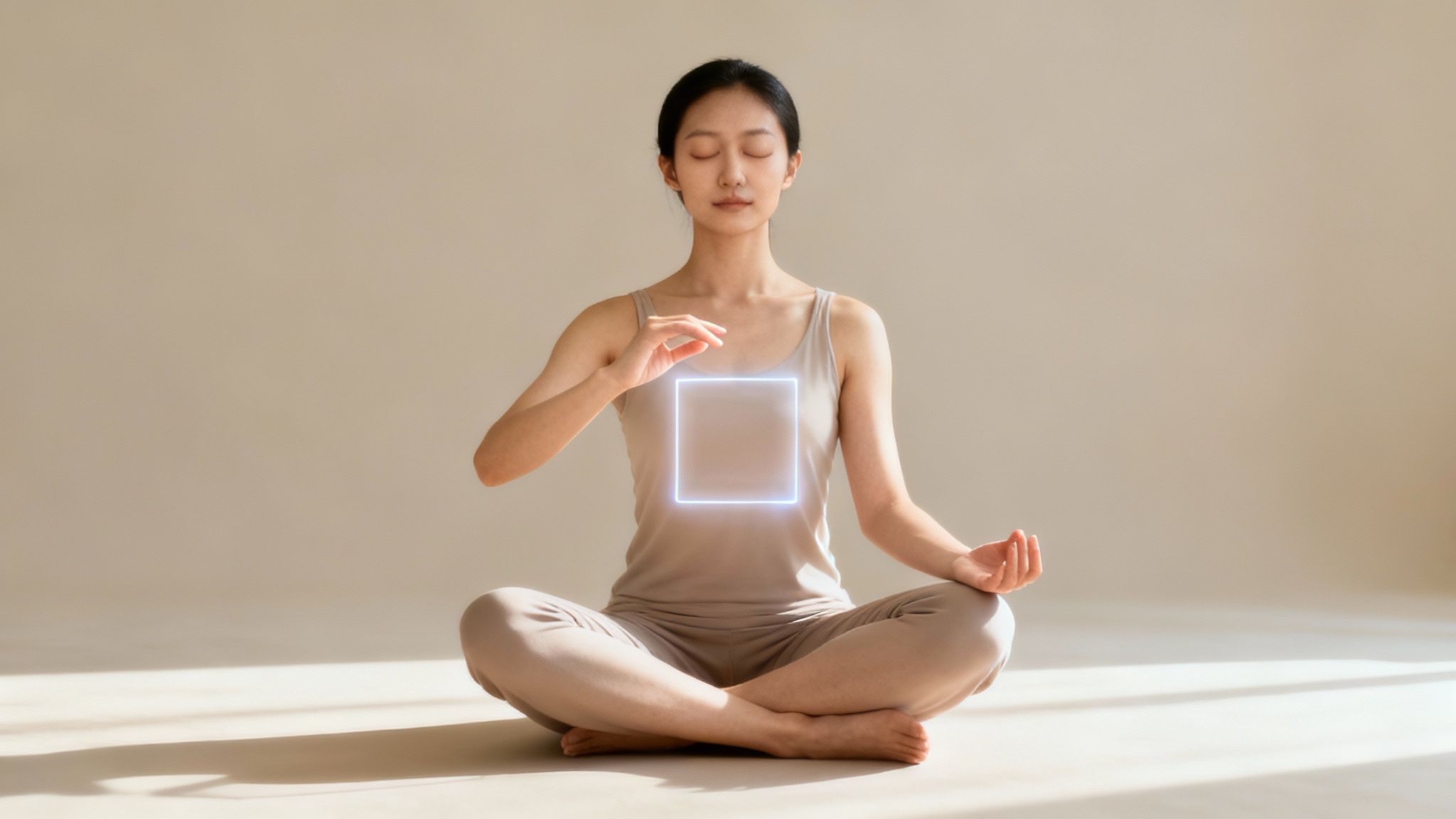
Popularized by U.S. Navy SEALs to maintain composure in high-stakes situations, this method is revered for its immediate physiological impact. Its structured nature gives your mind a clear task, making it one of the most accessible mindfulness exercises for anxiety when thoughts feel overwhelming.
How to Practice
- Get Comfortable: Sit upright with your feet flat on the floor.
- Empty Your Lungs: Gently exhale all the air from your lungs.
- Inhale to Four: Slowly breathe in through your nose for a calm count of four.
- Hold for Four: Gently hold your breath for a count of four.
- Exhale to Four: Slowly exhale through your mouth for a count of four.
- Hold for Four: Hold your breath at the bottom for a count of four before beginning the next cycle.
Action Point: As you breathe, visualize tracing the sides of a square. Each four-second segment is one side of the box—a powerful mental anchor.
When to Use It
Box Breathing is your go-to tool for acute moments of anxiety—before a presentation, during a difficult conversation, or when you feel panic rising. Practicing for just 3-5 minutes can reset your nervous system and restore a sense of control.
3. Mindful Breathing (Breath Awareness)
Mindful Breathing is the heart of mindfulness practice, shifting your focus from overwhelming thoughts to the simple, grounding rhythm of your own breath. Popularized by visionaries like Jon Kabat-Zinn and Thich Nhat Hanh, this practice involves observing your breath's natural flow without trying to change it. By anchoring your attention to the physical sensations of each inhale and exhale, you create a space between you and your anxious feelings, proving they don't have to sweep you away.
This technique is fundamental to clinical anxiety treatments because it’s accessible anywhere, anytime. It trains your brain to disengage from the "what if" scenarios that fuel anxiety and instead root itself in the present moment. This is the superpower of emotional regulation.
How to Practice
- Find Your Posture: Sit upright in a chair or cross-legged on a cushion.
- Settle In: Gently close your eyes and bring your awareness inward.
- Observe Your Breath: Feel the sensation of air entering your nostrils, filling your lungs, and then leaving your body. Simply observe without force.
- Choose Your Anchor: Focus on one specific sensation, like the coolness of air at your nostrils or the gentle rise and fall of your belly.
- Gently Return: Your mind will wander. That's part of the process. When it does, gently and without judgment, guide your focus back to your breath.
Action Point: The real "work" of this practice is the moment you notice your mind has wandered and you gently bring it back. Each return strengthens your mindfulness muscle.
When to Use It
Mindful Breathing is the perfect "go-to" exercise for acute anxiety, like when you're stuck in traffic or waiting for a difficult phone call. A daily 5-10 minute practice builds a foundation of calm that reduces baseline anxiety over time.
4. 5-4-3-2-1 Grounding Technique (Sensory Awareness)
The 5-4-3-2-1 Grounding Technique is an incredibly effective exercise that pulls you out of overwhelming thoughts and anchors you firmly in the present moment. It works by systematically engaging your five senses to notice your immediate environment, short-circuiting the anxious feedback loop in your brain. Research from fields like neuropsychology shows that this sensory shift interrupts panic by redirecting attention from internal distress to external, neutral information.
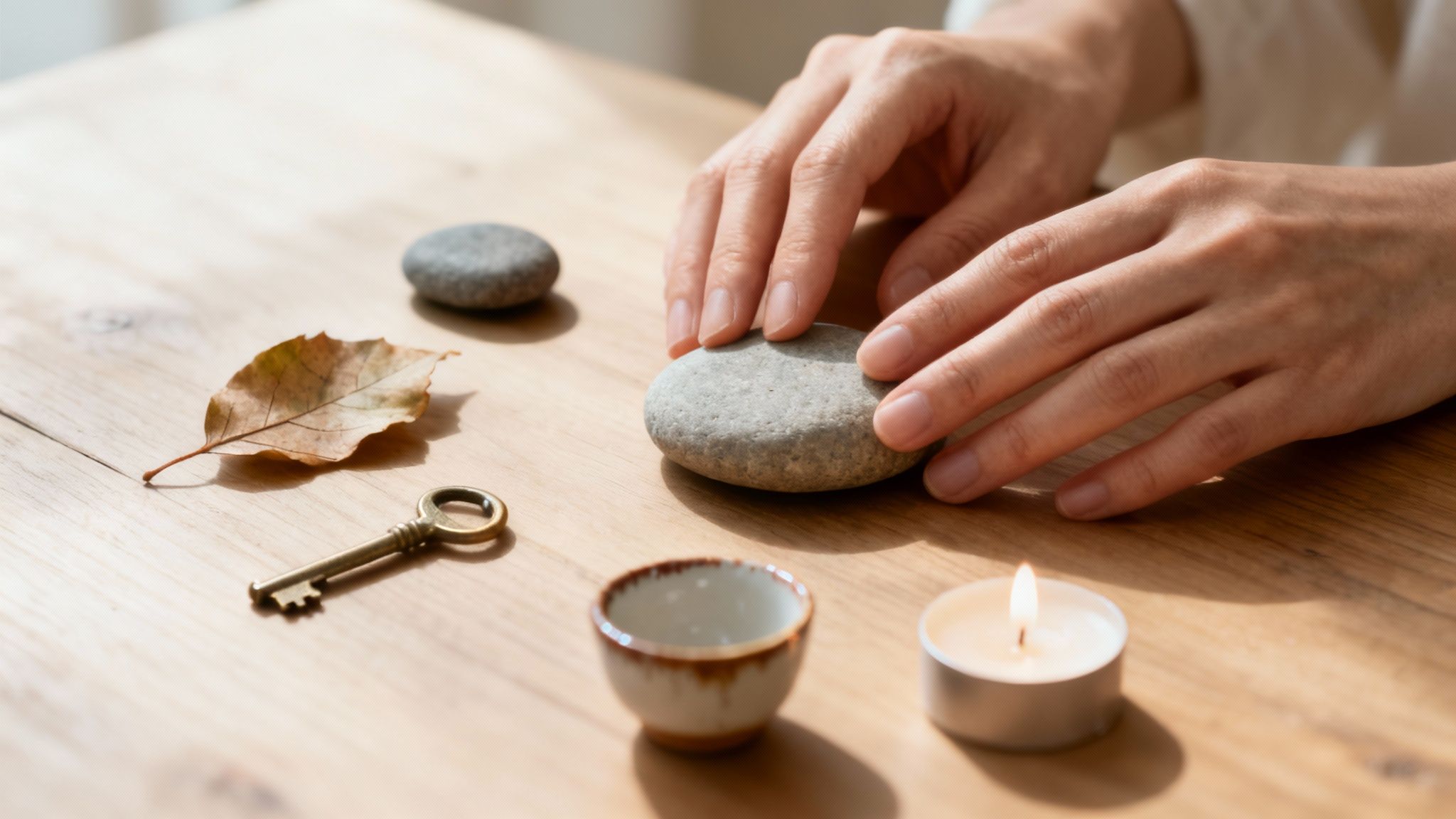
This method is a go-to tool in trauma-informed care because it is simple, discrete, and can be done anywhere. By redirecting your mental resources to observe sensory details, you signal to your nervous system that you are safe right now, which can rapidly de-escalate panic.
How to Practice
- Acknowledge 5 things you can see: Look around and name five distinct objects—a pen, a plant, a spot on the wall.
- Acknowledge 4 things you can feel: Notice the texture of your shirt, the firmness of the chair beneath you, the cool surface of a desk.
- Acknowledge 3 things you can hear: Listen for sounds you might normally ignore—a clock ticking, distant traffic, your own breathing.
- Acknowledge 2 things you can smell: Identify two scents in the air—the coffee on your desk or the soap on your hands.
- Acknowledge 1 thing you can taste: Focus on one taste—leftover toothpaste, a sip of water, or the natural taste in your mouth.
Action Point: Engage each sense deliberately. The goal isn't to rush through the list, but to fully experience each sensory input as an anchor to the present.
When to Use It
This technique is your emergency brake during sudden spikes of anxiety, panic attacks, or when you feel dissociated. It’s a perfect "in-the-moment" tool for high-stress situations at work, in crowded places, or during a difficult conversation.
5. Progressive Muscle Relaxation (PMR)
Progressive Muscle Relaxation (PMR) is a dynamic mindfulness exercise that directly targets the physical symptoms of stress. Developed by physician Edmund Jacobson, PMR involves systematically tensing and then releasing specific muscle groups. This process brilliantly trains you to recognize the subtle difference between tension and relaxation, giving you profound control over your body's stress response.
PMR is a staple in cognitive-behavioral therapy (CBT) because it powerfully interrupts the feedback loop where mental anxiety creates physical tension, which in turn fuels more anxious thoughts. By consciously creating and then releasing physical stress, you teach your body how to let go on a deep level.
How to Practice
- Find a Quiet Space: Sit comfortably or lie down. Loosen any tight clothing and take a few deep breaths.
- Tense and Release: Start with your feet. Tense the muscles tightly for about 5 seconds, focusing on the feeling of strain.
- Feel the Release: Abruptly release the tension and notice the contrasting sensation of release and heaviness for 10-15 seconds.
- Move Up the Body: Systematically repeat this tense-and-release cycle, moving through your legs, abdomen, arms, shoulders, and face.
- Rest in Stillness: Once finished, rest for a few minutes, enjoying the overall feeling of deep physical calm.
Action Point: The magic of PMR is in the contrast. Focus your full attention on the sensation of letting go. Make the release phase the true center of your practice.
When to Use It
PMR is exceptionally effective before sleep to dissolve physical tension and promote a restful night. It's also a fantastic "reset" after a stressful meeting or a difficult day. Committing to a daily 15-minute practice can significantly lower your baseline anxiety.
6. Loving-Kindness Meditation (Metta)
Loving-Kindness Meditation, or Metta, is a heart-centered practice that shifts your focus from worry to compassion. This exercise involves silently repeating phrases of goodwill toward yourself and others. By intentionally cultivating feelings of kindness, you can powerfully counteract the brain's negativity bias, which often fuels self-criticism and anxious thought patterns.
This technique is a core component of Mindfulness-Based Cognitive Therapy (MBCT). Scientific research, including studies using fMRI scans, shows that it activates brain regions associated with positive emotions and empathy, effectively reducing self-criticism and the social anxiety it creates.
How to Practice
- Find Your Seat: Sit comfortably with an upright but relaxed posture. You can close your eyes or soften your gaze.
- Start with Yourself: Silently repeat phrases directed inward, such as: "May I be happy. May I be healthy. May I be safe. May I live with ease."
- Expand Your Circle: Extend these phrases to a loved one, then a neutral person (like a barista), and then someone you find difficult.
- Extend to All: Conclude by offering these wishes to all living beings everywhere.
- Focus on Intention: Gently repeat the phrases, letting the words resonate without forcing any particular emotion.
Action Point: The sincerity of your intention matters more than feeling a sudden wave of emotion. If your mind wanders, just gently guide it back to the phrases.
When to Use It
This is a wonderful practice to start your day, setting a compassionate tone for your interactions. It's especially powerful when you're feeling self-critical or experiencing social anxiety. Start with a short 5-10 minute session a few times a week.
7. Mindful Movement (Walking Meditation & Yoga)
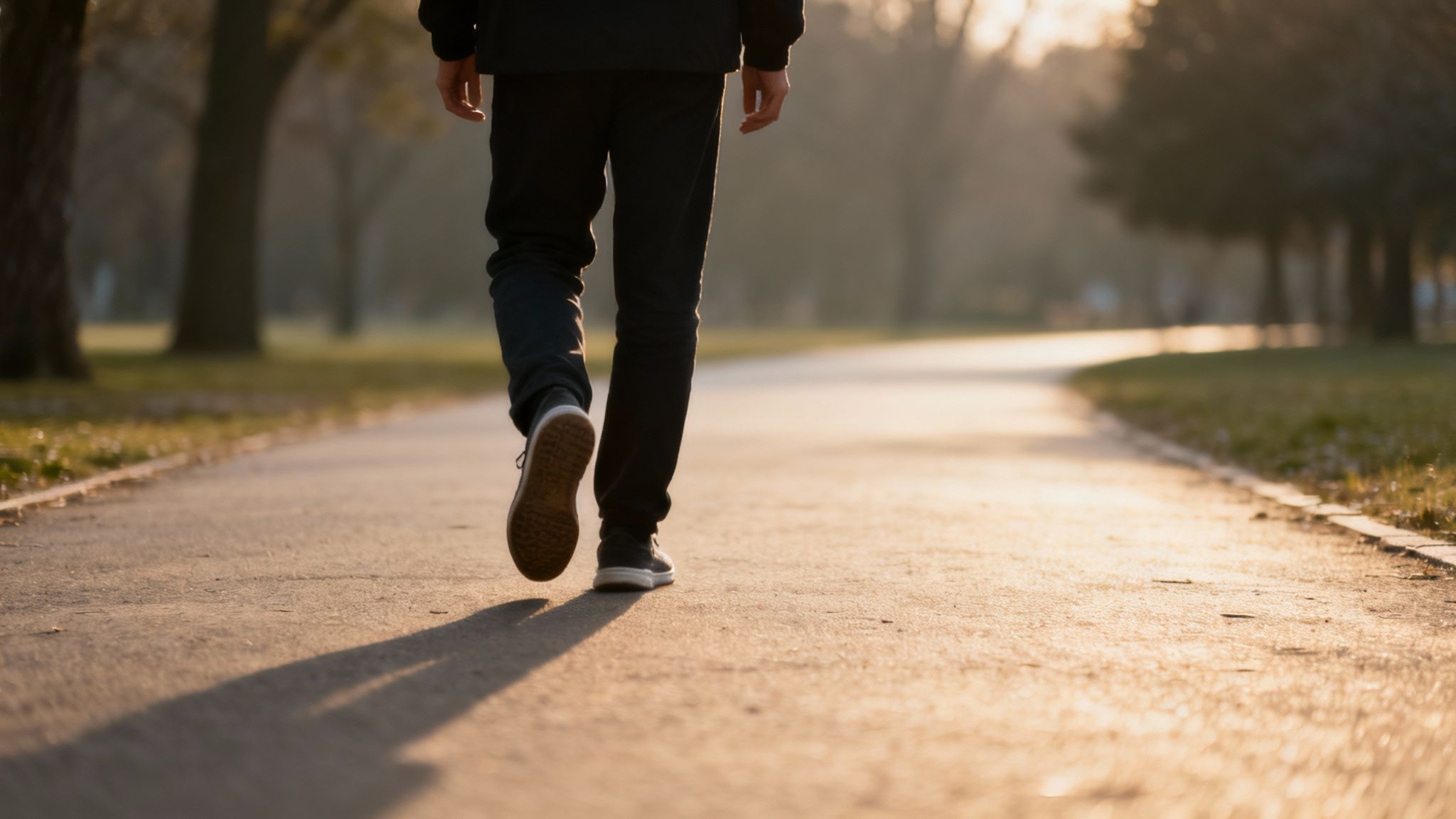
Mindful Movement integrates physical activity with present-moment awareness, offering a dynamic alternative to sitting still. Practices like walking meditation and mindful yoga combine the proven anxiety-reducing benefits of exercise with the mental clarity of mindfulness. This approach anchors your attention in the physical sensations of movement, making it harder for your mind to drift into anxious thoughts.
This technique, central to the teachings of mindfulness master Thich Nhat Hanh, shows that mindfulness isn't about being still; it's about being present. By consciously connecting your breath to your steps or yoga poses, you transform simple physical activity into a profound practice for calming your entire nervous system.
How to Practice
- Find Your Space: Choose a safe, quiet path for walking or a comfortable area for yoga.
- Set an Intention: Begin by deciding to focus solely on the experience of moving.
- Sync Breath and Movement: As you walk, match your inhales and exhales to your steps (e.g., inhale for three steps, exhale for three). In yoga, link your breath to each transition.
- Focus on Sensations: Pay attention to the feeling of your feet on the ground or the stretch in your muscles.
- Acknowledge and Return: When your mind wanders, gently guide your focus back to the physical sensations of your movement.
Action Point: Try this practice without headphones. Allowing yourself to hear the sounds around you and the rhythm of your own body is a key part of the immersive experience.
When to Use It
This is one of the best mindfulness exercises for anxiety when you feel restless or have excess nervous energy. A 10-minute mindful walk during a work break can reset your entire day.
8. Mindful Observation (Focused Attention)
Mindful Observation is a simple yet profound practice that trains your brain to sustain focus. By selecting an object—like a flickering candle flame or a complex flower—and observing it in detail, you anchor your awareness in the present. This actively interrupts the cycle of worry by giving your mind a specific task, pulling it away from abstract anxious thoughts and grounding it in tangible reality.
This technique strengthens the "attention muscle" of the brain, making it easier to redirect your focus when anxiety tries to take over. By engaging deeply with the visual details of an object, you are practicing sustained, non-judgmental awareness—a core skill for managing an anxious mind.
How to Practice
- Select an Object: Choose something with interesting detail—a plant, a smooth stone, a piece of artwork.
- Find a Quiet Space: Sit comfortably and place the object in your line of sight.
- Observe with Soft Eyes: Gaze at the object and begin to notice every detail: its colors, textures, shadows, and the way light plays on its surface.
- Acknowledge and Return: When your mind wanders, gently acknowledge the thought and guide your attention back to the object.
- Start Small: Begin with just 3-5 minutes and gradually increase the duration as your focus improves.
Action Point: Start with a neutral object that doesn't have strong emotional attachments. This makes it easier to practice pure observation without triggering other thoughts or memories.
When to Use It
Use this exercise when your thoughts feel scattered or when you're stuck in a repetitive worry loop. It’s an excellent "reset button" during a stressful workday and can be a calming prelude to a task like using a coloring book for anxiety.
9. Guided Imagery and Visualization
Guided Imagery and Visualization harnesses your mind's incredible power to influence your body's response. This technique involves using your imagination to create a detailed, peaceful mental scene, engaging all your senses to make it feel real. By immersing yourself in this tranquil inner world, you effectively calm your nervous system and trigger your body’s natural relaxation response.
This method is widely used in clinical settings, and research has shown its effectiveness in reducing stress and anxiety. By creating a mental sanctuary, you build a powerful tool for resilience that you can access anytime, anywhere.
How to Practice
- Find a Quiet Space: Sit or lie down comfortably where you won't be disturbed. Gently close your eyes.
- Begin with Breath: Take several slow, deep breaths to signal to your body that it's time to relax.
- Engage Your Imagination: Imagine a peaceful place—a quiet beach, a sunlit forest, a cozy cabin.
- Involve All Senses: What do you see? Hear the gentle waves or rustling leaves. What do you smell? The salty air or earthy pine. What do you feel? The warm sun on your skin.
- Remain in Your Scene: Stay in your visualized space for 5-15 minutes, allowing the feelings of peace to permeate your body and mind.
Action Point: The more vivid and sensory-rich your visualization is, the more effective it will be. If your mind wanders, gently guide it back to the details of your peaceful place.
When to Use It
Guided imagery is perfect when you feel trapped by anxious thoughts or are anticipating a stressful event. Use it during a work break to reset or before a difficult conversation to ground yourself in calm.
10. Mindful Journaling and Written Reflection
Mindful Journaling is a contemplative practice that allows you to externalize anxious thoughts, observing them without getting entangled. By translating abstract feelings into concrete words, this exercise provides clarity and distance, interrupting the rumination loops that fuel anxiety. It's a method of self-discovery that helps you understand your triggers from a mindful, non-judgmental perspective.
Pioneered in therapeutic contexts by researchers like Dr. James Pennebaker, expressive writing is scientifically proven to improve psychological well-being. This transforms your journal from a simple diary into a powerful tool for emotional regulation.
How to Practice
- Set the Stage: Find a quiet space and a dedicated notebook. Set a timer for 10-15 minutes.
- Write Freely: Start writing whatever comes to mind about your feelings and worries. Don't censor yourself or worry about grammar.
- Observe Without Judgment: Write as an impartial observer. If a difficult emotion arises, simply note it and keep writing.
- Incorporate Gratitude: If you get stuck on anxieties, try shifting to list three things you are grateful for to rebalance your perspective.
- Reflect Briefly: When the timer goes off, read what you wrote (if you wish) and notice any patterns or insights without criticism.
Action Point: If you feel stuck, use a prompt like, "What is my anxiety trying to tell me right now?" or "If my anxiety had a shape and color, what would it be?"
When to Use It
This is a powerful practice for your morning routine to set a clear intention, or in the evening to release lingering worries before sleep. To dive deeper into this transformative habit, explore the key benefits of journaling for mental health.
Top 10 Mindfulness Exercises Comparison
| Technique | 🔄 Implementation complexity | ⚡ Speed & practicality | 📊 Expected outcomes | 💡 Ideal use cases | ⭐ Key advantages |
|---|---|---|---|---|---|
| Body Scan Meditation | Moderate — guided sequential attention, requires time | 15–45 min; quiet space preferred; low portability | Immediate relaxation; increased body awareness; reduced physical tension | Chronic anxiety, insomnia, clinical wellness programs | Identifies tension patterns; beginner-friendly; no equipment |
| Box Breathing (Square Breathing) | Low — simple cyclical pattern, minimal instruction | 1–5 min; highly portable and discreet | Rapid parasympathetic activation; quick anxiety/panic reduction | Acute anxiety, panic attacks, performance/high-stress moments | Fast relief; evidence-backed; easy to use anywhere |
| Mindful Breathing (Breath Awareness) | Low — observational practice, minimal instruction | 5–20 min; can be integrated into daily activities; highly portable | Gradual reduction in rumination; improved attention and baseline calm | Daily stress management, foundation for other practices | Easiest to learn; low barrier; integrates into routine |
| 5-4-3-2-1 Grounding Technique | Low — stepwise sensory prompts, simple to follow | 3–5 min; portable but needs sensory access | Immediate grounding; disrupts anxiety spirals and dissociation | Panic attacks, intrusive thoughts, dissociation episodes | Fast interruption of anxiety; discreet; versatile |
| Progressive Muscle Relaxation (PMR) | Moderate — guided tension-release sequence, body knowledge helpful | 16–20 min; best lying or seated; less portable | Reduced muscle tension; improved sleep; cumulative stress reduction | Insomnia, chronic tension, stress-related pain | Strong physical relaxation; cumulative benefits; teachable |
| Loving-Kindness Meditation (Metta) | Moderate — sustained focus and emotional engagement | 15–30 min; quiet environment preferred; portable | Increased positive emotion; reduced self-criticism; improved social connection | Social anxiety, perfectionism, low self-compassion | Builds self-compassion; shifts emotional tone; evidence-supported |
| Mindful Movement (Walking Meditation & Yoga) | Moderate — coordinates movement with attention | Flexible (10+ min); requires safe space; weather-dependent outdoors | Reduces restlessness; combines exercise and mindfulness benefits | Restlessness, overthinking, those who struggle sitting still | Combines physical and mental benefits; adaptable |
| Mindful Observation (Focused Attention) | Low — single-object sustained attention, minimal setup | 5–20 min; needs an object and low distraction environment | Improved concentration; interrupts rumination and mental chatter | Racing thoughts, concentration issues, art therapy | Clear focal point; builds sustained attention; simple |
| Guided Imagery & Visualization | Low–Moderate — guided scripts/audio boost effectiveness | 10–20 min; best with recordings but portable with imagination | Vivid relaxation; sensory calming; useful for medical anxiety | Medical procedures, performance anxiety, insomnia | Highly engaging; customizable; available via apps |
| Mindful Journaling & Written Reflection | Low — simple writing practice, prompts optional | 10–20 min; needs private/quiet space; portable with notebook | Externalizes anxiety; improves emotional processing over time | Rumination, emotional processing, therapy homework | Tangible record of progress; increases clarity; accessible |
Integrating Mindfulness Into Your Life: Your Journey Starts Now
You now have a powerful toolkit of ten distinct mindfulness exercises for anxiety, each offering a unique pathway back to the present moment. From the deep physical awareness of the Body Scan to the immediate sensory relief of the 5-4-3-2-1 technique, these are more than just exercises—they are invitations to a new, more empowered relationship with your mind.
The true value of this knowledge lies in consistent, compassionate application. The goal isn't to eliminate anxiety forever. Instead, the purpose is to build the skill and confidence to navigate anxiety when it arises, transforming it from an overwhelming wave into a current you can skillfully ride. This is the heart of resilience.
Your Actionable Path Forward
Embarking on this journey can feel big, so let's make it simple. Your task isn't to master all ten exercises at once. It's to begin.
- Start Small, Start Now: Choose just one exercise from this list that inspires you. Perhaps it's the structured simplicity of Box Breathing or the gentle movement of a Walking Meditation. Commit to practicing it for just three to five minutes each day for one week.
- Schedule Your Stillness: Treat your mindfulness practice like an important appointment. Use a planner to block out a specific time. Seeing it written down transforms a vague intention into a concrete commitment.
- Create a Supportive Environment: Your surroundings deeply impact your mental state. Dedicate a small corner of your home to your practice. Adding a piece of calming decor can serve as a visual cue, reminding you to pause and breathe.
- Track Your Progress with Kindness: Consistency builds momentum. Use a printable tracker to note the days you practice. This isn't about achieving a perfect streak; it's about celebrating your effort. Every single time you show up for yourself is a victory.
Remember, this is a practice of self-compassion, not perfection. There will be days your mind wanders constantly, and days you forget to practice. That’s okay. The key is to simply begin again, with kindness. Each breath, each moment of returning to the present, is a quiet triumph. You are building a profound capacity to meet life's challenges with greater calm and clarity. Your journey to a more mindful, less anxious life starts with this single, beautiful step.
Ready to build a consistent and beautiful mindfulness routine? Explore the Mesmos collection of intentionally designed planners, calming decor, and wellness tools at Mesmos to create the supportive environment your practice deserves.


