


Have you ever wondered why some people navigate life's challenges with grace and build strong relationships effortlessly? It’s not just about being smart; it’s about being emotionally smart. This incredible power is called emotional intelligence (EI), and it's a skill you can build to transform your life.
Think of emotional intelligence as your inner compass. It’s the ability to recognize and understand your own emotions, and just as importantly, to tune into the feelings of those around you. It’s not a “soft skill”—it’s a superpower for creating a more successful and fulfilling life.
What Is Emotional Intelligence, Really?
Emotional intelligence is the calm voice that guides you to make a wise choice in a moment of stress. It’s the empathy that deepens your connection with a loved one and the resilience that empowers you to rise after a setback. It is a uniquely human quality that no machine can ever replicate.
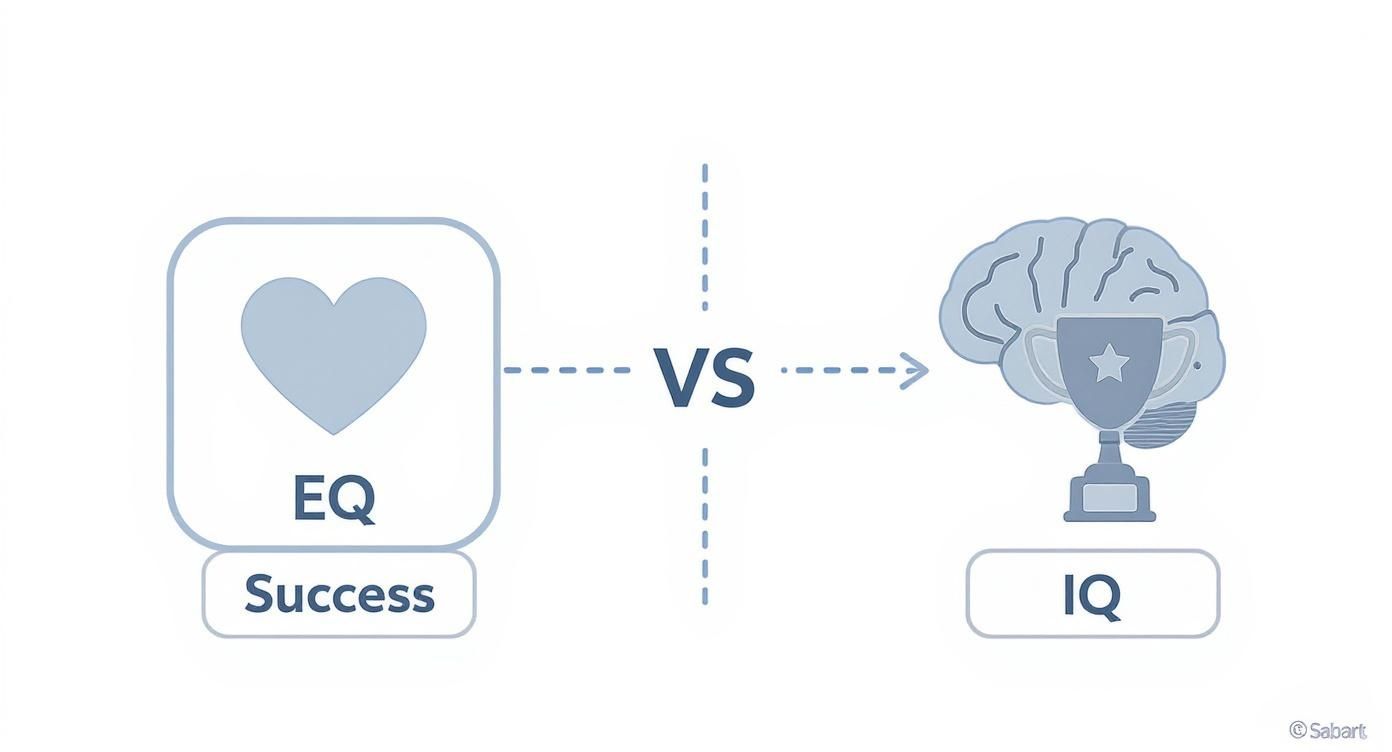
While a high IQ might help you solve problems, your EQ (Emotional Quotient) is what helps you build a meaningful career, nurture lasting relationships, and live a life filled with purpose.
This isn’t just a feel-good concept—it's backed by powerful science. A compelling study by TalentSmart found that EI is responsible for 58% of success in all types of jobs. It's a game-changer, and it's why the demand for emotionally intelligent individuals is skyrocketing.
The Four Pillars of Emotional Intelligence
So, how does this superpower work? Emotional intelligence is built on four core pillars. Understanding them is the first step toward unlocking a more empowered and connected you.
Here’s a simple breakdown of what these pillars are and how they can change your life.
The Four Pillars of Emotional Intelligence
| Pillar | What It Means | Why It Matters |
|---|---|---|
| Self-Awareness | Knowing your own feelings and how they shape your thoughts and actions. | This is your foundation. You can’t navigate your world until you first understand yourself. |
| Self-Regulation | The ability to manage your impulses and emotions in a healthy, constructive way. | This keeps you centered and allows you to respond thoughtfully instead of reacting impulsively. |
| Social Awareness | Truly understanding the feelings, needs, and perspectives of other people. | This is the heart of empathy. It allows you to build genuine trust and connect with others on a deeper level. |
| Relationship Management | Using your emotional understanding to build strong, positive, and inspiring connections. | This is where it all comes together to help you communicate clearly, inspire others, and navigate conflict with grace. |
At the heart of it all lies the first pillar. The journey to a higher EQ always begins with cultivating self-awareness, because true understanding of others starts with understanding yourself.
Your First Action Step
Ready to begin your journey? Let’s start with a simple, powerful action.
For the next 24 hours, practice an "emotional check-in." Three times during the day—morning, noon, and night—pause for just 60 seconds. Ask yourself: "What am I feeling right now?"
Don’t judge the answer. Just name it. Is it excitement? Worry? Gratitude? This small act of noticing is your first step toward emotional mastery.
Why EQ Can Matter More Than IQ
For generations, we were told that a high IQ was the ultimate predictor of success. While intellect is undeniably important, a quieter, more profound force often plays a far greater role in our happiness and achievements: emotional intelligence (EQ).
Imagine two brilliant doctors. Both have exceptional medical knowledge. One is technically perfect but struggles to connect with patients, often appearing cold and distant. The other is just as skilled but possesses a deep well of empathy, allowing them to build trust, comfort anxious families, and lead their team with unity and respect. Which one embodies true success?
This is where the distinction between EQ and IQ shines. IQ might get you the job, but EQ is what helps you excel and inspire once you're there.
The Science of Success
This isn't just an inspiring idea; it's a measurable advantage in the modern world. Companies are realizing that their most effective leaders and top performers are those who can connect, motivate, and collaborate on a human level.
The data is clear. The World Economic Forum has consistently identified emotional intelligence as a critical skill for the future. In fact, 71% of hiring managers surveyed by CareerBuilder stated they value emotional intelligence over IQ. You can read more about why EQ is a top skill for workplace success on resiliencei.com.
In essence, IQ is about what you know, while EQ is about how you apply that knowledge to navigate the beautifully complex world of human interaction. A high EQ transforms knowledge into wisdom.
Leadership That Inspires
Think of a manager leading a team through a stressful, high-stakes project. Instead of just pushing for results, a leader with high EQ taps into their skills. They practice self-awareness, recognizing their own stress and choosing not to let it dictate their actions. They use social awareness, listening deeply to their team's concerns and validating their feelings.
Finally, they put relationship management into action by fostering a supportive environment, celebrating small victories, and empowering each team member. The result? The team feels inspired, morale soars, and they achieve incredible results together. This is the power of emotional intelligence. It's a skill that creates a ripple effect of positivity and success, and it often begins with the belief that you can grow. To explore this further, learn more about how to develop a growth mindset in our guide.
A Practical Guide to Building Your Emotional Intelligence
Knowing what emotional intelligence is and why it's so important is the first step. Now for the exciting part: building it. This isn't about changing who you are; it's about unlocking a more aware, balanced, and connected version of yourself that is already within you. This journey is about small, consistent actions that blossom into powerful new habits.
Think of it like tending a garden. With consistent care—sunlight, water, and attention—a tiny seed flourishes into something beautiful. Your emotional intelligence grows in the same way. Every practical step you take nurtures your inner world so you can thrive in the outer one.
This guide is your roadmap. Let’s begin.
Awaken Self-Awareness with Journaling
Self-awareness is the bedrock of emotional intelligence. It’s the ability to see yourself clearly—to understand your feelings and how they influence your behavior. One of the most powerful and simple tools for this is a journal.
Journaling creates a space to observe your thoughts and feelings without judgment, helping you uncover the "why" behind your emotions.
Action Point: Try these prompts tonight:
- When did I feel most alive today, and what was happening? Connect with your sources of joy.
- What was my biggest challenge, and what emotion did it trigger? Naming an emotion is the first step to understanding it.
- If I could replay one interaction today, what might I do differently? This is for learning, not regret.
Master Self-Regulation with Mindful Breathing
Once you're aware of your emotions, the next step is managing them. Self-regulation is your ability to stay calm under pressure and pause before reacting. It’s the space between a trigger and your response.
When you feel overwhelmed, your body’s stress response can take over. A simple breathing technique is a powerful way to regain control.
"Between stimulus and response there is a space. In that space is our power to choose our response. In our response lies our growth and our freedom." – Viktor E. Frankl
Action Point: Try Box Breathing the next time you feel stressed:
- Breathe in slowly for a count of four.
- Hold your breath for a count of four.
- Breathe out slowly for a count of four.
- Hold your breath again for a count of four.
Repeat this four to five times. This simple act signals to your brain that you are safe, allowing you to think clearly. For deeper relaxation, other practices can also be incredibly helpful; see how Swedish massage therapy for anxiety and stress reduction can promote a state of calm.
Sharpen Social Awareness Through Active Listening
Social awareness is your ability to tune into the emotional world of others. It’s the root of empathy and compassion. The fastest way to build this skill is to become a truly active listener.
Many of us listen with the intent to reply, not to understand. Active listening is about being fully present, focusing not just on the words, but on the tone and body language of the other person.
Action Point: In your next conversation, try this:
- Listen to understand. Let them finish their entire thought without interrupting.
- Ask curious questions. Use phrases like, "Tell me more about that," or "How did that feel for you?"
- Reflect their feelings. Acknowledge their emotion with a simple, "That sounds really challenging," or "I can see how excited you are about this."
This practice makes others feel truly seen and heard, strengthening any relationship instantly.
Emotional Intelligence in Your Everyday Life
Understanding the theory of emotional intelligence is one thing, but seeing it transform real-world moments is where the magic happens. This isn't an abstract concept for leadership seminars; it's a practical, everyday skill that turns difficult situations into opportunities for connection and growth.
Let's explore how the pillars of EI can reshape your world, one conversation at a time.
Interestingly, while most of us value these skills, they are rarer than we think. According to research, only 36% of people can accurately identify their emotions as they happen. The self-perception gap is even more significant: while 95% of people think they’re self-aware, only 10-15% actually are. You can find more surprising statistics about emotional intelligence on apollotechnical.com.
From Conflict to Connection: A Parent’s Story
Picture a child having a meltdown in a store. It's a stressful, public moment filled with frustration and embarrassment.
Without EI: The instinct is often to react with frustration, raising one's voice or making threats ("If you don't stop, we're leaving!"). This usually escalates the situation, leaving everyone feeling disconnected.
With EI: An emotionally intelligent parent takes a breath (self-regulation) to calm their own rising stress. They tap into social awareness (empathy) to see the world through their child's eyes—perhaps they're overwhelmed or tired. Kneeling down, they use relationship management to connect.
They might say something calm and validating, like, "You have some really big feelings right now. It's so frustrating when we can't get what we want. I'm right here with you."
This simple act of acknowledgment changes everything. It diffuses the tension and makes the child feel seen and understood. It builds a foundation of trust and teaches a powerful lesson in emotional regulation.
Handling Tough Feedback at Work
Now, imagine receiving tough feedback on a project you poured your heart into. The initial sting of criticism can feel personal.
Without EI: The common reaction is defensiveness—interrupting to justify your work, blaming others, or shutting down. This closes the door to growth and can damage professional relationships.
With EI: You take a deep breath (self-regulation). You listen fully, recognizing the feedback as an opportunity, not an attack (self-awareness). Then, you guide the conversation forward.
Action Point: Use these emotionally intelligent phrases:
- "Thank you for sharing this. Can you help me understand which part missed the mark?"
- "What would you suggest I focus on to improve it?"
- "I appreciate this perspective. I'm committed to getting it right."
This response transforms a moment of potential conflict into a collaborative dialogue, showcasing your confidence, humility, and dedication to growth.
Your Toolkit for Continued Growth
Your journey into emotional intelligence is a beautiful, lifelong adventure of growth. Think of this as your personal launchpad, filled with resources to guide and inspire you as you continue to build this powerful skill.
The most rewarding growth happens with consistent, gentle effort. These tools are here to support you every step of the way.
Start with Self-Assessment
To know where you’re going, you first need to know where you are. A credible emotional intelligence assessment can provide a snapshot of your strengths and highlight areas for growth.
While free online quizzes are fun, consider a scientifically validated tool for a more accurate picture:
- The EQ-i 2.0®: One of the world's leading self-report assessments, it offers a detailed look at your emotional and social functioning.
- The Mayer-Salovey-Caruso Emotional Intelligence Test (MSCEIT™): This ability-based test measures how you actually solve emotional problems, offering a unique and valuable perspective.
These assessments are best taken with a certified professional who can help you interpret the results and create a personalized growth plan.
Dive Deeper with Influential Reading
The pioneers in this field have shared immense wisdom. Their books can illuminate your path with inspiring stories and accessible science.
Add these to your reading list for a solid foundation:
- Emotional Intelligence: Why It Can Matter More Than IQ by Daniel Goleman: The groundbreaking book that introduced emotional intelligence to the world.
- Permission to Feel by Marc Brackett, Ph.D.: From the director of the Yale Center for Emotional Intelligence, this book offers a practical framework for using your emotions wisely.
- Atlas of the Heart by Brené Brown: A beautiful exploration of the vast landscape of human emotions, giving you the language to understand your experiences with greater clarity. As you uncover these insights, a powerful daily practice is to learn how to start journaling and give your feelings a voice.
Your Questions About Emotional Intelligence, Answered
As you explore emotional intelligence, questions are a natural and wonderful part of the journey. Let’s clear up some of the most common ones to keep you inspired and moving forward.
Can Emotional Intelligence Be Learned, or Are You Just Born With It?
Great question! The inspiring answer is that it can absolutely be learned. While some people may have a natural inclination, emotional intelligence is not a fixed trait.
Think of it like a muscle. It is a set of skills that you can practice and strengthen throughout your life. Every time you practice mindfulness, active listening, or self-reflection, you are building your EI.
What Is the Difference Between EQ and IQ?
This gets to the heart of what makes us human. IQ and EQ measure two different but equally vital types of ability.
- IQ (Intelligence Quotient): This measures your cognitive abilities—like logic, reasoning, and processing complex information. It's your "book smarts."
- EQ (Emotional Quotient): This measures your emotional intelligence. It’s your ability to understand and manage your own feelings and navigate the emotions of others with empathy and grace.
While a high IQ is valuable, a growing body of research confirms that a high EQ is what truly fuels long-term success, inspiring leadership, and fulfilling relationships.
How Can I Measure My Emotional Intelligence?
Several trusted assessments can give you a clear picture of your emotional intelligence. The most respected ones, like the Mayer-Salovey-Caruso Emotional Intelligence Test (MSCEIT) or the EQ-i 2.0, are administered by certified professionals and provide deep, actionable insights.
While free online quizzes can be a fun starting point, these formal assessments offer a far more accurate and helpful view of your strengths and opportunities for growth.
Is Having High EI the Same Thing As Being "Emotional"?
Not at all—and this is a crucial distinction. Being emotional simply means you experience your feelings, which is a beautiful part of being human!
Emotional intelligence is the skill of recognizing those feelings, understanding what they are telling you, and managing them in a constructive way.
Someone with high EI isn't necessarily more or less emotional. They are simply better at using their feelings as valuable information to guide their thoughts and actions, leading to better outcomes for themselves and those around them.
At Mesmos, we believe in nurturing this inner wisdom. Our thoughtful gifts and stationery are designed to inspire those little moments of reflection and connection that help you bring more intention and beauty into your everyday life. Discover a gift that supports your journey today.


