


When anxiety whispers—or screams—your breath is the most powerful tool you have to reclaim your peace. It’s not just about taking a deep breath; it’s about using intentional, science-backed breathing exercises to actively switch off your body's stress alarm. You hold the power to shift from a state of panic to profound calm in just a few minutes, simply by harnessing the rhythm you carry with you every second of every day.
How Your Breath Can Instantly Soothe Anxiety
Imagine having a dimmer switch for the loud, relentless noise of an anxious mind. Your breath is that switch.
When you feel overwhelmed, your body snaps into "fight-or-flight" mode. Your heart pounds, your breathing turns shallow, and your thoughts race. It's a primal survival instinct, but let's be honest—it’s usually triggered by a stressful email, not a saber-toothed tiger.
Slow, deep breathing sends a direct signal to your brain that you are safe. This simple act stimulates the vagus nerve, a key player in your nervous system that helps manage stress. By consciously slowing your breath, you activate the parasympathetic nervous system—your body’s natural 'rest and digest' state. This is the science of self-soothing in action, and you can do it anywhere.
The Power of a Consistent Practice
The best part? You don't need hours to feel a difference. Consistency is far more powerful than intensity.
A 2023 review of 26 separate studies confirmed what many have felt firsthand: structured breathwork leads to significant reductions in stress and anxiety. The research, published in Scientific Reports, showed that as little as 5–10 minutes a day can create meaningful change, making it a perfectly doable practice for anyone.
This is about empowering yourself with a tool you already possess. It’s a gentle reminder that relief isn't somewhere "out there"—it's within you, waiting in your very next breath.
"Your breath is the anchor to the present moment. When your mind drifts to worry, your breath can always guide you back to a place of safety and calm."
Breathwork is a fantastic starting point. When you’re ready to build a more robust toolkit, exploring other effective grounding techniques for anxiety can provide even more immediate relief and perfectly complement your practice. Combining these approaches helps you feel more prepared and in control, no matter what life throws at you.
The Science Behind Your Body's Built-In Stress Reducer
Have you ever wondered why a deep breath feels so instantly calming? It’s not just a feeling—it’s biology. Your breath is a remote control for your nervous system, giving you a direct line to dial down stress and find relief from anxiety.
When anxiety hits, your sympathetic nervous system—the "fight-or-flight" response—takes over. It floods you with adrenaline and cortisol, making your heart pound. But here’s the amazing part: intentional, slow breathing acts as a circuit breaker. It switches on the parasympathetic nervous system, your "rest and digest" state. A few deep belly breaths are the fastest way to activate it.
Tapping into Your Vagus Nerve
The secret ingredient is the vagus nerve. Think of it as a superhighway connecting your brain to your major organs. When you practice slow, deep breathing, you're actually stimulating this nerve.
This stimulation sends a powerful "all clear" signal straight to your brain.
A shallow, rapid breath tells your brain, "Danger ahead!" But a long, slow exhale communicates, "You are safe. It's okay to relax." This simple shift can physically lower your heart rate and blood pressure, creating a wave of calm.
By consciously changing your breath's pattern, you change your mind's state. You're using a direct line to the parts of your brain that manage fear, empowering you to take back control.
The science backs this up beautifully. A massive 2023 review of 58 studies found that a staggering 75% of breathing interventions led to significant drops in stress or anxiety.
Another study showed that just 30 deep, resisted breaths a day for six weeks lowered systolic blood pressure by about 9 mmHg—a meaningful change contributing to better long-term heart health.
From Physiology to Peace
Once you understand this, breathing exercises shift from a hopeful wish to a science-backed strategy. It isn’t magic; it’s physiology. You are using your body's natural mechanics to regulate how you feel.
This is also why breathwork is a cornerstone of mindfulness and meditation. When you focus on your breath, you aren't just distracting yourself; you are actively changing your body's chemistry. For anyone looking to build a more robust mindfulness routine, pairing breathwork with meditation for stress and anxiety relief can create an even more profound sense of calm.
This powerful link is also why there are so many resources on controlled breathing patterns for falling asleep—its impact on our well-being is immense. Knowing the "why" turns a simple exercise into an act of self-empowerment.
Four Powerful Breathing Techniques You Can Use Anywhere
Let's move from the why to the how. You have the power to shift your mental state with just a few intentional breaths. Here are four evidence-based breathing exercises you can do anytime, anywhere. No equipment needed.
Think of these as invitations to reconnect with your body’s natural rhythm. Each one offers a unique way to find your center.
This simple diagram shows what’s happening—how a single, deep breath can interrupt the anxiety cycle and guide you from stress back to calm.
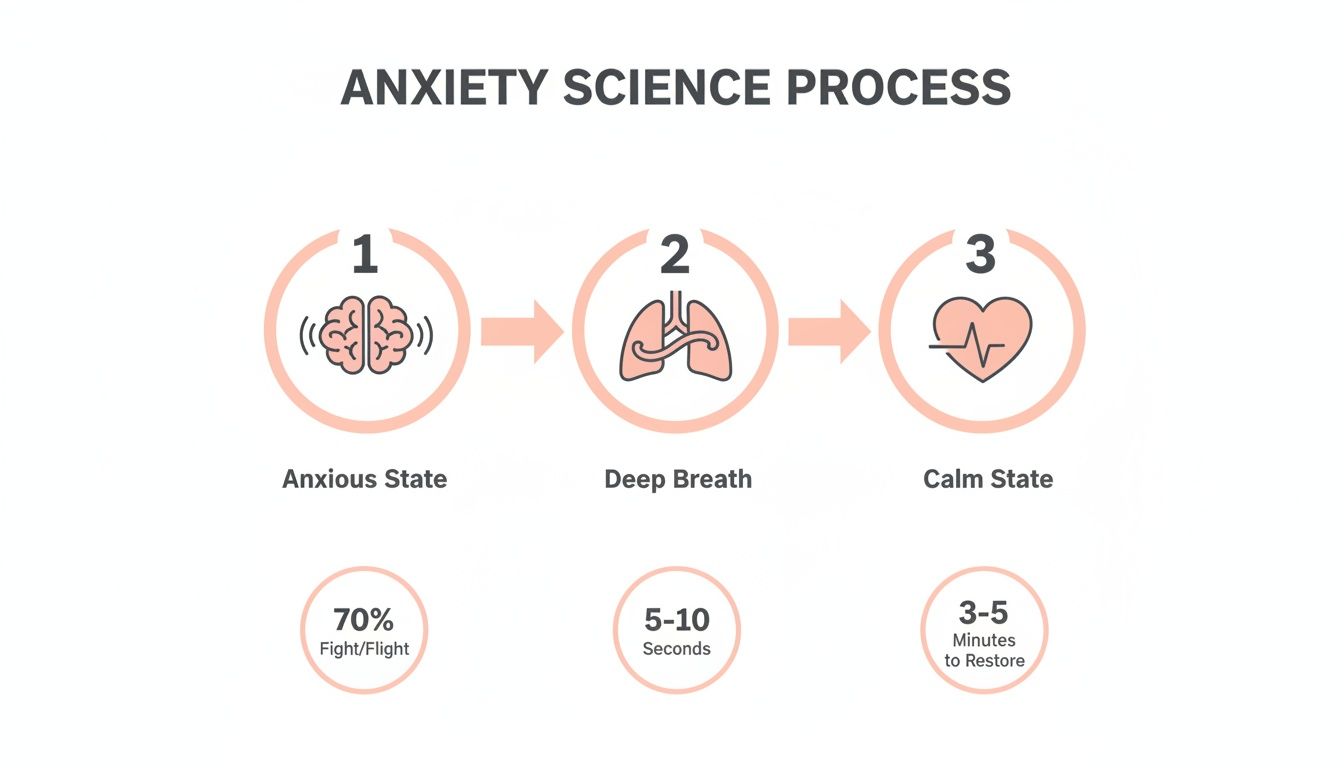
That conscious breath is the bridge between feeling overwhelmed and regaining your sense of control.
The Grounding Breath: Diaphragmatic Breathing
This is the foundation of all healthy breathing. Often called belly breathing, it’s about breathing deeply into your abdomen, just as you did naturally as a baby. Most of us have become "chest breathers," taking short, shallow sips of air that fuel our stress response. Diaphragmatic breathing flips that script.
Your Action Point: Place one hand on your chest and the other on your belly. As you breathe in slowly through your nose, your goal is to make the hand on your belly rise while the one on your chest stays still. Then, exhale slowly through your mouth and feel your belly fall. Try this for 2 minutes.
This isn't just a relaxation trick. A 2022 evidence-based review found that slow diaphragmatic breathing caused significant anxiety reductions in about 31% of studies, even for people with diagnosed anxiety disorders. That’s powerful proof. For a deeper dive, you can explore the clinical findings on deep breathing for anxiety relief yourself.
The Focusing Breath: Box Breathing
When your thoughts are racing, box breathing is your anchor. It’s a technique famously used by Navy SEALs to stay calm under pressure, and it works by creating a steady rhythm that gives your mind something to focus on besides anxiety.
Your Action Point:
- Breathe in slowly for a count of four.
- Gently hold that breath for a count of four.
- Breathe out slowly for a count of four.
- Gently hold the empty breath for a count of four. Repeat for 1-3 minutes before a stressful event.
As you do this, visualize tracing the sides of a square in your mind. This rhythmic pattern is amazing for breaking the cycle of frantic thoughts.
The Soothing Breath: The 4-7-8 Technique
Developed by Dr. Andrew Weil, the 4-7-8 technique is like a natural tranquilizer for your nervous system, especially helpful when you need to calm down fast or are having trouble sleeping. The magic is in the long exhale, which gives a powerful nudge to your "rest and digest" system.
Your Action Point:
- Let all the air out of your lungs with a whoosh.
- Close your mouth and inhale quietly through your nose for four seconds.
- Hold your breath for a count of seven seconds.
- Exhale completely through your mouth, making that whoosh sound again, for a full eight seconds. Repeat this cycle three or four times. The most important part is making your exhale twice as long as your inhale.
This breath is your emergency brake. When you feel a spike of anxiety, a few rounds of 4-7-8 can genuinely stop the spiral and bring you back to a place of peace.
The Balancing Breath: Coherent Breathing
Also known as resonant breathing, this is all about finding harmony. The goal is to breathe at a steady rate of about five to six breaths per minute. This rhythm has been shown to maximize your heart rate variability (HRV), a key marker of your body’s resilience to stress.
Your Action Point: Inhale for a count of six, and then exhale for a count of six. No holds, just a smooth, even rhythm. Practice for 5 minutes daily to build a solid baseline of calm.
Doing this for just a few minutes each day can help train your nervous system to be less reactive over time.
Your Quick Guide to Calming Breaths
Feeling overwhelmed by the options? Don't be. This cheat sheet will help you pick the right breath for the right moment.
| Breathing Technique | Best For | Time Commitment | Key Benefit |
|---|---|---|---|
| Diaphragmatic | Daily practice, re-learning how to breathe deeply. | 5-10 minutes | Reduces overall stress, improves oxygenation. |
| Box Breathing (4-4-4) | Moments of scattered thoughts or high pressure. | 1-3 minutes | Creates mental focus and calms the mind. |
| 4-7-8 Technique | Acute anxiety, panic, or trouble sleeping. | 1-2 minutes | Acts as a rapid "emergency brake" for anxiety. |
| Coherent Breathing | Building long-term stress resilience. | 5-10 minutes | Balances the nervous system, improves HRV. |
Whether you have 60 seconds before a meeting or 10 minutes to unwind, there’s a breath here that can help.
Making Breathwork a Natural Part of Your Day
Knowing how to use breathing exercises is one thing. Lasting change happens when these practices become as natural as pouring your morning coffee.
The goal isn't to add another task to your to-do list. It's to gently weave moments of calm into the life you already live.
One of the most powerful ways to do this is through habit stacking. Instead of trying to find new time, you link a breathing practice to a habit you already do without thinking.
Start Small with Habit Stacking
Connect your breathwork to a daily cue that’s already there. This approach makes your new habit feel less like a chore and more like a gentle, built-in reset button.
Your Action Points:
- While your coffee brews: Before that first sip, take five deep diaphragmatic breaths. Let your belly fully expand, and then let it all go with a slow exhale.
- The moment you close your laptop: Practice one minute of Box Breathing to create a clear separation between your work life and your personal time.
- As you get into your car: Before turning the key, do three rounds of the 4-7-8 breath to ground yourself before you head out.
This isn't about perfection; it's about presence. Attaching a brief moment of mindful breathing to an existing habit creates a powerful ripple effect, sending little signals of safety to your nervous system all day long.
This tiny, incremental approach is so powerful. Documenting these small wins can be incredibly motivating, which is why keeping a dedicated health and wellness journal can truly amplify the benefits of your new practice.
Crafting Your Own Micro-Routines
Once you get the hang of habit stacking, you can build tiny routines for different parts of your day. These micro-routines are short, sustainable, and effective at managing anxiety before it builds.
The Two-Minute Morning Reset Before your feet even touch the floor, lie in bed and place a hand on your belly. Take ten slow, deep belly breaths, focusing only on the gentle rise and fall. Set a calm tone for your day.
The Five-Minute Pre-Meeting Focus Feeling pre-meeting jitters? Find a quiet space and practice two or three minutes of Box Breathing. It will slow racing thoughts and help you walk in feeling composed.
The Ten-Minute Evening Wind-Down To prepare for restful sleep, dedicate ten minutes to Coherent Breathing. Sit or lie down comfortably and just breathe in for a count of six and out for six. This steady rhythm quiets the mental chatter from the day.
Common Questions on Your Breathwork Journey
Starting a new practice always brings up questions. It’s completely normal to wonder if you’re “doing it right.” Let’s talk through some of the most common thoughts that arise.
Think of this as a gentle conversation to build your confidence. Your journey is a personal one, and every breath is a step in the right direction.
What if My Mind Wanders During Practice?
First, congratulations—you noticed! The goal isn't a perfectly blank mind. Your brain is supposed to think.
The real practice is in the moment of return. When you catch your thoughts wandering, just kindly guide your attention back to your breath. Each time you do this, you’re building your focus muscle.
This isn't a failure; it's the very heart of the practice. Every time you bring your focus back to the sensation of your breath, you are actively training your mind to find its anchor in the present moment.
How Long Until I Notice a Difference?
Many people feel an immediate sense of calm, but the lasting benefits come from consistency. The effects of breathwork are cumulative.
You might notice small shifts at first—feeling a little less reactive in traffic or sleeping more soundly. Some studies show measurable benefits, like lower blood pressure, after just a few weeks of consistent practice. Be patient with yourself. You are retraining your nervous system, and that beautiful work takes time.
Is It Normal to Feel a Little Dizzy?
Yes, feeling a bit lightheaded can happen, especially when you’re new to deep, intentional breathing. It’s often a sign that you're changing the balance of oxygen and carbon dioxide in your body.
If this happens, simply ease up. There’s no need to push through it.
- Return to your normal breathing for a moment.
- Try shortening the inhales and exhales.
- Make sure you aren't forcing the breath too hard.
Listen to your body. Your breathwork should feel restorative and calming, never strenuous. As your body adapts, these sensations usually fade. Remember, this is a gentle practice of self-care, not a performance.
Your Questions, Answered
As you start to weave these simple breathing practices into your day, you might find a few questions bubbling up. That's a great sign! It means you're really connecting with the process. Let's walk through some of the most common ones to help you feel even more confident.
Can Breathing Exercises Alone Cure My Anxiety?
Think of these breathing techniques as your first line of defense—a powerful way to calm your nervous system and find your footing when you feel overwhelmed. They are incredibly effective for managing anxiety in the moment.
However, for chronic or severe anxiety, they shine brightest as part of a bigger picture. They are a wonderful companion to therapy, lifestyle changes, and professional medical advice. They empower you to be an active part of your own healing, but they don't have to be your only tool.
How Often Should I Practice These Techniques?
When you're building a new self-care habit, consistency is always more important than duration. You don’t need to carve out a huge chunk of your day to see real, lasting benefits.
Try starting with just 5-10 minutes a day. This small, daily commitment gently trains your nervous system to find its calm baseline, making the practice feel easy and sustainable. And of course, you can always turn to a specific technique whenever you feel a wave of anxiety coming on.
The goal is to make mindful breathing a gentle, reliable friend you can turn to anytime, not another chore on your to-do list. A few conscious breaths are always better than none.
Which Breathing Exercise Is Best for a Panic Attack?
During the intensity of a panic attack, your breathing often becomes fast and shallow, which can make the feelings of fear even stronger. The best thing to do is pick a simple, grounding technique that gives your mind something clear to hold onto.
- Diaphragmatic (Belly) Breathing: Placing a hand on your belly and feeling it rise and fall is a powerful physical anchor. It pulls your attention out of racing thoughts and back into the safety of your body.
- Box Breathing: The steady, predictable rhythm of breathing in, holding, and breathing out for the same count provides a solid structure when everything else feels out of control.
The most important thing to remember in these moments is to make your exhale longer than your inhale. A long, slow out-breath is the fastest way to activate your body's relaxation response, slow your heart rate, and send a signal to your brain that you are safe.
At Mesmos, we believe that small, intentional acts of self-care can create profound shifts in your well-being. Discover our collection of mindfulness tools and thoughtful gifts designed to inspire calm and significance in your daily life at https://mesmos.co.


